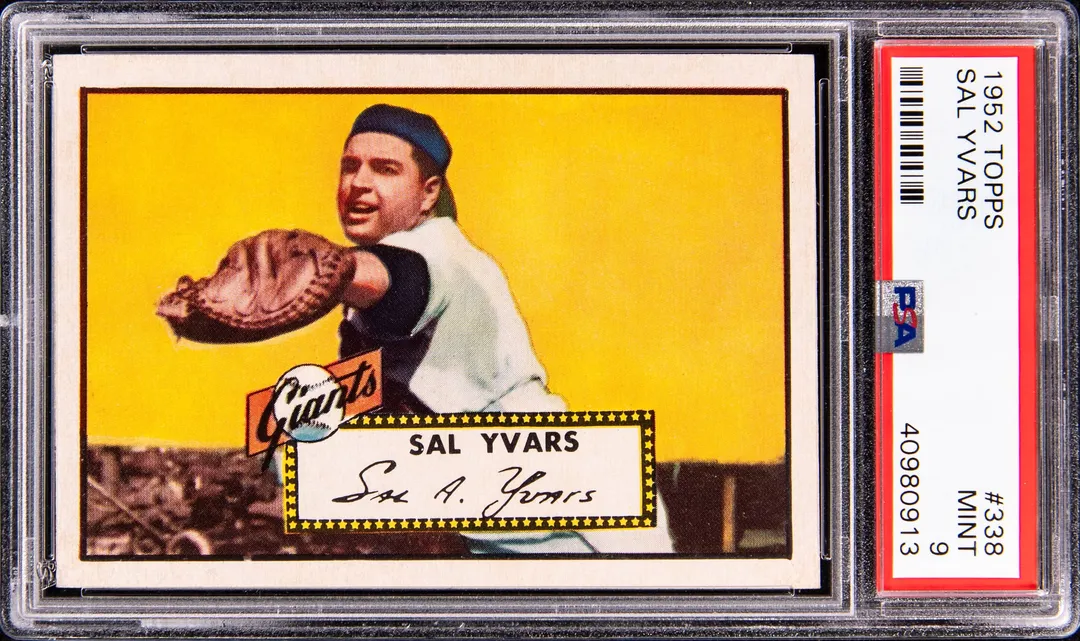
1952 Topps Sal Yvars PSA 9 High Number Sells Strong
A PSA 9 copy of the 1952 Topps #338 Sal Yvars high number rookie sold for $16,165 at Goldin on Feb 22, 2026. Here’s the context for vintage collectors.
Sold Card
1952 Topps #338 Sal Yvars Rookie Card - High Number - PSA MINT 9 - Pop 7; Highest PSA Copy
Sale Price
Platform
Goldin1952 Topps high numbers are where even seasoned vintage collectors slow down and pay closer attention. That’s exactly the territory we’re in with this recent sale:
1952 Topps #338 Sal Yvars Rookie Card – High Number – PSA MINT 9 – Pop 7; Highest PSA Copy
Sold for $16,165 at Goldin on February 22, 2026 (UTC).
In this breakdown, we’ll look at what makes this card interesting for vintage collectors, how the sale fits into recent market activity, and why a non-star player from 1952 can still command a five-figure price in high grade.
Card overview: a high-grade gem from a key vintage set
Let’s start with the basics:
- Player: Sal Yvars
- Team: New York Giants
- Year: 1952
- Set: 1952 Topps Baseball
- Card number: #338
- Card type: Recognized as Sal Yvars’ rookie card
- Run type: High number (part of the scarcer late-series print run)
- Grading company: PSA (Professional Sports Authenticator)
- Grade: PSA MINT 9
- Population: Pop 7 in PSA 9, with no PSA 10s, making this the highest-graded level available
There are no additional features like an autograph, patch, or serial numbering here—it’s a straight vintage base card. But for 1950s cardboard, the appeal is all about condition, scarcity, and set importance.
Why 1952 Topps high numbers matter
Even if Sal Yvars himself is not a Hall of Famer, his 1952 Topps card sits in one of the most important sets in the hobby. A quick refresher:
- 1952 Topps is widely considered Topps’ first full, flagship baseball release. When collectors say “flagship,” they mean the company’s main, annual set—the backbone of its baseball line.
- The high-number series (cards #311–407) is much tougher than the earlier series. Fewer copies were distributed, and unsold stock was reportedly dumped, which reduced long‑term supply.
Within that high-number run, most of the hobby focus usually goes to Mickey Mantle (#311), Jackie Robinson (#312), and other stars. But as grading became more popular, collectors started to notice how tough it is to find any of these high numbers in truly top condition.
That’s where a PSA 9 of a so‑called “common” player like Sal Yvars starts to stand out.
Grade and population: why PSA 9 matters here
In vintage, the grade often matters more than the player’s stat line.
According to PSA’s population data, this Sal Yvars #338 in PSA 9 is a pop 7 card, with no PSA 10s on record. When collectors say “pop report” or “population report,” they’re talking about how many copies of a specific card exist in each grade at a grading company.
For a 1952 high number, these numbers are meaningful:
- Low total graded population compared to modern issues.
- Very few examples reaching the MINT 9 level.
- No GEM MINT 10s to sit above it, which makes PSA 9 effectively the top of the market.
For set builders who chase high‑grade 1952 Topps runs, or for collectors who specialize in high‑number series cards, this kind of condition rarity is the main driver of value.
Market context: how does $16,165 fit in?
This copy sold at Goldin on February 22, 2026 (UTC) for $16,165.
To understand that number, we look at comps—short for “comparables,” meaning recent sales of the same card or very similar ones.
For this specific card and grade:
- PSA 9 high‑number commons from 1952 Topps have historically traded anywhere from the low five figures up into the mid five‑figure range, depending on eye appeal, player, and auction visibility.
- Non‑star high numbers in PSA 8 often sell sharply lower, which shows how steep the price curve can be between 8 and 9 in this set.
For this exact Sal Yvars #338 PSA 9, publicly recorded sales are sporadic—typical for a pop‑7 card. When a card surfaces infrequently and sits at the top of the population, any new sale becomes a useful reference point for pricing.
In that context, $16,165 is consistent with the broader pattern of strong but selective demand for top‑grade 1952 Topps high numbers. It’s not a Mantle‑level headline, but it reinforces the idea that condition‑focused collectors are still willing to pay a meaningful premium for scarce, high‑grade examples.
Because auction cycles, bidder pools, and general hobby conditions vary from sale to sale, this result should be viewed as a data point, not a guarantee of future value.
Collector significance: beyond star power
On the field, Sal Yvars doesn’t have the Hall of Fame resume that usually drives sky‑high prices. But in vintage, especially with 1950s cards, collectors often care about a different mix of factors:
Set importance
1952 Topps is a cornerstone vintage set. Collectors who build it in high grade need cards like #338, regardless of the player’s fame.Series scarcity
High numbers are simply harder to find, especially in strong condition. That scarcity is structural, not trend‑based.Condition scarcity
With only seven PSA 9s and no higher‑graded copies, this card occupies the top rung of the condition ladder. Set builders and registry competitors often chase precisely these kinds of cards.Registry and prestige collecting
Many PSA collectors use the PSA Set Registry to track and compare their sets. Owning a top‑pop (or tied top‑pop) card in a key set helps boost registry rankings and adds a measure of collecting prestige.
Put together, those factors help explain why a non‑star 1952 high number can still draw robust bidding.
Vintage supply and grading realities
Compared with modern and ultra‑modern cards (roughly mid‑2000s to present) that may have thousands of high‑grade copies, early‑1950s cards come from a very different environment:
- Distribution was smaller and more regional.
- Cards were handled by kids, not sleeved and top‑loaded on release.
- Centering, print quality, and cutting were inconsistent.
So when you see a 1952 Topps high number in PSA 9, you’re looking at a card that survived decades of potential damage and also cleared today’s tighter grading standards. That’s the kind of long‑term scarcity that appeals to collectors who think in terms of survivorship rather than just print runs.
Takeaways for collectors and small sellers
Some practical observations from this sale:
- High‑grade vintage still has focused demand. Even for non‑marquee names, top‑population 1952 high numbers continue to draw serious interest.
- Condition separation is real. The jump from PSA 8 to PSA 9 in 1952 high numbers can be dramatic. Subtle differences in surface, corners, and centering can translate into large price gaps.
- Auction venue and timing matter. A pop‑7, top‑grade card offered by a major auction house like Goldin on a clear schedule can attract the type of bidders who pursue registry‑level sets.
- Use sales like this as reference, not prediction. This result adds to the price history for 1952 Topps high numbers, but it’s just one data point in a market that moves with collector tastes, broader hobby trends, and supply.
For collectors coming back into vintage or newer hobbyists exploring beyond the big stars, cards like the 1952 Topps #338 Sal Yvars PSA 9 show how much depth there is beneath the headline names. In sets as important as 1952 Topps, the story is often told one high number at a time.
How figoca fits in
At figoca, we track auction results like this one from Goldin (February 22, 2026) to help collectors and small sellers understand where individual cards sit in the broader market—especially in segments like 1950s vintage where population, condition, and set context all matter.
Whether you’re building out a high‑grade 1952 Topps run or just trying to price a newly graded card, following sales like this Sal Yvars rookie provides a grounded, data‑aware reference point for your next move in the hobby.