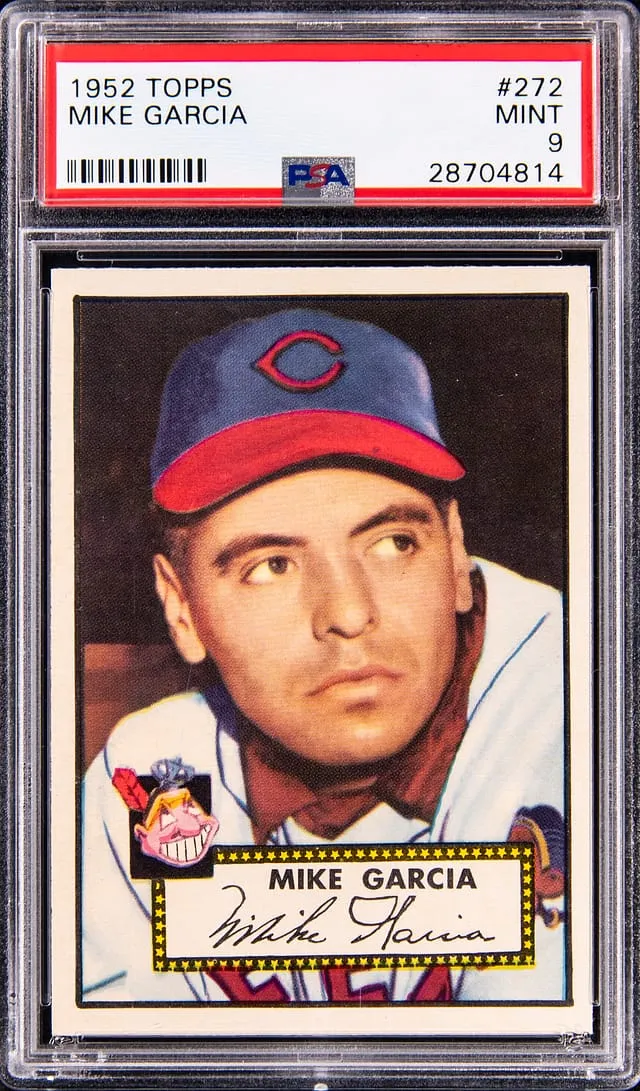
1952 Topps Mike Garcia PSA 9 sells for $23K
A pop 2 1952 Topps #272 Mike Garcia PSA 9 sold for $23,203 at Goldin, showing continued strength for top-grade vintage set cards.
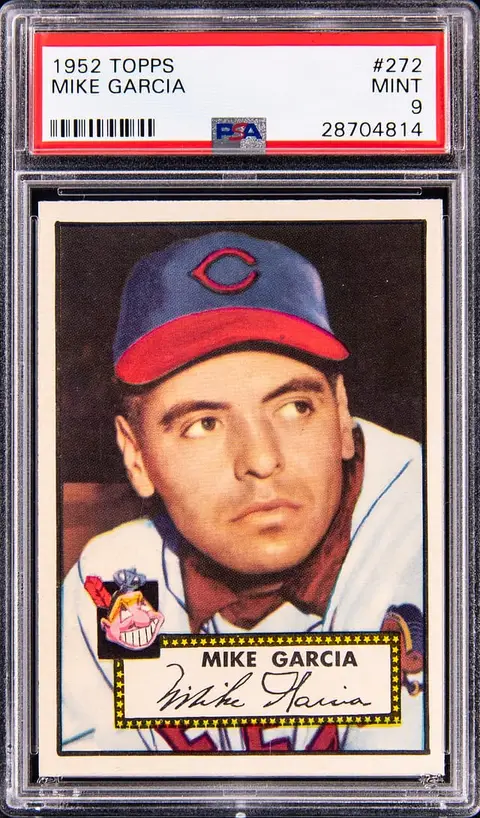
Sold Card
1952 Topps #272 Mike Garcia - PSA MINT 9 - Pop 2; Only One Higher PSA Copy
Sale Price
Platform
Goldin1952 Topps Mike Garcia PSA 9 Sells for $23,203 at Goldin
On February 22, 2026, Goldin closed a quiet but meaningful vintage sale: a 1952 Topps #272 Mike Garcia graded PSA MINT 9 realized $23,203. For most collectors this isn’t a headline name, but within vintage set building and pop-report chasing, this is exactly the kind of card that shows how deep demand for high-grade 1952 Topps really runs.
In this article we’ll break down what the card is, why a Mike Garcia can command five figures, and how this sale fits into the broader 1952 Topps market.
The card at a glance
- Player: Mike Garcia (Cleveland Indians, pitcher)
- Year / Set: 1952 Topps Baseball
- Card number: #272
- Grading company: PSA (Professional Sports Authenticator)
- Grade: PSA MINT 9
- Population: Pop 2 in PSA 9, with only one known higher PSA-graded copy
- Type: Standard base card (no parallel, no autograph, no relic)
The 1952 Topps set is widely considered Topps’ first true flagship baseball release. It is not Mike Garcia’s rookie card (his recognized rookies are earlier Bowman issues), but it is his key early Topps appearance from the most collected vintage set in the hobby.
Who was Mike Garcia, and why do collectors care?
Mike Garcia was a three-time All-Star and two-time ERA champion for the Cleveland Indians in the 1950s, and a core member of the famous “Big Four” pitching staff alongside Bob Feller, Bob Lemon, and Early Wynn. While he doesn’t carry the same hobby weight as Hall of Fame headliners, he is:
- An important arm on one of the era’s classic pitching staffs
- A recognizable name for Cleveland team collectors
- A necessary card for anyone building 1952 Topps sets in high grade
For many vintage collectors, the story is less about the individual player and more about completing an ultra-high-grade run of a landmark set.
1952 Topps: why the set matters
The 1952 Topps baseball set is a hobby pillar. Key reasons it commands attention:
- Historical importance: Often treated as the beginning of modern baseball card design: larger format, full-color fronts, stats and bios on the back.
- Iconic checklist: Headlined by the Mickey Mantle #311 and many early Topps cards of stars from the era.
- Condition difficulty: Centering, print quality, and handling over 70+ years make true high-grade copies harder to find.
Because of this, even non-star players in PSA 8, 9, and especially 10 can attract strong bidding from set builders. A population report (often shortened to “pop report”) from PSA provides the number of copies graded at each level. When that report shows very few high-grade examples, competition among set collectors can drive prices higher than the player’s name alone might suggest.
Population and grade scarcity
For this card, the PSA pop report shows:
- PSA 9 (MINT): Population 2
- Higher than PSA 9: Only 1 copy (PSA 10)
In practical terms, that means there are only three examples that qualify as the very best graded versions of this card in the world. For collectors aiming to assemble 1952 Topps in PSA 9 or better, they are competing over a very small pool of available copies.
When that kind of scarcity meets an active set-building community, prices can detach from what you might expect based solely on the player’s Hall of Fame status or raw-card value.
Price context: how does $23,203 fit in?
This card sold for $23,203 at Goldin on February 22, 2026.
To understand what that means, hobbyists usually look at “comps” (short for comparables): recent sales of the same card and similar cards. While there are not many public, recent sales of this exact card in PSA 9 due to the tiny population, we can still frame the result by looking at:
- Lower grades of the same card
- PSA 9 sales of similar 1952 Topps non-star cards
- General trends in high-grade 1952 Topps pricing
Across major marketplaces and auction houses, a typical 1952 Topps mid-level player in PSA 8 often ranges in the low to mid four figures, depending on scarcity and eye appeal. PSA 9 examples of condition-sensitive 1952 commons and semi-stars can reach well into five figures, especially when pop counts are in the low single digits.
Against that backdrop, a pop 2, only-one-higher Mike Garcia in PSA 9 landing just over $23,000 is consistent with what we’ve seen from scarce, high-grade vintage commons and semi-stars. It reflects:
- Very limited supply at the top of the grading scale
- Steady demand from advanced set builders and registry competitors
- Ongoing willingness among vintage-focused collectors to pay a premium for population-scarce 1952 Topps cards
Because sales of this specific card in PSA 9 are so rare, each transaction effectively helps define the market. Instead of a long, predictable price history, you get infrequent but meaningful data points.
Why this result matters for collectors
This sale reinforces a few key themes in the current hobby environment:
1. Set building in high grade is still powerful
The buyer of a pop 2, near top-pop 1952 Topps Mike Garcia in PSA 9 is very likely a set builder or registry competitor. Registry sets (online checklists where collectors input their graded cards to compare sets with others) often reward higher grades with more points, so a pop 2 PSA 9 can be crucial for a top-ranked 1952 Topps run.
The price shows that demand for elite-condition vintage, especially in historically important sets, remains resilient.
2. Player name isn’t the only driver of value
Compared to stars like Mantle, Mays, or Jackie Robinson, Mike Garcia is a relatively modest name in the hobby. Yet this card crossed the $20,000 mark because of:
- The set’s stature
- The grade (MINT 9)
- The ultra-low population at the top
For newer collectors, this is a clear example of how card value can be a mix of player popularity, set history, and grade scarcity.
3. High-grade vintage remains thinly traded
When you are dealing with populations of two or three copies, the market is naturally thin:
- There are very few listings
- Sales can be years apart
- Each auction can swing value perceptions more than in a highly liquid modern card
Collectors should think about these cards less like a stock that trades every day, and more like a rare piece of memorabilia that surfaces occasionally.
Takeaways for different types of collectors
New and returning collectors
- This sale is a reminder that you don’t need a superstar to see strong prices in vintage; condition and set importance matter a lot.
- When you hear “pop 2, only one higher,” it signals real scarcity at the grading level, not just general rarity of the card itself.
Active hobbyists and small sellers
- If you deal in 1950s and 1960s baseball, tracking high-grade non-star sales like this can help you rethink how you price and prioritize submissions.
- It may be worth revisiting raw vintage inventory for cards that could grade at the top of the scale, especially from flagship sets like 1952 Topps.
Vintage-focused collectors
- This result at Goldin on February 22, 2026 fits the pattern of strong competition for top-pop 1952 Topps cards.
- For registry participants, this confirms that even secondary names, when ultra-low pop in PSA 9 or PSA 10, can draw serious bidding.
Final thoughts
The 1952 Topps #272 Mike Garcia PSA MINT 9 isn’t the sort of card that dominates hobby headlines, but its $23,203 sale at Goldin on February 22, 2026 is a useful data point for anyone who follows vintage markets closely.
It highlights how much weight collectors still give to set importance, grade scarcity, and population reports. For those building or tracking high-grade 1950s baseball runs, this transaction quietly reinforces what many already know: in vintage, the right combination of history, condition, and scarcity can make even an unassuming card a centerpiece.