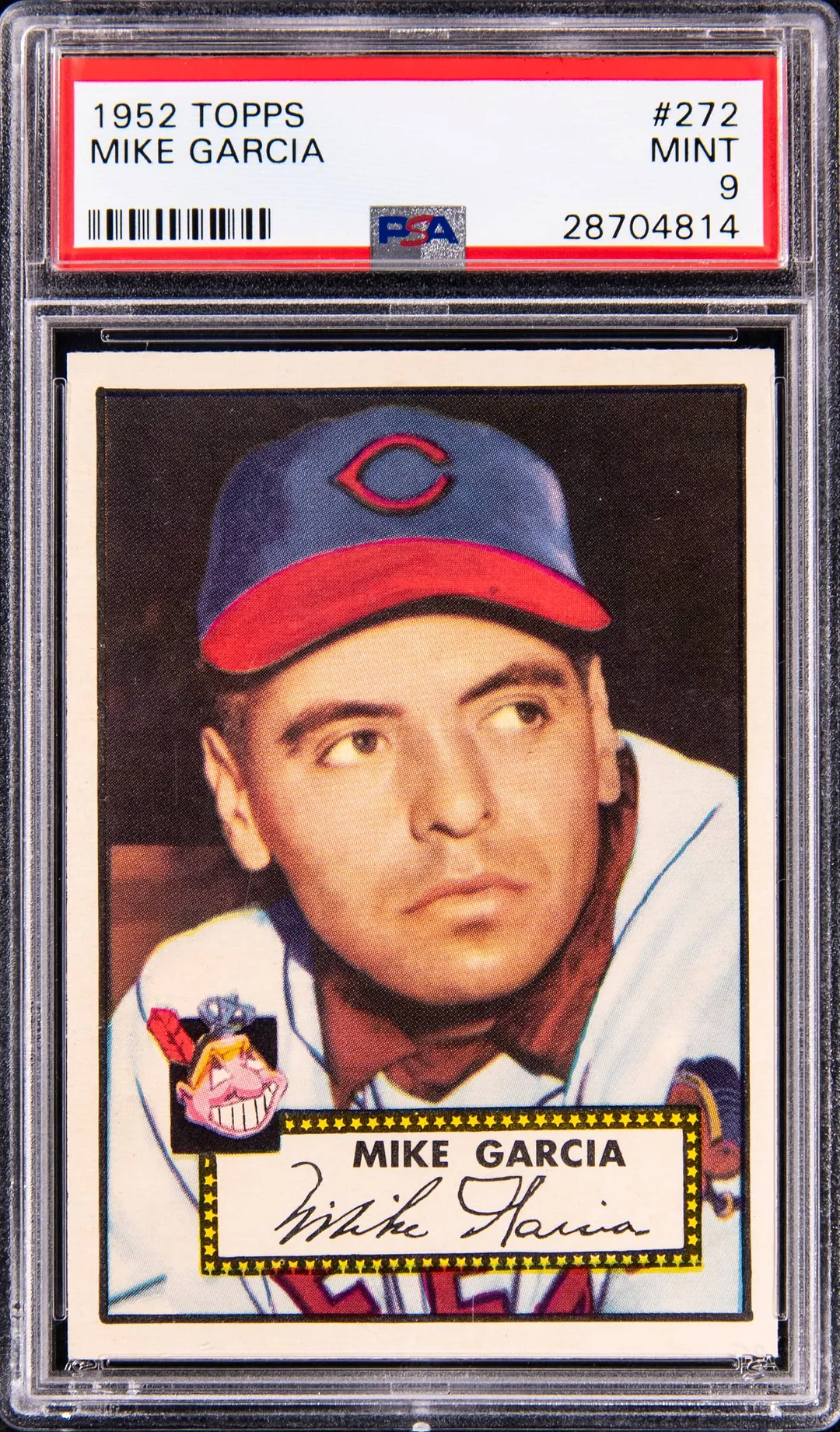
1952 Topps Mike Garcia PSA 9 sells for $23,203
Goldin sold a 1952 Topps #272 Mike Garcia PSA MINT 9 (pop 2, one higher) for $23,203 on 2/22/26. A case study in vintage grade scarcity.
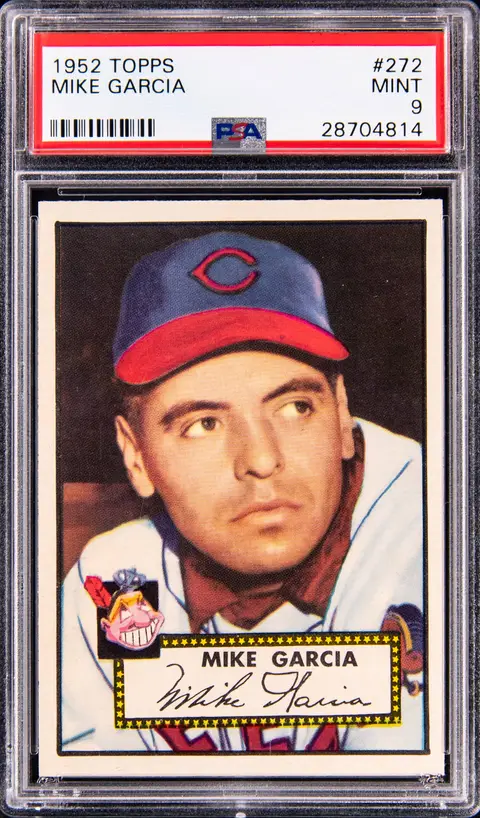
Sold Card
1952 Topps #272 Mike Garcia - PSA MINT 9 - Pop 2; Only One Higher PSA Copy
Sale Price
Platform
Goldin1952 Topps baseball remains one of the core vintage sets for many collectors, and high-grade examples of its tougher numbers rarely change hands. A recent sale at Goldin on 2/22/26 underscored that reality: a 1952 Topps #272 Mike Garcia graded PSA MINT 9 realized $23,203.
This card is now one of the defining high-grade copies of Garcia’s flagship Topps issue, and it offers a useful case study in how condition scarcity drives vintage pricing.
The card: 1952 Topps #272 Mike Garcia, PSA MINT 9
Let’s start with the basics:
- Player: Mike “The Big Bear” Garcia, Cleveland Indians pitcher
- Team: Cleveland Indians
- Year / Set: 1952 Topps Baseball
- Card number: #272
- Key issue? Not a rookie card, but a notable card from a landmark set
- Grading company: PSA (Professional Sports Authenticator)
- Grade: PSA MINT 9
- Population: Pop 2 in PSA 9, with only one PSA 10 graded higher
While Garcia’s 1952 Topps is not a rookie or a “face of the set” card, it is part of one of the most studied and collected vintage baseball releases. The combination of a high PSA grade and a very small population in that grade is what drives hobby interest.
Why 1952 Topps matters so much
Among vintage collectors, 1952 Topps is considered a foundational, “flagship-style” set. Flagship, in plain language, refers to a brand’s main annual set that tends to define an era for collectors.
Key reasons this set commands attention:
- Historical place: It is Topps’ first widely recognized, full-sized modern baseball release, often treated as the starting point of the modern card era.
- Iconic checklist: Headlined by the Mickey Mantle #311, but supported by an unusually deep checklist of stars and regional favorites.
- Design and photography: Large portraits, bright backgrounds, and bold nameplates helped set a visual template that collectors still associate with vintage.
Even outside the big stars, commons and semi-stars in high grade are heavily pursued because many were printed and handled in ways that make surviving mint copies uncommon.
Mike Garcia’s hobby profile
Mike Garcia was a central figure on the Cleveland Indians’ pitching staff in the late 1940s and 1950s. He was a multiple-time All-Star and a key part of the rotation on the strong 1954 Indians team.
From a pure hobby standpoint, he is not in the same price tier as Mantle, Mays, or Jackie Robinson. However, solid players from the 1952 Topps set can still see substantial premiums when they appear in very high grades with tiny population counts.
In this case:
- The card is not a rookie card.
- It is part of the core early-1950s Topps run that many set builders and vintage specialists chase in top grade.
- Garcia’s long-term place in baseball history makes him a recognizable name for fans of that era, particularly Cleveland collectors.
Population report and grade scarcity
A pop report (population report) is the grading company’s count of how many copies of a particular card they’ve graded at each grade level.
For this Mike Garcia card, PSA’s pop details (as referenced in the listing) are:
- PSA 9 (MINT): Population 2
- Higher grade: Only 1 copy exists in PSA 10
That pop structure matters:
- Set builders who target PSA 8–10 runs of 1952 Topps have very few options when it comes to Garcia in PSA 9.
- Registry competitors—collectors who track and compare their graded sets on PSA’s Set Registry—often need the highest-graded available example to improve their set’s ranking.
In practical terms, a pop 2 with only one higher means that when one of these PSA 9s surfaces, there may be several serious bidders but almost no supply.
The sale: $23,203 at Goldin on 2/22/26
This copy of 1952 Topps #272 Mike Garcia PSA MINT 9 (Pop 2, only one higher) sold at Goldin on 2/22/26 for $23,203.
For newer collectors: the sale price was originally listed as 2,320,300 cents; dividing by 100 gives the final price in dollars.
Price context and recent comps
In the vintage space, it is common for:
- Lower grades (PSA 3–6) to trade more frequently at relatively modest prices.
- High-end outliers (PSA 8–10) to sell far less often, with prices that can move significantly from one sale to the next.
For a non-rookie, non-superstar player, a five-figure result is almost always a function of grade plus set rather than individual player demand. That appears to be the dynamic here: this is a trophy-grade card from an A-tier vintage set, with essentially no available supply at the top of the pop report.
Recent public auctions for this exact card in PSA 9 are limited, which is typical of low-pop vintage in very high grade. When a card is pop 2 with one higher, the entire public record of sales may consist of just a small handful of events over many years.
When you compare this sale to the more available mid-grade copies of Garcia’s 1952 Topps, you see a clear scarcity premium for mint condition. Mid-grade examples often trade for a fraction of this price, underscoring how condition is a primary driver in the vintage market.
How this fits into the broader 1950s market
Vintage baseball, especially 1950s Topps, has generally been supported by long-term collectors working on:
- Complete sets in consistent grades.
- Team runs focused on specific franchises like the Indians, Yankees, or Dodgers.
- Player runs for pitchers and position players from a particular era.
Within that framework, cards like Mike Garcia’s 1952 Topps in PSA 9 serve a specific role:
- Registry leverage: A pop 2 PSA 9 can materially improve a registry set score in a competitive category.
- Set-building milestones: For collectors who want a high-grade 1952 Topps run, crossing off a scarce number like #272 in PSA 9 is a significant milestone.
- Scarcity-based value: Even if the player isn’t a top-tier hobby icon, the combination of set importance and grading scarcity can support strong prices.
Factors that can influence interest
A few broader points that often affect interest in cards of this type:
- Condition awareness: As more collectors learn to read centering, corners, and print quality, the gap between mid-grade and high-grade vintage has stayed pronounced.
- Registry competition: When multiple collectors are close in set rankings, rare upgrades like a PSA 9 of a tough number can trigger aggressive bidding.
- Set-level demand: Interest in 1952 Topps as a project has remained fairly steady, which helps support prices for strong examples across the checklist.
There hasn’t been a specific news event around Mike Garcia himself that explains this sale; this result is better understood as a function of long-standing demand for top-grade 1952 Topps cards and a lack of available supply in PSA 9.
What collectors can take away
For collectors and small sellers, this sale at Goldin on 2/22/26 highlights a few practical lessons:
- Know the set, not just the player. A non-Hall of Fame or non-headliner from a historic release can still be highly sought after in top grade.
- Check the pop report. A pop 2 with only one higher is a structural scarcity that often matters more than the name on the front.
- High grade magnifies small differences. At the top end, tiny improvements in centering or surface can move a card from PSA 8 to PSA 9, and from three-figure into four- or five-figure territory.
If you’re building a 1952 Topps run, the 1952 Topps #272 Mike Garcia PSA MINT 9 is a reminder of how challenging the final stretch can be. And if you’re just starting to explore vintage, it’s a clear example of how condition and set prestige shape the upper end of the market.
As always, treat this sale as one data point among many. It offers useful price context and a window into current demand, but it’s not a guarantee of where the next copy will land or how the broader market will move.