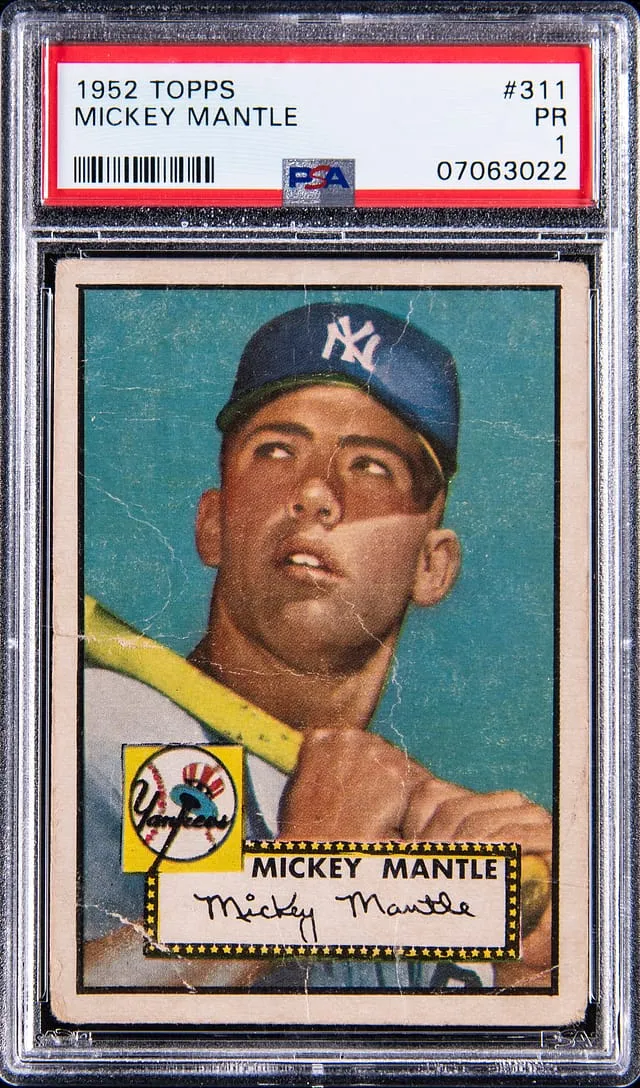
1952 Topps Mickey Mantle PSA 1 sells for $53K
Goldin sold a 1952 Topps #311 Mickey Mantle PSA 1 for $53,284 on March 6, 2026. See why low-grade copies of this iconic card still command big prices.
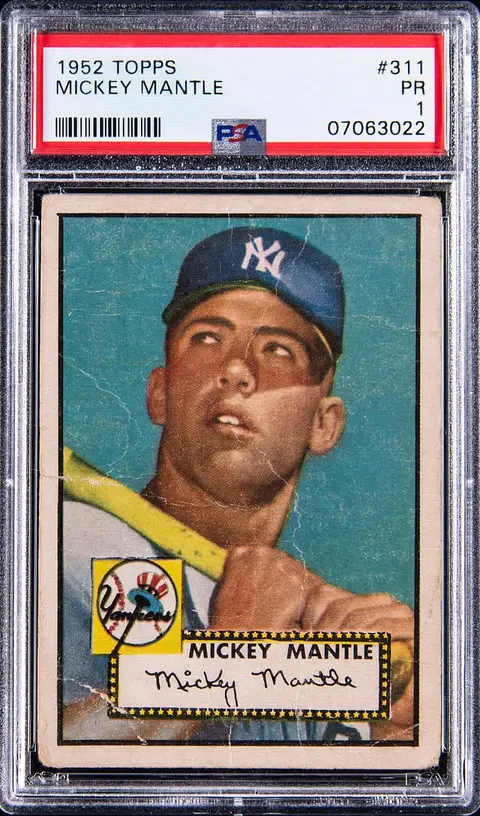
Sold Card
1952 Topps #311 Mickey Mantle - PSA PR 1
Sale Price
Platform
Goldin1952 Topps Mickey Mantle is one of those cards that pulls every part of the hobby together: history, scarcity, condition debates, and big auction results.
A well-worn copy just reminded everyone of that.
On March 6, 2026, Goldin sold a 1952 Topps #311 Mickey Mantle graded PSA PR 1 for $53,284. For a card technically in “Poor” condition, that number says a lot about how the market views Mantle’s flagship Topps card.
Identifying the card
Let’s start with the basics:
- Player: Mickey Mantle (New York Yankees)
- Year / Set: 1952 Topps Baseball
- Card number: #311
- Status: Widely treated as Mantle’s flagship Topps card and a blue‑chip key to the entire vintage market
- Era: Vintage (early post‑war)
- Grading company: PSA (Professional Sports Authenticator)
- Grade: PR 1 (Poor)
1952 Topps #311 isn’t technically Mantle’s true rookie (that honor usually goes to his 1951 Bowman), but it functions as his iconic card. Many collectors treat it as the Mantle to own, especially in the context of mainstream, post‑war baseball cards.
This copy has no special parallel, autograph, or patch—those weren’t a thing in 1952 Topps. Its appeal is entirely about:
- The player (Mantle)
- The set (Topps’ landmark early issue)
- The card’s place in hobby history
Why 1952 Topps Mantle matters so much
For newer collectors, it helps to understand what this card represents:
- Set importance: 1952 Topps is one of the most important post‑war baseball sets. Larger format, bright color, team logos, and a checklist that signaled the modern trading card era.
- Short‑print mystique: Mantle’s #311 comes from the tougher "high number" series, long associated with smaller distribution and the famous story of unsold cases being dumped into the Hudson River.
- Cultural icon: Mickey Mantle is a central figure in baseball lore—triple crown winner, multiple MVPs, and the face of the Yankees’ 1950s dynasty.
- Hobby bellwether: High‑end Mantle sales often show up in mainstream news and are frequently used as shorthand for the health of the vintage market.
Because of all that, even low‑grade examples are heavily chased. Collectors are often willing to accept creases, rounded corners, paper loss, and centering issues just to have a copy in their collection.
Understanding a PSA 1 (Poor) grade
PSA’s PR 1 label is the lowest numeric grade, but that doesn’t mean the card is unwanted. It usually indicates one or more of the following:
- Heavy creasing or wrinkles
- Very rounded or damaged corners
- Possible surface issues (stains, paper loss, writing)
- Overall well‑loved or mishandled condition
In the vintage world, especially for iconic cards, the phrase “buy the card, not the grade” comes up a lot. Collectors will scrutinize eye appeal within the same grade:
- Centering
- Color and registration (how sharp the print looks)
- Front vs. back damage
Two PSA 1s can look very different. Strong eye appeal in a low grade can push prices higher than “typical” copies, while heavy front‑side damage might hold a card back.
Market context and recent sales
In hobby shorthand, a “comp” is a recent comparable sale—a way to ground price expectations by looking at similar cards, grades, and auction formats.
For 1952 Topps Mantle, the market has years of public auction data behind it, including:
- Top‑end record territory: High‑grade copies (PSA 8 and above) have sold in the seven‑figure range, including headline‑making results at major auction houses.
- Mid‑grade strength: Solid mid‑grade copies (PSA 4–6) have often landed in the strong five‑figure to six‑figure range depending on eye appeal and market conditions.
- Low‑grade resilience: Auth/Altered, PSA 1, and PSA 1.5 examples have consistently attracted firm bidding because they are entry points into an otherwise very expensive card.
This Goldin result at $53,284 sits in that context:
- It is a PSA 1, the lowest numeric grade.
- Despite the grade, it still commands a price that would rival or exceed many modern, serial‑numbered chase cards.
- The sale reinforces that demand for ownership of this specific card often outweighs condition concerns.
Compared with typical ranges seen in recent years, a PSA 1 Mantle tends to trade broadly in the five‑figure territory, with wide variation depending on eye appeal, timing, and auction venue. A realized price in the low‑to‑mid $50,000s is consistent with the idea that even low‑grade copies are treated as blue‑chip vintage pieces.
Population and scarcity (in context)
“Pop report” is hobby shorthand for the population report—how many copies a grading company has recorded at each grade level.
The 1952 Topps Mantle is not scarce in the same sense as a modern serial‑numbered card, but:
- There are only so many surviving copies after decades of handling and storage.
- High‑grade examples are genuinely scarce relative to demand.
- Low‑grade copies are more numerous, but demand is also much broader, spanning vintage purists, Yankee fans, set builders, and investors.
Because of that, the card behaves more like a historical artifact than a typical insert or parallel. The exact number of PSA 1s may rise slowly over time as more raw copies are graded, but the overall supply of authentic 1952 Mantle cards remains finite.
What this sale suggests about the market
A single auction never tells the whole story, but this Goldin sale offers a few useful signals:
- Mantle’s flagship appeal is intact. Even in a PSA 1, collectors are still willing to commit meaningful capital to the card.
- Condition is a spectrum, not a yes/no. Within “low grade,” eye appeal and presentation still matter. While the specific visual details of this copy aren’t captured in the sale data alone, the realized price implies competitive interest.
- Vintage blue chips remain a reference point. When people discuss the broader sports card market—ups, downs, or sideways—1952 Mantle results are almost always part of the conversation.
Takeaways for different types of collectors
Whether you are just getting into vintage or you’ve been around the hobby for decades, a sale like this offers a few practical lessons:
- For newcomers: It’s normal for iconic vintage cards to sell for strong prices even in low grades. You don’t have to chase this exact card—there are Mantle and 1950s options at lower price points that still carry history.
- For returning collectors: The days of finding affordable, raw 1952 Mantles in the wild are mostly gone. Slabbed, authenticated copies dominate the market, and graded condition has become a major price driver.
- For active hobbyists and small sellers: Results like this help recalibrate expectations when you evaluate collections. A PSA 1 on a historically important card can be more valuable than a gem mint grade on a modern issue with weaker long‑term demand.
Where figoca fits in
At figoca, we track sales like this PSA 1 Mantle to build cleaner, more context‑rich price histories. Rather than focusing on the headline number alone, we look at:
- Grade
- Auction house (in this case, Goldin)
- Sale date (here, March 6, 2026, UTC)
- Card era and set significance
Putting those pieces together helps collectors read the market in a calmer, more informed way—especially on cards as important as the 1952 Topps Mickey Mantle.
This $53,284 sale at Goldin is not just another comp. It’s another data point in a long timeline that shows how the hobby continues to value the card many consider the heart of post‑war baseball collecting.