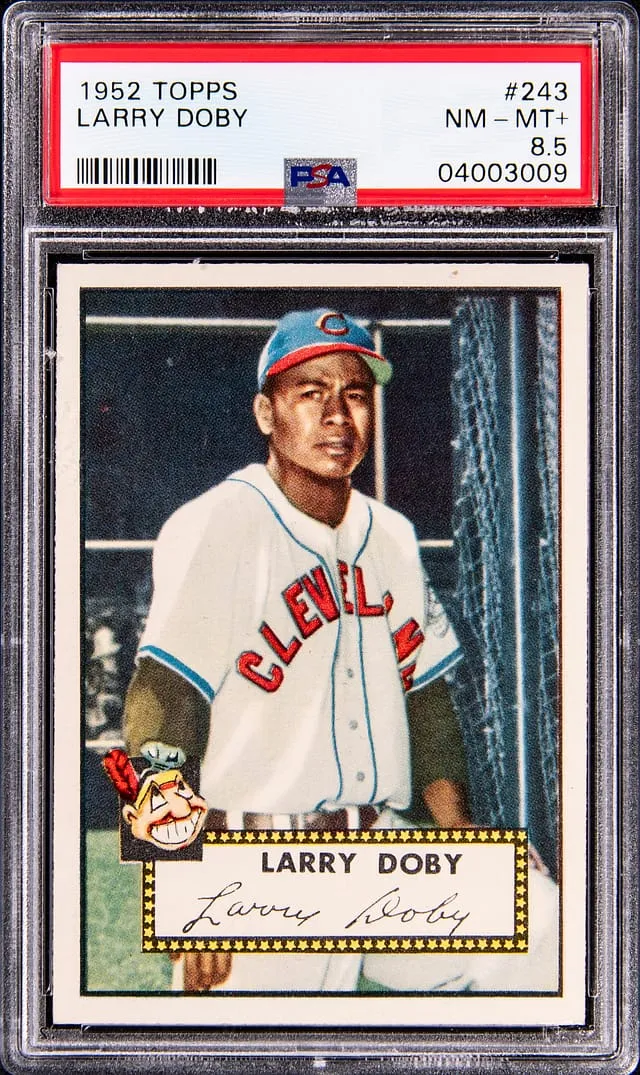
1952 Topps Larry Doby PSA 8.5 sells for $36,905
Goldin sold a 1952 Topps #243 Larry Doby PSA 8.5 for $36,905. Learn why this high-grade, low-pop Hall of Famer is a key vintage baseball card.
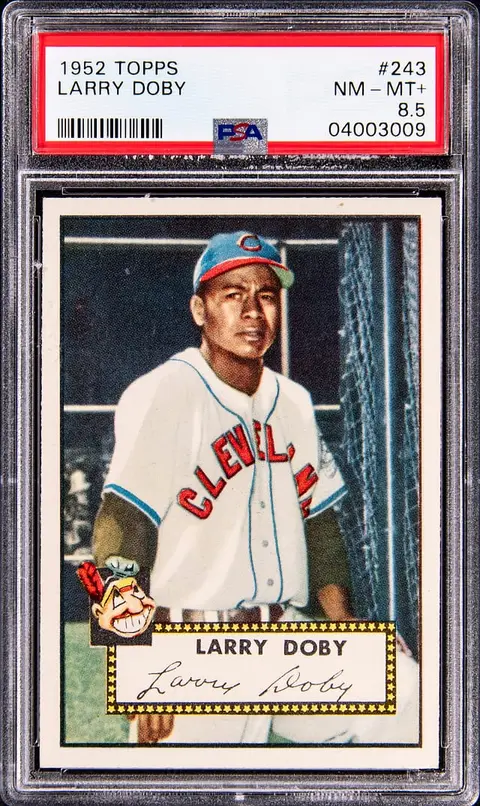
Sold Card
1952 Topps #243 Larry Doby - PSA NM-MT+ 8.5 - Pop 2; 7 Higher PSA Copies
Sale Price
Platform
GoldinA PSA 8.5 copy of the 1952 Topps #243 Larry Doby just changed hands at Goldin on February 22, 2026 for $36,905, drawing fresh attention to one of the most historically important position-player cards of the early postwar era.
Card at a glance
- Player: Larry Doby
- Team: Cleveland Indians
- Year / Set: 1952 Topps Baseball
- Card number: #243
- Rookie?: Not a rookie card (Doby’s playing-day issues begin in the late 1940s), but a key early Topps card.
- Grading company: PSA (Professional Sports Authenticator)
- Grade: NM-MT+ 8.5
- Population: Pop 2 in PSA 8.5, with only 7 higher-graded PSA copies reported at the time of the sale.
- Sale: Goldin auction, closed February 22, 2026
- Price: $36,905
This is a standard base card from the landmark 1952 Topps set, not an autograph, patch, or serial-numbered parallel. The appeal here is almost entirely about the combination of set, player, and grade rarity.
Why this Larry Doby card matters
Larry Doby was the first Black player in the American League, debuting with Cleveland in 1947, just months after Jackie Robinson broke the color barrier in the National League. He was a seven-time All-Star, a World Series champion, and a Hall of Famer whose contribution to baseball integration is increasingly recognized by historians and collectors.
From a hobby perspective, Doby’s cards tend to sit in a quieter lane than Jackie Robinson’s, but they occupy a similar historical space: they are touchstones for collectors who focus on civil rights milestones, the integration era, and Hall of Fame legacies.
The 1952 Topps set itself is one of the pillars of the vintage hobby. It’s Topps’ first widely collected, full-scale baseball set and contains flagship cards of Mickey Mantle, Jackie Robinson, Willie Mays, and many others. Even mid-tier stars in high grade can be difficult to find thanks to:
- Production and distribution quirks in 1952
- Centering and print-quality issues
- Decades of handling before professional grading existed
Doby isn’t in the ultra-scarce high-number run, but his card still benefits from the halo effect of being in this set: collectors often build runs of Hall of Famers from 1952 Topps, and Doby is a must-have name in that checklist.
Grade, population, and scarcity
In PSA’s system, NM-MT+ 8.5 is a high-end vintage grade—well above what most surviving 1952 Topps cards can achieve. Vintage issues often show corner wear, surface defects, or centering problems that cap their grades.
Key points on this specific copy:
- Pop report: Only 2 copies in PSA 8.5 and just 7 higher in PSA 9 or better at the time of sale.
- Relative scarcity: That means only a small handful of collectors can own a copy at this level or above, which tends to concentrate demand when a high-grade example surfaces.
- Condition premium: For vintage, the jump from strong mid-grade (PSA 5–6) to high-end (PSA 8 and above) is usually where prices accelerate, because the supply of truly sharp examples drops off quickly.
Recent sales and market context
For context, it helps to look at “comps,” shorthand in the hobby for comparable recent sales of the same card or closely related versions.
For the 1952 Topps #243 Larry Doby, the market often breaks down roughly as follows:
- Mid-grade copies (PSA 4–6): Typically trade in the low-to-mid hundreds of dollars, depending on eye appeal, centering, and auction visibility.
- Strong high-grade (PSA 7–8): Move into the low-thousands to mid-thousands. A PSA 8, for example, has historically commanded a notable premium over 7s because it signals a near top-tier survivor.
- Premium high-grade (PSA 8.5–9): Sales are far less frequent. When they do surface at major houses, they often land solidly into five-figure territory, with prices influenced heavily by the card’s centering and overall look in addition to the numeric grade.
The $36,905 result at Goldin on February 22, 2026 sits firmly in the premium tier for this card. Given the tiny population in PSA 8.5 and above, there are not many directly comparable sales, but this price lines up with a broader trend where:
- Historically significant Hall of Famers have seen steady interest in high grade.
- Integration-era stars like Doby, Satchel Paige, and others receive more attention as collectors focus on narrative and legacy, not just hobby popularity.
- The very best examples of non-Mantle, non-Robinson cards from 1952 Topps have been repriced over the past few years as set collectors chase top registries.
Without a dense track record of 8.5 and 9 sales, it’s difficult to call this number definitively high or low, but it is clearly at the upper end of the Doby market and consistent with the scarcity and importance of the card.
How this sale fits into the vintage landscape
Vintage—roughly pre-1980 for most collectors—has different dynamics from modern and ultra-modern cards:
- Fixed supply: Production is long over, and the total number of surviving, gradable cards is relatively stable.
- Grade separation: Each jump in grade, especially above PSA 7, represents a sharper break in supply than we’re used to in modern products.
- Historical focus: Collectors tend to prioritize Hall of Famers, key sets, and cards that connect to specific eras or milestones.
Within that context, this Larry Doby 1952 Topps in PSA 8.5 checks several hobby boxes:
- Hall of Fame, historically significant player – Doby’s role in integration gives this card meaning beyond statistics.
- Iconic flagship set – 1952 Topps is a foundation of many vintage collections.
- Grade scarcity – With a pop of 2 in 8.5 and only 7 higher, this is near the top of the condition pyramid.
The sale at Goldin likely reflects a combination of:
- Registry competition (collectors building top-ranked PSA sets).
- Renewed interest in historically important players.
- Ongoing demand for high-grade examples from the 1952 Topps run, even beyond Mantle and the marquee cards.
What collectors can take away
Whether you are a newer collector or coming back to the hobby, this sale offers a few practical lessons:
- Know the set context. A card from 1952 Topps, even of a “secondary” star, can behave very differently in the market from a similar player in a later, more plentiful set.
- Look beyond rookies. While rookie cards often get the attention, important early Topps issues of Hall of Famers—especially those tied to significant historical stories—can be central pieces in vintage collections.
- Population reports matter. Checking the PSA pop report helps clarify how many high-grade copies exist. When you see language like “Pop 2; 7 higher,” it indicates a narrow top tier that can push prices up when a strong example becomes available.
- Eye appeal still counts. Among the same grade, well-centered and clean-looking copies typically draw more interest, especially in high-profile auctions.
Final thoughts
The February 22, 2026 Goldin sale of the 1952 Topps #243 Larry Doby in PSA NM-MT+ 8.5 for $36,905 underlines how the market continues to recognize the importance of integration-era Hall of Famers in top condition.
For set builders and vintage specialists, it’s another data point showing that when truly elite examples of key 1950s cards surface—especially in historically important names like Doby—they can command a premium anchored more in history and scarcity than in short-term hobby cycles.
As always, collectors should treat sales like this as reference points, not guarantees. Recent results are useful for understanding where the market has been, but future prices will continue to depend on supply, demand, and how the hobby’s appreciation of Larry Doby’s legacy evolves over time.