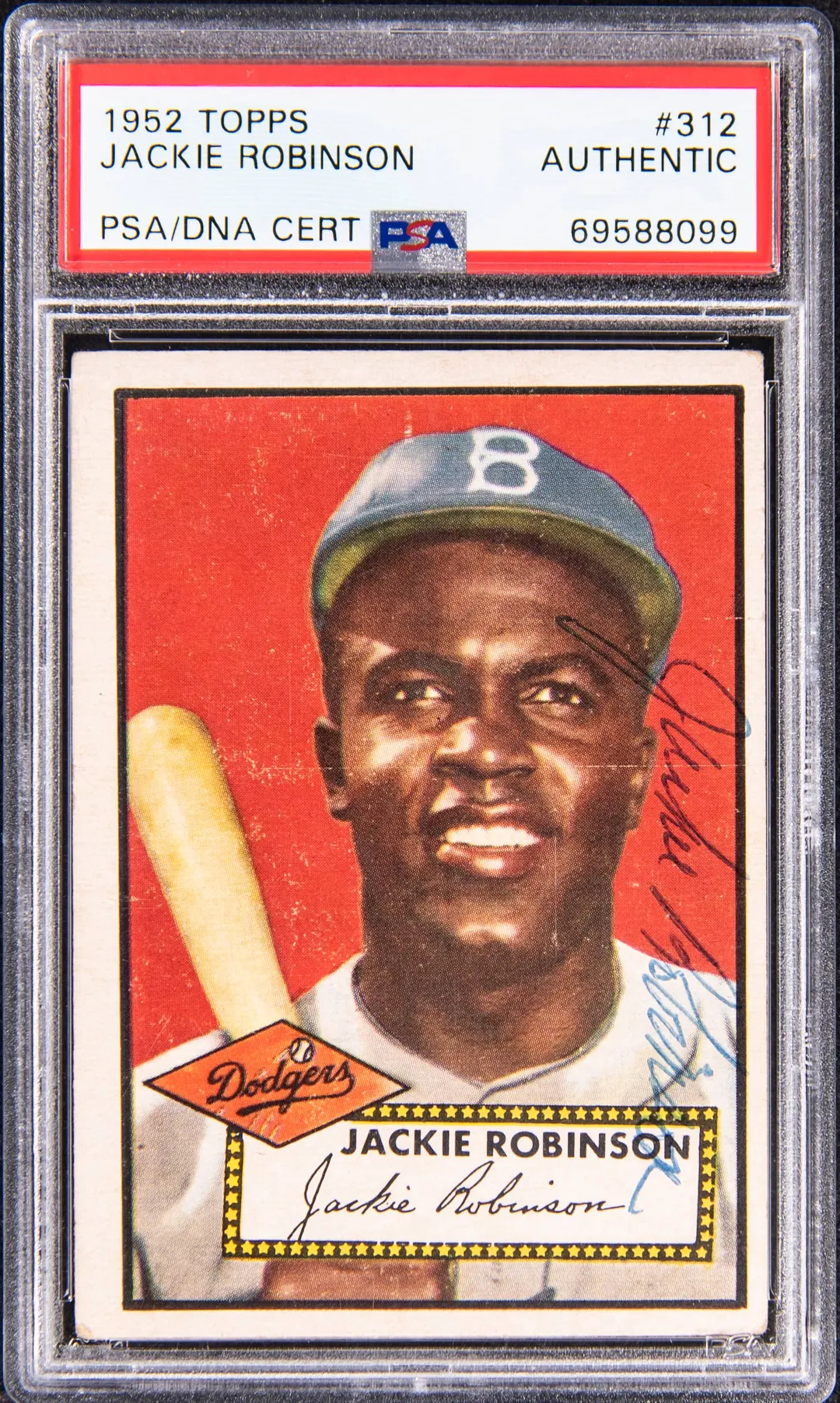
1952 Topps Jackie Robinson Signed Card Sells for $185K
Goldin sold a 1952 Topps #312 Signed Jackie Robinson for $185,440. See why this PSA/DNA-authenticated vintage card matters to collectors.
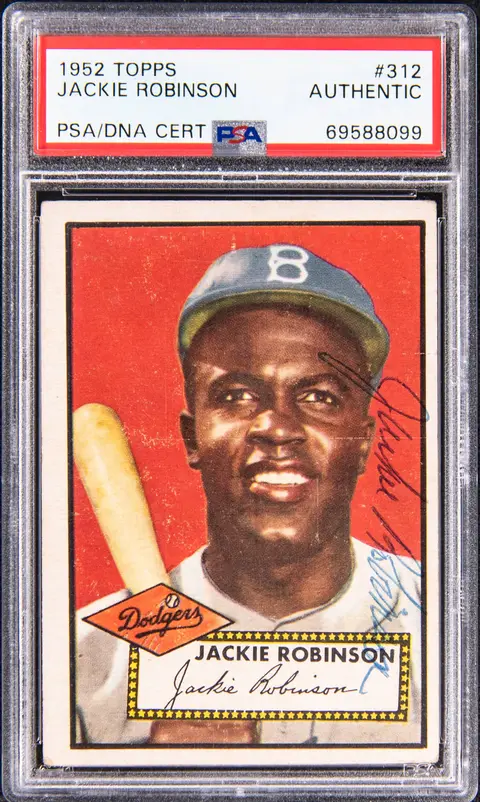
Sold Card
1952 Topps #312 Signed Jackie Robinson – PSA Authentic; PSA/DNA Authentic – One of the Most Significant Signed Cards Extant!
Sale Price
Platform
Goldin1952 Topps #312 Signed Jackie Robinson – PSA Authentic; PSA/DNA Authentic – One of the Most Significant Signed Cards Extant!
On February 22, 2026, Goldin sold a 1952 Topps #312 Jackie Robinson with an on-card autograph for $185,440. For vintage baseball and Jackie collectors, this is one of the most meaningful combinations you can get: an early Topps playing-era card of Robinson, paired with a verified signature, all authenticated by PSA.
In this article, we’ll walk through what this card is, why it matters, how this sale fits into recent market context, and what collectors can take away from it.
Card overview: a signed 1952 Topps Jackie Robinson
Let’s start by identifying the card clearly:
- Player: Jackie Robinson
- Team: Brooklyn Dodgers
- Year: 1952
- Set: 1952 Topps Baseball
- Card number: #312
- Card type: base card (not a parallel), considered a key issue from a landmark set
- Era: vintage (pre-1970)
- Autograph: on-card autograph, authenticated by PSA/DNA
- Card holder label: PSA Authentic (card) and PSA/DNA Authentic (autograph)
This is not Jackie Robinson’s rookie card (his recognized rookies are in 1948 Leaf and 1949 Bowman), but his 1952 Topps is a major hobby cornerstone. The 1952 Topps set is widely treated as Topps’ first flagship baseball release in the modern sense of the word: full-color, larger format, and distributed nationally.
What makes this example special is the autograph. PSA has assigned:
- PSA Authentic (card) – indicating the card itself is genuine, with no numerical grade for condition.
- PSA/DNA Authentic (auto) – confirming the signature is a genuine Jackie Robinson autograph.
For 1950s cards, on-card signatures are almost always added by hand later (at signings or in-person encounters). There were no pack-pulled certified autographs in 1952. That means each signed example is inherently low-population and unique in eye appeal.
Why the 1952 Topps Jackie Robinson matters
Even without ink, Jackie Robinson’s 1952 Topps #312 is one of the defining cards of post-war baseball.
Key reasons collectors value this card:
Jackie Robinson’s historical impact
Robinson broke MLB’s color barrier in 1947 with the Brooklyn Dodgers, altering both baseball and American culture. His cards sit at the intersection of sports history and social history.1952 Topps as a landmark set
The 1952 Topps release is one of the most studied and collected vintage sets. It introduced the larger card size and design language that would define modern Topps. The set includes multiple Hall of Famers and the famous Mickey Mantle #311. Within that checklist, Jackie’s #312 is a headliner.Era-driven scarcity
As a vintage card, high-grade or well-preserved copies are naturally scarce. Cards were handled by kids, placed in stacks, clipped with rubber bands, or pinned. Autographed examples from Robinson’s playing days are far scarcer still.Autograph scarcity and significance
Jackie Robinson passed away in 1972. That cuts off the supply of authentic signatures over 50 years ago. Compared to modern players who sign thousands of stickers and on-card autos for products, authenticated Robinson autographs—especially on key playing-era cards—are limited and carefully followed by advanced collectors.
The combination of an iconic set, an all-time great player, and a real signature explains why a piece like this is often described as “one of the most significant signed cards extant.” It represents both hobby history and broader cultural history in one slab.
Market context: how does $185,440 fit in?
The hammer result at Goldin on February 22, 2026 was $185,440. Converted from the input price in cents, that’s a clean $185,440 in USD.
To make sense of this number, it helps to break down a few angles:
1. Unsigned 1952 Topps Jackie Robinson prices
For context, here’s how unsigned copies of #312 have tended to behave on major auction platforms (Heritage, Goldin, REA, and others) in recent years:
- Mid-grade examples (PSA 4–5) often land in the mid–five-figure range, sometimes touching six figures depending on eye appeal and auction timing.
- High-grade examples (PSA 7 and above) can push well into six figures, with particularly strong prices for top-end eye appeal and well-centered copies.
Exact numbers vary over time, but the general pattern is clear: an unsigned, numerically graded 1952 Topps Jackie Robinson is already a serious, five- to six-figure card.
2. Signed vintage Jackie Robinson cards
Finding strong, verifiably authentic Jackie signatures on playing-era Topps or Bowman cards is much tougher than finding unsigned copies.
Some trends from recent years:
- Signed 1948 Leaf or 1949 Bowman Robinsons with PSA/DNA authentication have sold significantly higher than their unsigned counterparts, often multiples of the base-card price when eye appeal is strong.
- Signed 1950s Topps Robinson cards (including 1952) tend to show a similar pattern: the autograph layer adds a large premium, especially when the card is well-centered and the signature is bold.
Because pop reports for signed vintage cards are scattered (and often lower than for base cards), the market tends to treat each strong example almost as its own small event.
3. Where $185,440 likely sits
Based on public auction records and how collectors typically value signed vintage Hall of Famer cards, a sale at $185,440 for a PSA Authentic / PSA/DNA Authentic 1952 Topps Jackie Robinson:
- Lands squarely in what you’d expect for a premier signed example of a key Jackie card.
- Reflects a substantial premium over most unsigned copies in mid grades, aligning with what we’ve seen on other marquee signed vintage stars.
- Underscores how collectors are willing to treat strong, authenticated Jackie autographs on important playing-era cards as distinct, trophy-level items rather than just “upgraded” base cards.
It is difficult to call this price either surprisingly low or dramatically high without a large pool of directly comparable sales. Truly apples-to-apples comparables—same card, same era, on-card signature, similar condition, and PSA/DNA authentication—are rare. That in itself is part of the story: scarcity of direct comps keeps each major sale in the spotlight.
Population, grading, and the role of PSA/DNA
When collectors talk about a “pop report,” they mean the population report: how many copies a grading company has recorded at each grade level. For signed vintage cards, population data gets more nuanced:
- Unsigned graded cards are counted in the main PSA card pop report.
- Autograph-authenticated cards may fall under PSA/DNA’s separate tracking and cross-overs.
For a card like this, there are comparatively few PSA/DNA-authenticated signed 1952 Topps Jackie Robinsons relative to unsigned graded examples. Even within that small group, not all signatures are equal: placement, pen strength, and contrast against the artwork dramatically affect collector preference.
PSA’s dual label—Authentic for the card and Authentic for the auto—provides two critical assurances:
- The card itself is a genuine 1952 Topps #312.
- The signature is a genuine Jackie Robinson autograph.
For a player as widely forged as Jackie Robinson, that authentication layer is essential. Many advanced collectors will only consider PSA/DNA (or an equivalent tier authenticator) for high-end vintage autographs.
Why this sale matters for collectors and the market
From a collector-to-collector standpoint, this Goldin sale highlights a few broader themes in the current market.
1. Playing-era signed cards of inner-circle legends are maturing as a category
Modern cards often chase scarcity through serial numbering, parallels, and pack-issued autographs. Vintage doesn’t work that way. Scarcity comes more naturally: low survival rates, historical context, and limited autograph supply.
This sale reinforces a trend we’ve seen across multiple auction houses:
- Collectors are increasingly willing to treat playing-era signed cards of true icons—like Robinson, Ruth, Mantle, Mays—as distinct, trophy-level items, not just novelties.
- The market often separates these from both unsigned vintage and from cut signatures or modern tribute autographs, giving them their own lane.
2. Historical narrative continues to drive demand
Jackie Robinson’s story is central to why this card matters. The demand isn’t only about batting averages or WAR; it’s about what Robinson represents.
Cards tied to historically meaningful players and moments tend to show resilience and collector loyalty, even as the broader market cycles through periods of strength and softness. This sale fits neatly into that pattern.
3. Data awareness eclipses pure hype
Today’s buyers and sellers are more data-aware than ever. Terms like “comps” (recent comparable sales used as reference points) and “auction history” are now part of everyday hobby language.
This $185,440 result didn’t occur in a vacuum:
- Bidders could reference unsigned 1952 Jackie sales from other platforms.
- They could look at past signed Jackie Robinson results, even if not perfectly comparable.
- They could weigh the autograph quality, eye appeal, and timing.
The final price reflects a negotiation of all those factors—history, scarcity, and recent data—rather than short-lived hype.
Takeaways for different types of collectors
Whether you’re new to vintage or already deep into pre-1970s cards, there are a few practical lessons to pull from this Goldin sale.
New and returning collectors
- Start by learning the key sets and players. 1952 Topps and Jackie Robinson are foundational. Even if this level of price is far above your budget, understanding why this card is important will help you make better decisions across the board.
- Get comfortable with authentication. For signed vintage, third-party verification—like PSA/DNA—is vital. It reduces the risk of buying a forged signature.
Active hobbyists
- Think in tiers, not just grades. A signed, PSA/DNA-authenticated 1952 Robinson occupies a different tier than unsigned copies, even if both are labeled “Authentic.” Eye appeal of the auto matters just as much as the card’s corners or centering.
- Use comps thoughtfully. For ultra-rare items, there may be few true comps. In those cases, use nearby data points (unsigned cards, other years, similar players) with caution and context.
Small sellers and traders
- Documentation adds trust. If you handle any signed vintage, solid provenance and authentication are key to attracting serious buyers.
- Tell the story, but stay grounded. Highlight historical significance, set importance, and population context, but avoid promising future gains. Focus on what the card represents right now.
Final thoughts
The February 22, 2026 sale of a 1952 Topps #312 Signed Jackie Robinson—PSA Authentic with a PSA/DNA Authentic autograph—for $185,440 at Goldin underscores the enduring strength of historically important, playing-era signed cards.
This isn’t just a high-dollar result; it’s a data point in a longer story. As the hobby continues to mature, pieces like this help define how collectors value cultural significance, vintage scarcity, and authenticated autographs in relation to more modern chase cards.
For anyone building a deeper understanding of the market, keeping an eye on sales like this is essential. They remind us that behind the numbers, there’s a story worth knowing—and in Jackie Robinson’s case, a story that extends well beyond the hobby itself.