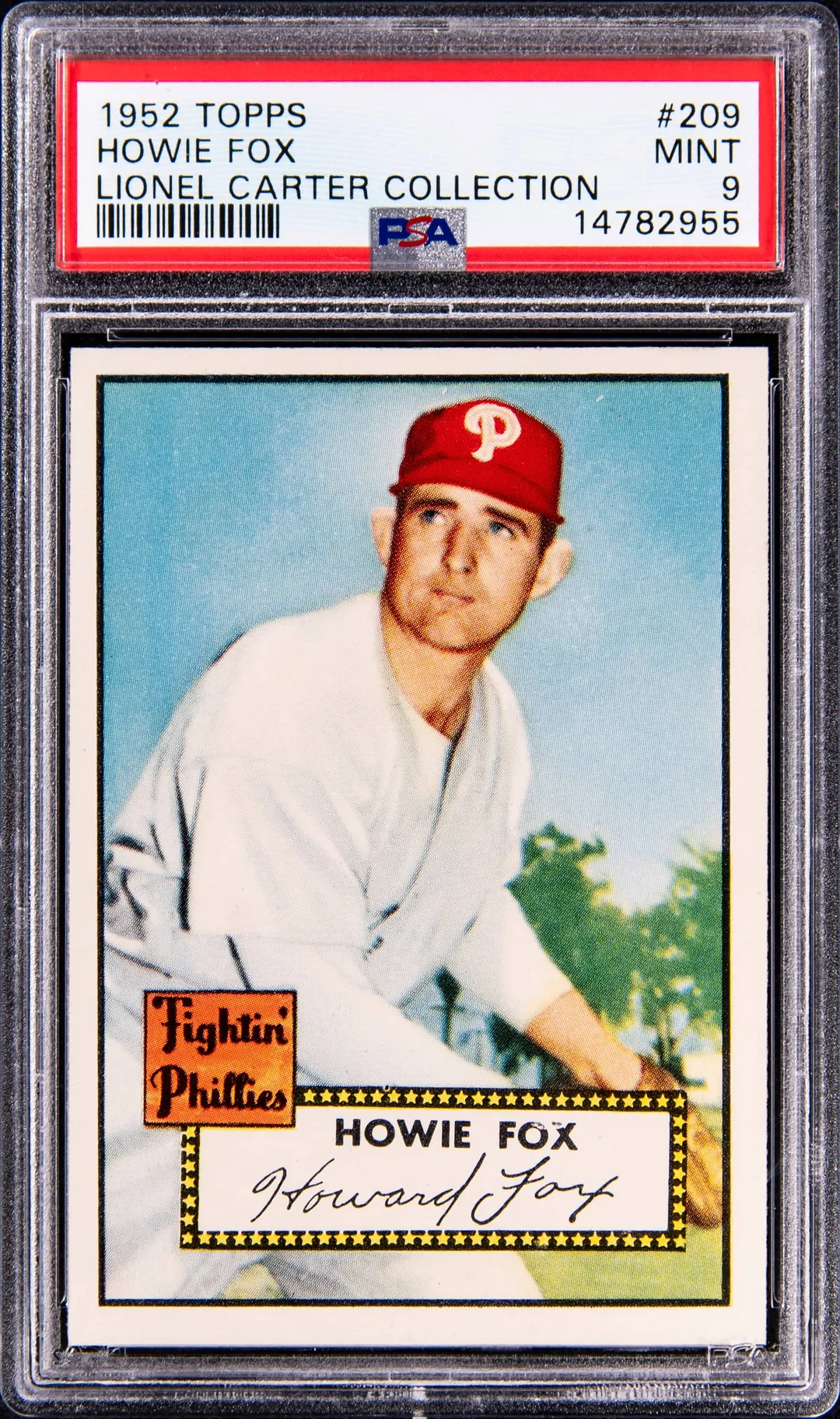
1952 Topps Howie Fox PSA 9 Lionel Carter Sale
A 1952 Topps #209 Howie Fox PSA 9 from the Lionel Carter Collection sold for $16,653 at Goldin on 2/22/26. Here’s what it means for vintage set collectors.
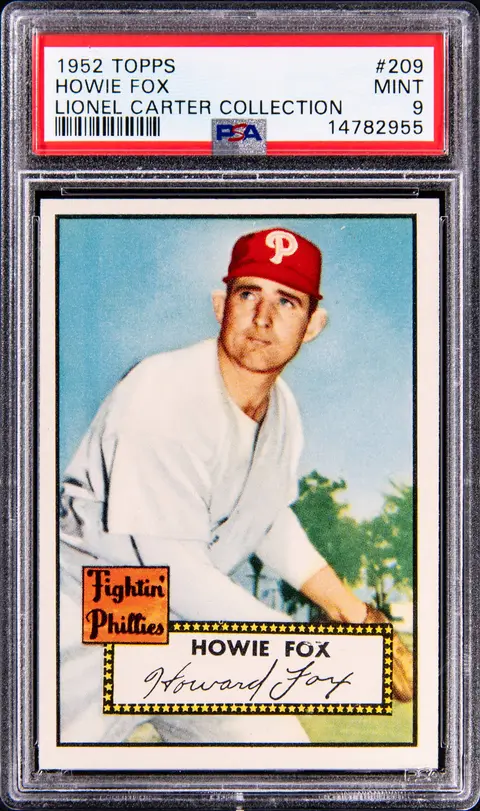
Sold Card
1952 Topps #209 Howie Fox - Lionel Carter Collection - PSA MINT 9 - Pop 6; Highest PSA Copy
Sale Price
Platform
GoldinVintage high-grade 1952 Topps continues to show steady strength, and the latest data point comes from Goldin’s 2/22/26 auction: a 1952 Topps #209 Howie Fox from the famed Lionel Carter Collection, graded PSA MINT 9, realized $16,653.
For a card that many casual collectors might overlook at first glance, this result says a lot about how the market treats condition, provenance, and the 1952 Topps set as a whole.
The card: 1952 Topps #209 Howie Fox, PSA 9, Lionel Carter Collection
Let’s pin down exactly what sold:
- Year / Set: 1952 Topps Baseball
- Card number: #209
- Player: Howie Fox, pitcher
- Team: Philadelphia Phillies (as depicted on the card)
- Grading company: PSA (Professional Sports Authenticator)
- Grade: PSA MINT 9
- Population: PSA Pop 6 in MINT 9, with this example noted as a highest PSA copy (no PSA 10s currently listed)
- Provenance: From the Lionel Carter Collection, a highly respected provenance in vintage cards
This is not a rookie card or a short-print superstar, but it is a high-grade example from one of the hobby’s most important vintage sets. The lack of higher-graded copies makes this a true condition census card: it sits at the top of PSA’s pop report.
Why 1952 Topps matters
The 1952 Topps set is widely considered the defining post-war baseball issue. For newer collectors:
- It was Topps’ first major full-sized baseball set.
- It helped establish the modern card look: larger format, strong color, player name, team logo, and stats.
- It includes iconic keys like the Mickey Mantle, Jackie Robinson, Willie Mays, and numerous early Topps cards of Hall of Famers.
Collectors often describe 1952 Topps as a “pillar set” for vintage. Even commons and role players can command serious premiums in top grades because:
- Survival rates in true mint condition are low.
- Printing quality and centering issues make PSA 9s tough.
- The set is heavily pursued by set builders trying to assemble high-grade or registry-leading runs.
In that context, a PSA 9 of a non-star like Howie Fox still matters: it fills a challenging slot for advanced 1952 Topps collectors, especially those chasing top placement on PSA’s Set Registry.
The Lionel Carter Collection: why provenance matters
The Lionel Carter Collection has long been respected for its eye appeal and originality. Carter was an early hobby pioneer, known for acquiring cards directly in their era and preserving them carefully over decades.
When a card comes from this collection, collectors generally associate it with:
- Strong surface and color, even by the strict standards of vintage.
- Long-term, single-owner provenance, which many believe reduces the risk of alterations.
- A bit of historical hobby pedigree, similar to how coins and comics value famous collections.
That provenance, combined with the PSA 9 grade and low population, helps explain why a non-star 1952 Topps card can reach five figures.
Market context and recent sales
When we look for comps—short for comparable sales, meaning recent sales of the same card or very similar examples—the picture for this exact card is limited. PSA 9s of low- and mid-number 1952 Topps commons simply do not trade frequently, especially when they are pop 6 with no higher-graded copies.
However, we can place this result in context by looking at:
- Other 1952 Topps commons in PSA 9
- Sales of the same card in lower grades
- Premiums for Lionel Carter provenance
Across major auction houses, many 1952 Topps commons in PSA 9 have settled in the low- to mid-five-figure range, depending on:
- Player popularity
- Image appeal
- Relative scarcity (some numbers are tougher than others)
- Provenance and eye appeal
When the pop is very low and there is no PSA 10, prices often drift toward the upper end of that band. Condition census cards (those tied for or holding the highest grade) tend to attract set registry collectors, who sometimes bid more aggressively to secure the best-graded copy available.
While exact, recent public comps for this specific Howie Fox PSA 9 are thin, the $16,653 result at Goldin on 2/22/26 aligns with what we typically see for:
- Top-pop or tied-top-pop 1952 Topps commons in PSA 9, and
- Cards with desirable provenance like Lionel Carter.
This sale appears more in line with strong but reasonable registry-driven pricing, not an outlier spike. There is no widely cited past record for this specific card at a dramatically higher or lower level; rather, it fits into the ongoing pattern of high-grade 1952 Topps stability.
Grade scarcity and the PSA pop report
A pop report (population report) is the grading company’s public count of how many copies of a card exist in each grade. Here, PSA lists:
- PSA 9 MINT: 6 copies
- PSA 10 GEM MINT: none currently reported
That means all PSA 9s are effectively tied for the finest known examples in PSA holders. When a card has no GEM MINT 10 and just a handful of 9s, each 9 becomes very important to collectors targeting:
- Top-ranked set registry positions, or
- Personal projects focused on the best-graded examples of the entire 1952 Topps run.
Even though Howie Fox himself is not a Hall of Famer, his card becomes a bottleneck for those building elite sets. If you want a near-perfect 1952 Topps in PSA holders, you have to secure cards like this one.
Why collectors care about this card
Several threads pull together to make this specific example noteworthy:
- Set importance: 1952 Topps is foundational to vintage baseball collecting.
- Grade: PSA 9 from this era is extremely tough, especially with strong centering and color.
- Population: Only six in PSA 9, none higher.
- Provenance: Lionel Carter Collection adds hobby prestige.
- Era: As a vintage (early 1950s) card, it predates mass overproduction and modern ultra-graded scarcity tactics.
For newer or returning collectors, this sale is a reminder that not only stars matter in vintage. Commons and secondary players can command serious prices once you combine a landmark set, a top grade, and meaningful provenance.
How this $16,653 result fits the broader market
Converted from the hammer price reported in cents, this card sold for $16,653 at Goldin on February 22, 2026 (UTC).
Viewed alongside other vintage sales:
- It reinforces the idea that high-grade vintage remains relatively steady even as modern and ultra-modern segments can be more volatile.
- It shows that registry and provenance premiums are alive and well—collectors are still willing to pay more for:
- Pop 5–10 cards with no higher grade, and
- Named, respected collections.
There is no obvious short-term news story around Howie Fox himself driving this sale. Instead, the price reflects structural hobby factors:
- The durability of 1952 Topps demand
- The ongoing interest in building best-possible graded sets
- A continued focus on blue-chip vintage issues over purely speculative modern plays
Takeaways for collectors and small sellers
If you’re newer to vintage or looking to understand what this means for your own cards, a few practical points:
Set and condition can outweigh star power. Even a non-star like Howie Fox can reach mid-five figures when the card is from an iconic set, in top grade, and with strong provenance.
Provenance adds a layer, not a guarantee. Named collections such as Lionel Carter’s can add a premium, but that premium still sits on top of the fundamentals: set importance, grade, and eye appeal.
Review the pop report before pricing. Especially with vintage, check PSA’s population report so you understand:
- How many exist in your card’s grade
- Whether there are higher-graded copies exerting downward pressure on your card’s ceiling
Expect thin data for top-pop cards. With only six PSA 9s and no 10s, sales will be infrequent. That means:
- Individual auction results can vary depending on who shows up to bid.
- A single sale is better read as a data point than a rigid price guide.
Think in terms of ranges, not absolutes. For cards like this, it’s more realistic to talk about recent sales ranges and relative positioning inside the broader 1952 Topps market than to treat one auction hammer as a permanent benchmark.
For figoca users tracking the vintage space, this Goldin sale highlights how condition census vintage continues to command firm prices, even for non-marquee names. If you collect 1950s baseball, this Howie Fox PSA 9 from the Lionel Carter Collection is a textbook example of how set importance, top-grade scarcity, and provenance interact in today’s market.