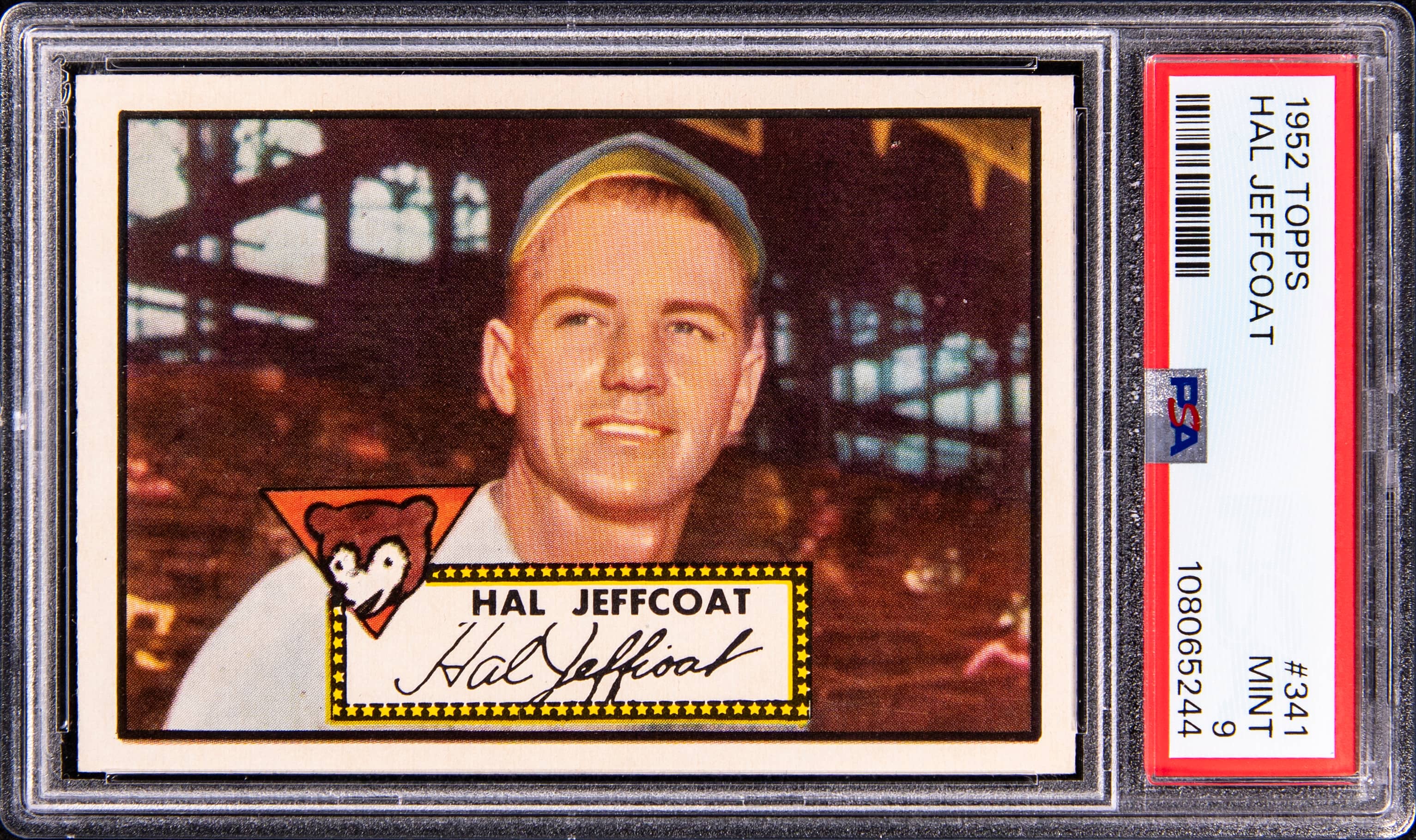
1952 Topps Hal Jeffcoat PSA 9 Sale at Goldin
Figoca reviews the $20,740 Goldin sale of a pop 5, highest-graded 1952 Topps #341 Hal Jeffcoat PSA 9 high number and its market context.
Sold Card
1952 Topps #341 Hal Jeffcoat - High Number - PSA MINT 9 - Pop 5; Highest PSA Copy
Sale Price
Platform
GoldinA PSA 9 1952 Topps High Number Hal Jeffcoat Just Cleared $20,740
For most collectors, a 1952 Topps conversation starts and ends with Mickey Mantle. But the set’s high-number run (cards #311–407) is a world of its own, and the quieter stories inside that run are where a lot of true scarcity lives.
On February 22, 2026, Goldin sold a 1952 Topps #341 Hal Jeffcoat – High Number – graded PSA MINT 9 – for $20,740. With a PSA population of just 5 in this grade and none higher, this result is a useful data point for anyone tracking high-grade 1952 Topps commons and semi‑stars.
In this breakdown, we’ll look at what this card is, why the grade matters so much, and how this sale fits into the broader 1952 Topps market.
Key details of the card
• Card: 1952 Topps Baseball #341 Hal Jeffcoat
• Player: Hal Jeffcoat, outfielder/pitcher
• Team: Cincinnati Reds (then the Cincinnati Redlegs)
• Set: 1952 Topps Baseball
• Card number: #341
• Subset: High Number series (#311–407)
• Rookie/key issue: Not a rookie card, but part of the tough high-number run
• Grading company: PSA (Professional Sports Authenticator)
• Grade: PSA MINT 9
• Population: Pop 5 in PSA 9, with no PSA 10s – this is the highest graded level for the card
• Special attributes: Standard base issue; no autograph or patch – the value is driven by set, era, and condition
This is a straightforward base card from one of the most important vintage baseball sets ever produced. Its significance isn’t about a Hall of Fame name or a key rookie tag, but about how difficult it is to find 1952 Topps high numbers in truly elite condition.
Why 1952 Topps high numbers matter
When people talk about “high numbers,” they mean the last series in a set’s checklist – often printed later and, in many vintage releases, in lower quantities. For 1952 Topps, the high-number series runs from #311 to #407 and is famous for being both scarcer and harder to find in high grade.
A few reasons:
Distribution and scarcity
The 1952 high numbers were printed and distributed late in the season. Hobby lore (and repeated reporting) says unsold stock was dumped at sea years later, further reducing surviving supply. Whatever the exact details, the result is clear in today’s population reports: high numbers are noticeably tougher than low numbers, especially in top grades.Condition sensitivity
1952 Topps cards are large for their era and often show corner wear, centering issues, and print defects. MINT 9 copies—particularly from the high-number run—are a small percentage of all graded examples.Set-building demand
Many vintage collectors are “set builders” who try to assemble complete runs, often in a specific grading tier (for example, all PSA 8s or better). High-number commons and semi-stars in PSA 9 can be surprisingly competitive because they’re true bottlenecks for high-end set registries.
Hal Jeffcoat himself is not a Hall of Famer, but this is exactly the kind of card that matters to advanced 1952 Topps projects: a tough series, elite grade, and low pop.
Understanding the PSA 9 pop 5, highest graded note
PSA’s population report (often shortened to “pop report”) tracks how many copies of each card have been graded at each grade level. For this card, the key facts are:
• PSA 9 population: 5 copies
• PSA 10 population: 0 copies
• Highest graded: PSA 9 is the top of the grading ladder for this issue right now
When a listing notes “Pop 5; Highest PSA Copy,” it means only 5 copies exist at this grade, and none are graded higher. For collectors who care about owning the “best known” example, this matters more than the player name. It also influences how sharp the bidding can get when one of those few copies surfaces at a major auction house.
The Goldin sale: $20,740 on February 22, 2026
• Auction house: Goldin
• Sale date: February 22, 2026 (UTC)
• Final price: $20,740 (converted from the reported 2,074,000 cents)
Goldin is one of the key marketplaces for higher‑end vintage and graded singles, so results from their auctions often serve as “comps” – shorthand in the hobby for recent, comparable sales that collectors look at when evaluating current prices.
Market context and recent sales
Because population is so low at PSA 9, this specific card in this exact grade does not trade frequently. That means:
• You won’t see a steady stream of sales to form a tight price range.
• Each new public sale can reset expectations for where the market views the card.
When you look at closely related versions—such as:
• Lower grades of the same card (PSA 7 or PSA 8), and
• Other high-number 1952 Topps commons and semi‑stars in PSA 9
—you tend to see a pattern:
• Lower grades attract broader collector interest because they’re more affordable, but they’re more common.
• PSA 9 high numbers, especially with pops under 10, behave more like niche, condition-rarity pieces. Bidders are often set builders or focused vintage specialists.
Within that context, a $20,740 result for a PSA 9, pop 5, highest-graded 1952 Topps high‑number card fits the broader trend we’ve seen over the last few years:
• Strong premiums for the very top of the population report,
• Even when the player is not a hobby headliner, and
• Especially when the card helps unlock high‑end set registry rankings.
Because this card does not trade often in PSA 9, it’s better to treat this Goldin sale as a fresh benchmark rather than as an outlier against a long, predictable history of comps.
Why collectors care about a non-star like Hal Jeffcoat
For newer or returning collectors, it can be surprising that a non-Hall of Famer can command a five‑figure price. A few key concepts help make sense of it:
Set significance over player fame
1952 Topps is widely treated as Topps’ flagship debut in the modern baseball card era. Collectors value it for its design, history, and place in the hobby, even beyond the Mantle card.Condition rarity
“Condition rarity” means a card isn’t particularly rare as a physical object, but truly high-grade examples are rare. That’s exactly what’s happening here: 1952 Topps Hal Jeffcoat isn’t impossible to find, but a PSA 9 copy is.Registry competition
PSA’s Set Registry lets collectors compare their graded sets by average grade and completeness. A pop‑5, highest‑graded card can be a difference-maker in those rankings, which increases demand when one surfaces.Vintage era dynamics
This is a vintage card—over 70 years old—with printing and distribution realities very different from modern, serial‑numbered parallels. There’s no /10 stamp or “1-of-1” logo, but scarcity shows up in grading data instead.
How this sale fits into the broader 1952 Topps market
If you zoom out from this single card and look at 1952 Topps more generally, a few patterns emerge:
• Iconic headliners (Mantle, Mays, Robinson, Mathews) tend to get most of the attention and headlines.
• High‑number commons in PSA 7–8 remain relatively accessible compared to the major stars.
• High‑number PSA 9s with tiny pops continue to show healthy demand among advanced collectors.
In that environment, a $20,740 sale for a pop‑5, highest‑graded Hal Jeffcoat card is consistent with how the market has treated similar condition-rarity pieces: not speculative, but supported by:
• A top‑tier vintage set,
• True graded scarcity, and
• A concentrated but motivated collector base.
It’s important to remember that this doesn’t imply any guaranteed direction for future prices. It’s one well-documented data point that helps define the current range for ultra‑high‑grade 1952 Topps high numbers.
Takeaways for collectors and small sellers
If you’re collecting or selling within this space, a few practical lessons emerge from this sale:
Pay attention to pop report details
“Pop 5; Highest PSA Copy” isn’t just a tagline—it’s central to how this card is valued. Checking the population report for any vintage card you’re considering can help you understand where condition rarity might matter.Not every 1952 Topps card behaves the same
A mid‑grade Jeffcoat will live in a very different price range than this PSA 9. Condition tiers (PSA 4–6, PSA 7–8, PSA 9) each form their own markets.Auction venue can matter
This card sold through Goldin on February 22, 2026. Major auction houses with established vintage audiences tend to be where pop‑5, top‑of‑the‑ladder copies surface, because they can reach the specific bidders who care most.Think in terms of “recent sales,” not predictions
For both buyers and sellers, it’s more helpful to view this as a recent sale that adds to the data, rather than as a promise of what future results will be.
Where this leaves the 1952 Topps #341 Jeffcoat
As of this Goldin sale, the 1952 Topps #341 Hal Jeffcoat PSA 9 sits in a small club:
• Only 5 copies in the hobby at this grade,
• None higher on the PSA scale, and
• A fresh public comp at $20,740 as of February 22, 2026.
For most collectors, the more accessible versions of this card will be in lower grades, where the nostalgia of 1952 Topps can be enjoyed without five‑figure price tags. For a handful of advanced set builders and vintage specialists, though, cards like this are exactly where the quiet battles are fought.
Figoca will continue to track sales like this so collectors can place their own cards—and their own goals—in a clearer, data‑aware context.