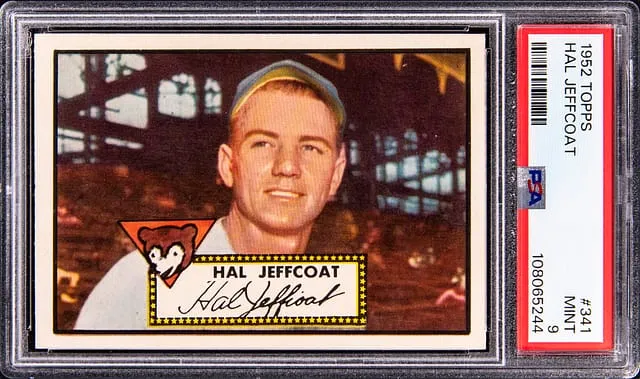
1952 Topps Hal Jeffcoat PSA 9 High Number Sells
A PSA 9 (pop 5) 1952 Topps #341 Hal Jeffcoat high-number card sold for $20,740 at Goldin on Feb 22, 2026. Here’s what it means for vintage collectors.
Sold Card
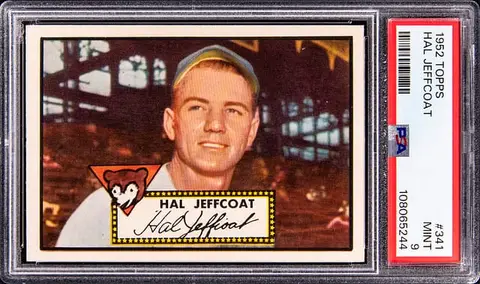
1952 Topps #341 Hal Jeffcoat - High Number - PSA MINT 9 - Pop 5; Highest PSA Copy
Sale Price
Platform
Goldin1952 Topps #341 Hal Jeffcoat - High Number - PSA MINT 9 - Pop 5; Highest PSA Copy Sells for $20,740 at Goldin
On February 22, 2026, Goldin closed the sale of a 1952 Topps #341 Hal Jeffcoat high-number card graded PSA MINT 9 for $20,740. For most collectors, Hal Jeffcoat is not a headline name, but this specific card checks several boxes that matter deeply in vintage baseball: 1952 Topps, high-number scarcity, and top-of-pop (the highest grade recorded by PSA).
Below is a breakdown of what this card is, why it matters, and how this sale fits into the broader vintage market.
Card at a glance
- Player: Hal Jeffcoat
- Team: Chicago Cubs
- Year / Set: 1952 Topps Baseball
- Card number: #341
- Subset / run: High-number series
- Rookie or key issue? Not a true rookie, but a key high-number card in an iconic set
- Grading company: PSA (Professional Sports Authenticator)
- Grade: PSA 9 (MINT)
- Population (pop report): Pop 5 in PSA 9; no PSA 10s, making PSA 9 the highest grade on record at PSA
- Attributes: Standard base card; no autograph, patch, or serial numbering
“Pop” or population refers to how many copies a grading company has graded at each level. A pop 5 in PSA 9 with no PSA 10s effectively makes this a top-of-the-line example for registry and condition-focused collectors.
Why 1952 Topps high numbers matter
The 1952 Topps Baseball set is widely treated as a foundational modern baseball issue. While the set is best known for Mickey Mantle’s card and several major Hall of Famers, the high-number series (typically card #311–407) has its own kind of importance:
- Tougher distribution: High numbers from 1952 are famously scarcer than low and mid numbers. The back-half of the print run was distributed later in the season and in smaller quantities. A portion of unsold high-number stock was also reportedly dumped into the ocean, which the hobby often cites when explaining the scarcity.
- Condition sensitivity: Many surviving examples show heavy corner wear, centering issues, and print defects. High-grade copies, especially PSA 8 and above, are significantly harder to come by.
- Set-building pressure: Many collectors try to build 1952 Topps sets in a consistent grade range. High-number commons and semi-stars can command premiums in higher grades simply because they are harder to find.
Hal Jeffcoat is not a Hall of Famer, but his card is part of this high-number run, which is naturally more limited than the rest of the set. For set builders and PSA Set Registry participants (collectors who compete to assemble graded sets), a pop 5 PSA 9 with no higher examples is a meaningful piece.
Player and card significance
Hal Jeffcoat spent his career as both an outfielder and a pitcher, most notably with the Chicago Cubs and later the Cincinnati Reds. While he is not a marquee star, his 1952 Topps card lands at the intersection of:
- A flagship early Topps design that many consider the start of the modern card era.
- The high-number stretch, historically recognized as tougher to source.
- Top-of-pop status in a set where condition drives substantial interest.
For collectors focused on star power alone, this may seem like a niche target. But for:
- 1950s set collectors,
- PSA Registry builders, and
- condition-focused vintage buyers,
this is a textbook example of how a non-star card can still attract strong bidding when it checks the right rarity and condition boxes.
Market context and price positioning
The realized price of $20,740 at Goldin on February 22, 2026, sits at the intersection of several market forces:
Vintage condition scarcity:
In 1952 Topps, especially in the high numbers, the spread between grades is steep. A PSA 6 might be accessible to many collectors, but once you move into PSA 8 and PSA 9 territory, the card shifts into a scarcity tier that appeals to a smaller but more competitive group of bidders.Top-of-pop premium:
When a card is tied for the highest grade ever given by PSA (here, pop 5 in PSA 9, with no PSA 10s), it often draws additional interest from registry-focused collectors. These buyers are not just purchasing a card; they are competing for leaderboard position on the PSA Set Registry.High-number pressure:
High numbers from 1952 have historically sold at a premium over comparable low numbers in similar condition. While exact comparables (or “comps,” meaning recent, similar sales used as price references) vary card by card, the pattern across the set is consistent: high numbers in top condition tend to punch above their weight.
Across major auction houses and marketplaces, recent sales of 1952 Topps high-number commons and semi-stars in PSA 9 often land in the five-figure range, especially when they are pop-scarce and registry-relevant. Exact numbers differ by player, centering, and eye appeal, but the $20,000+ result here lines up with that broader pattern of condition and scarcity commanding strong bids.
Within that context, the $20,740 price realized appears consistent with what the market has shown for similarly scarce, high-grade, high-number 1952 Topps cards. It reflects the premium that collectors are willing to pay for a top example when population numbers are this tight.
What this sale tells us about the vintage market
A result like this can be useful for both active hobbyists and newer collectors who are trying to understand how value forms in vintage:
Set and series can matter as much as the player.
In modern products, value often clusters heavily around star rookies and big parallels. In vintage, especially in iconic sets like 1952 Topps, where the card sits in the checklist and how tough it is in high grade can be just as important as the name on the front.Top-of-pop cards continue to attract focused demand.
PSA 9 examples with no PSA 10s often command meaningful premiums, even for non-star players. That pattern has held for years in registry-heavy sets such as 1952 Topps, 1953 Topps, and other early flagship issues.Auction houses still play a key role for premium vintage.
While everyday cards move easily on fixed-price marketplaces, the strongest bidding for condition rarities like this typically shows up at major auction houses. The Goldin platform has become a regular venue for these kinds of set-builder and registry-focused battles.
Takeaways for collectors and small sellers
If you’re new to vintage or returning to the hobby:
When you look at a card, ask two questions:
- How iconic is the set?
- How tough is this card in high grade?
Even a non-star can be important if it belongs to a high-demand set and is genuinely scarce in top condition.
Learn how to read population reports, which are publicly available from grading companies. For PSA, you can search by year and card number to see how many copies exist in each grade. A low pop in PSA 9 and PSA 10 can help explain why a card is drawing more attention.
When checking comps (recent comparable sales), be aware that vintage prices can vary widely by centering, color, and overall eye appeal, even within the same numerical grade. Two PSA 9s are not always equal in the eyes of bidders.
For small sellers and dealers:
High-grade vintage high numbers, even for role players or commons, are worth investigating carefully. Submitting truly sharp raw copies to grading can unlock a tier of demand that is not visible in raw-only sales.
Keep an eye on auction house results like this Goldin sale. They help anchor expectations for what top-condition examples can do, and they offer a benchmark when you’re deciding whether a given card belongs in a fixed-price listing or a competitive auction environment.
Final thoughts
The 1952 Topps #341 Hal Jeffcoat high-number in PSA MINT 9 is not the type of card that grabs mainstream headlines, but within the vintage community, it represents something important: the continuing strength of condition scarcity and set-building demand in one of the hobby’s cornerstone releases.
The $20,740 result at Goldin on February 22, 2026 underscores how collectors still value top-of-pop examples from historically important sets, even when the name on the card is not a perennial All-Star. For collectors building high-grade 1952 Topps runs, this sale is another data point confirming that competition for the best surviving copies remains very real.
As always, these sales are snapshots of a moment in time, not guarantees of future prices. But they do tell a consistent story: in vintage, the combination of iconic set, high-number scarcity, and top-of-pop condition continues to command serious attention from committed collectors.