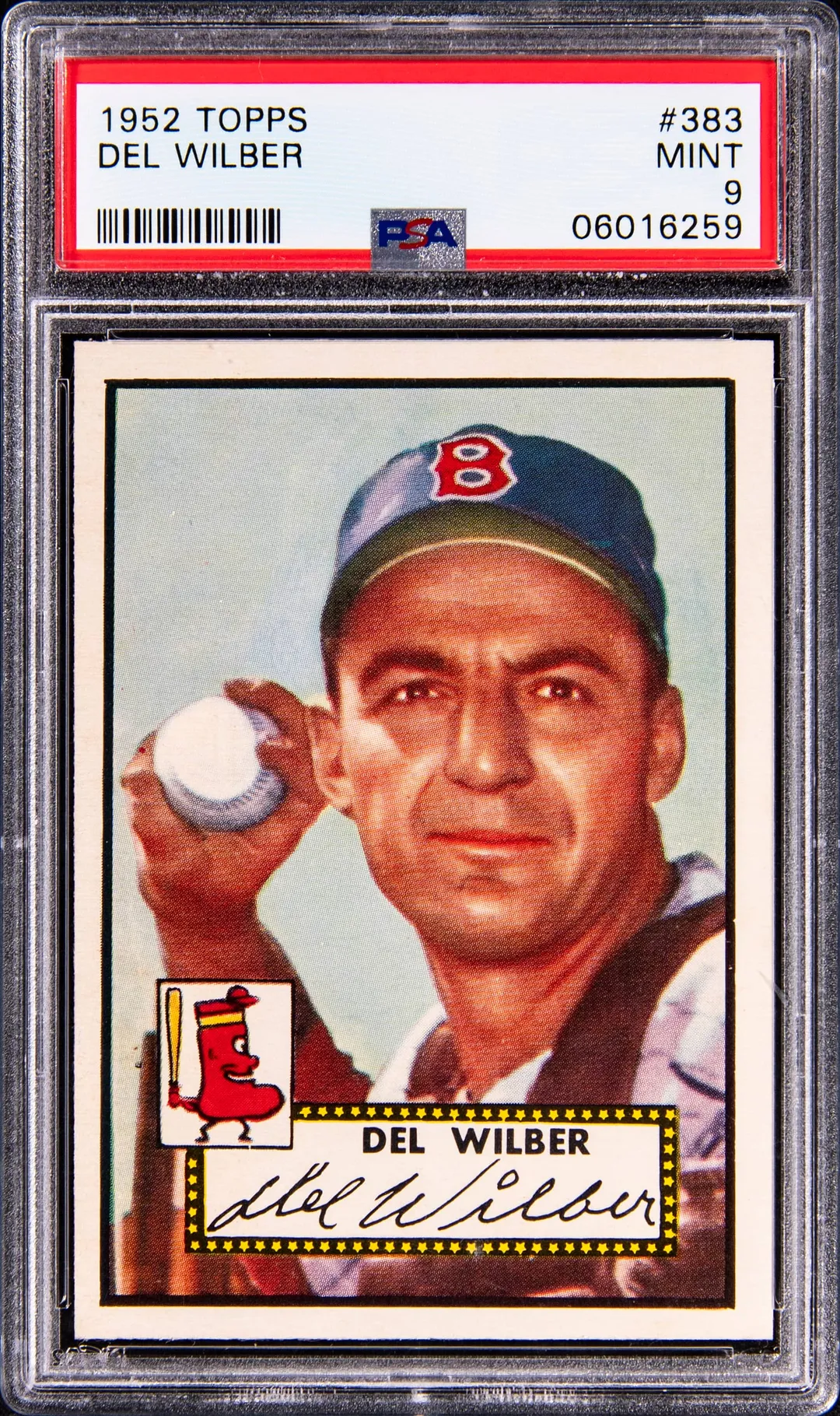
1952 Topps Del Wilber PSA 9 High Number Sells for $16K
Breaking down the $16,104 Goldin sale of a scarce 1952 Topps #383 Del Wilber PSA 9 high number and what it shows about vintage set demand.
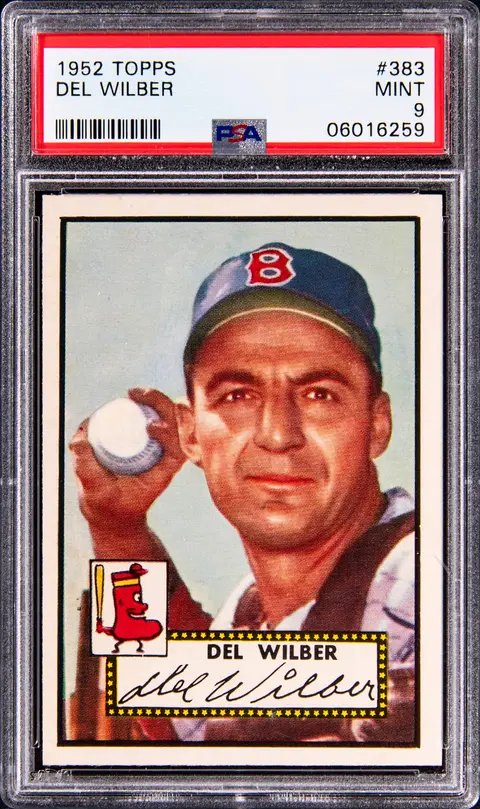
Sold Card
1952 Topps #383 Del Wilber - High Number - PSA MINT 9 - Pop 5; Only 2 Higher PSA Copies
Sale Price
Platform
Goldin1952 Topps #383 Del Wilber in PSA MINT 9 is not the kind of card that usually grabs headlines, but a recent result at Goldin shows how deep collector interest in high-grade vintage really goes.
On February 22, 2026, Goldin sold a 1952 Topps #383 Del Wilber – a high-number series card – graded PSA MINT 9 for $16,104. The PSA population report lists only 5 copies at this grade, with just 2 higher-graded examples in existence. For a mid-tier player, that is an extremely tight supply at the top of the grading scale.
Card overview
- Player: Del Wilber (catcher)
- Team: Boston Red Sox
- Year / Set: 1952 Topps Baseball
- Card number: #383
- Series: High Number (late-series short supply)
- Rookie / key issue: Not a rookie, but a key high-number card in a landmark set
- Grading company: PSA (Professional Sports Authenticator)
- Grade: PSA MINT 9
- Population: Pop 5 in PSA 9, with only 2 higher PSA-graded copies
The 1952 Topps set is widely regarded as the first true modern baseball card set. It introduced the larger card size, colorful portraits, and a checklist structure that shaped the hobby for decades. Within this set, the high-number run (cards #311–407) is significantly tougher than the low and middle numbers, because distribution was limited and much leftover stock was destroyed.
Del Wilber himself is not a Hall of Famer, but his #383 card sits solidly within that challenging high-number range. For collectors who build 1952 Topps registry sets at PSA, this makes a strong example of #383 an important puzzle piece.
Why the PSA 9 matters
In vintage, the combination of condition and set importance often outweighs the player. The Wilber card checks several boxes that serious 1952 Topps collectors look for:
High number scarcity
The high-number series is known for lower print runs and rougher survival. Many copies that do surface show heavy corner wear, centering issues, or print defects. That pushes truly high-grade examples into very low population territory.Condition scarcity at the top
PSA’s pop report (their census of graded copies) shows just 5 examples in PSA 9 and only 2 higher. That means all PSA 9 owners together can fit around a small table, and PSA 10 is essentially unreachable for most collectors.Registry pressure
PSA’s Set Registry ranks collectors who build complete or near-complete graded runs. For a flagship vintage set like 1952 Topps, registry competition is strong. When there are only a handful of PSA 9 copies of a particular high-number card, any one that surfaces can attract multiple advanced buyers trying to upgrade their sets.
Market context and price positioning
This Goldin sale closed at $16,104. For context, here’s how that generally fits with broader trends, based on recent public auction results for similar 1952 Topps high-number PSA 9 commons and semi-commons:
- Well-centered PSA 9 high-number commons from this set often land in the mid four-figure to low five-figure range, depending on eye appeal and exact scarcity.
- Cards with very low populations in 9 (especially when only 1–3 copies exist above that grade) tend to command a premium when they surface, because advanced set builders may have waited years for a shot at upgrading.
The Wilber result at $16,104 comes in toward the upper band of what’s typical for a non-star, low-pop, high-number in PSA 9. Several factors likely contributed:
- Very small pop at the top: Pop 5, only 2 higher, keeps supply tight.
- 1952 Topps set prestige: Even lesser-known players benefit from the overall demand for this specific set.
- Auction format: Goldin routinely reaches serious vintage buyers, which can help fully test the market when a card of this caliber appears.
Because individual high-number cards in PSA 9 don’t come to market frequently, it’s difficult to draw a precise trend line for this exact card. Instead, it’s more useful to see this as one data point within an ongoing pattern: high-grade 1952 Topps high numbers continue to attract strong, steady interest from focused collectors.
Collector significance
This is not a Mantle-level marquee card, and Del Wilber is not driving demand through modern hobby headlines. The significance here is more structural:
A window into how set-building drives value
Many buyers of cards like this are not speculating on player performance. They are slowly building or upgrading a complete 1952 Topps run in high grade. When they finally see a PSA 9 copy of a card with a population of only five, they may be willing to stretch.High-number completion challenge
High numbers are often the barrier to finishing a 1952 Topps set. Even if a collector already owns all the key stars, filling gaps like #383 in high grade can take years.Vintage condition sensitivity
In era terms, this is classic vintage. Most surviving raw copies of 1952 Topps high numbers show the usual 1950s wear: rounded corners, surface wrinkles, edge chipping, and off-centering. The presence of a PSA MINT 9 copy, with sharp corners and strong overall presentation, stands out against that backdrop.
There hasn’t been major recent news around Del Wilber himself that would shift demand. This sale is much more about the ongoing status of 1952 Topps as a cornerstone of the hobby and the scarcity of elite-condition examples.
Takeaways for collectors and small sellers
For newer or returning collectors, this sale offers several practical lessons:
Set and series matter as much as the player
A mid-level player from a legendary set, especially in a tough series, can command strong prices when the card is scarce in top grade.Pop reports are key tools
Checking the PSA population report helps you understand how many examples exist at each grade. A pop of 5 in PSA 9 with only 2 higher tells you this is near the top of the ladder for this card.Comps should be used carefully
"Comps" (comparable sales) are recent, similar sales used to estimate current value. For thinly traded vintage cards like this, exact comps may be sparse. It’s often better to compare the card to similar high-number PSA 9s in the same set rather than to expect a perfect one-to-one comparison.Auction context influences results
A card like this listed on a high-visibility auction platform such as Goldin, with a good description and clear images, can reach the specific audience most likely to value its rarity.
Where this sale fits in the bigger picture
The February 22, 2026 Goldin sale of the 1952 Topps #383 Del Wilber PSA MINT 9 at $16,104 reinforces a consistent theme: for iconic vintage sets, top-grade examples of even non-star high numbers can be meaningful market events.
For collectors, it’s a reminder that building a high-grade 1952 Topps set often requires patience, careful attention to population data, and readiness to act when the right copy finally appears.
For small sellers sitting on raw 1952 Topps cards, especially high numbers, this is a signal to:
- Look closely at condition
- Consider professional grading for sharper examples
- Use population data and recent sales across multiple auction houses when evaluating potential price ranges
This Del Wilber sale won’t change the broader hobby on its own, but it’s a clear, data-backed snapshot of how deeply collectors still care about the flagship 1952 Topps set and the rare, high-grade survivors within it.