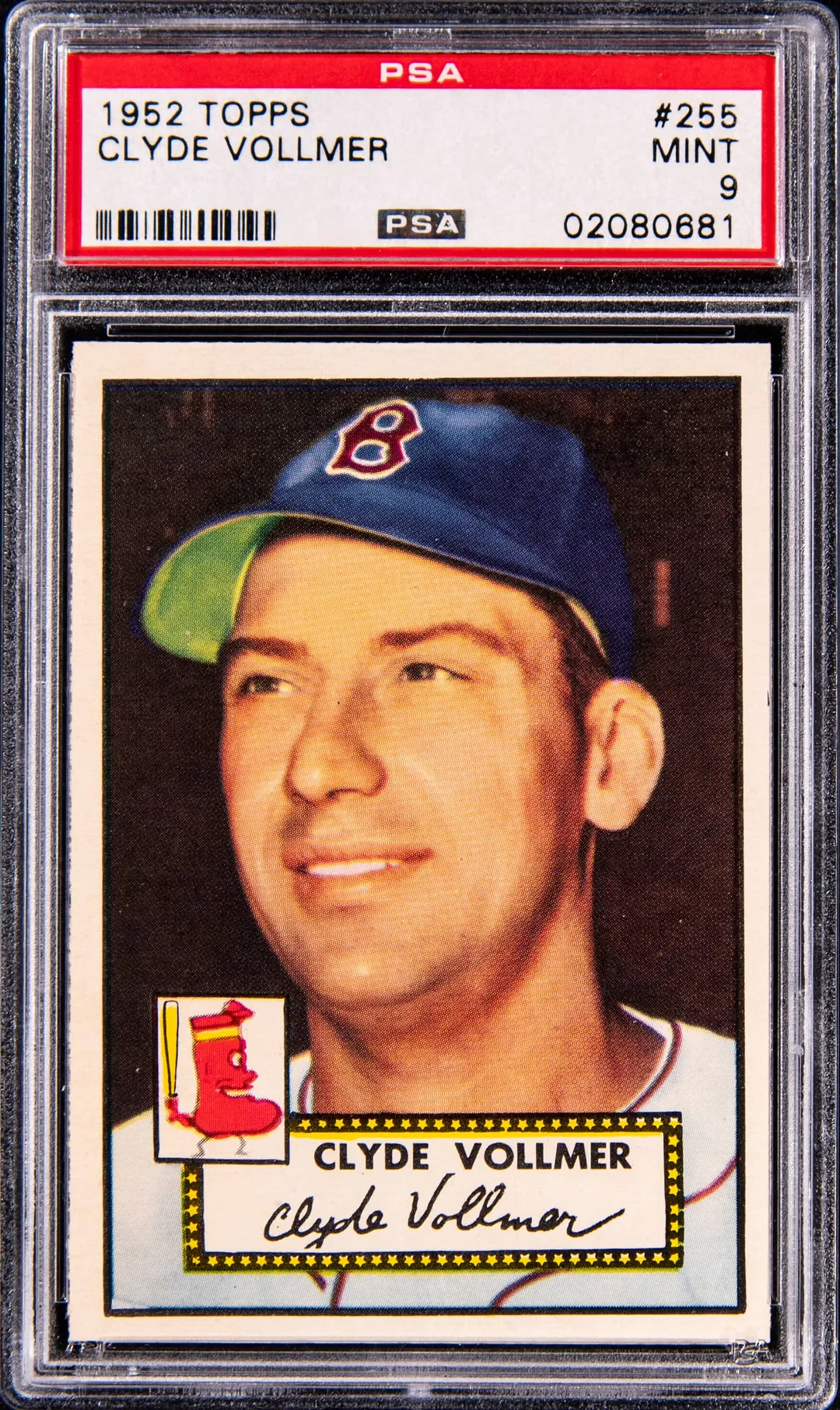
1952 Topps Clyde Vollmer PSA 9 Sells for $17,934
Goldin sold a 1952 Topps #255 Clyde Vollmer PSA 9 for $17,934. See how this Pop 6, top-pop vintage card fits into the 1952 Topps market.
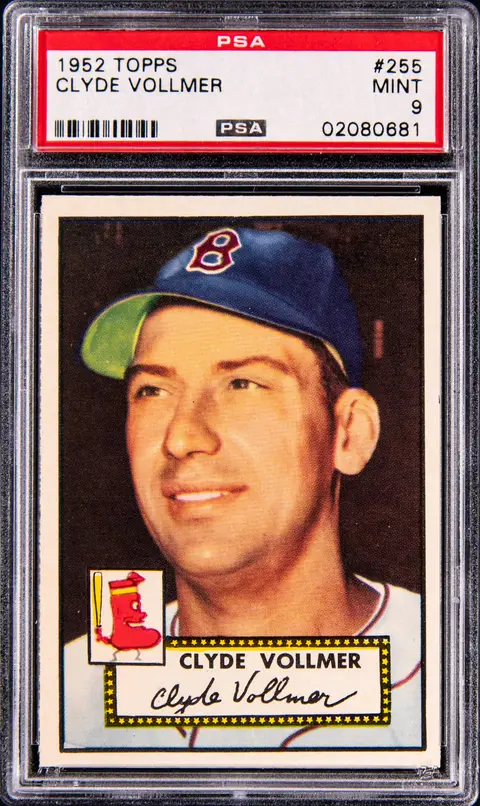
Sold Card
1952 Topps #255 Clyde Vollmer - PSA MINT 9 - Pop 6; Highest PSA Copy
Sale Price
Platform
GoldinA PSA 9 Clyde Vollmer Joins the 1952 Topps Elite
On February 22, 2026, Goldin sold a 1952 Topps #255 Clyde Vollmer graded PSA MINT 9 for $17,934. For a role player from the early 1950s, that number might surprise new or returning collectors. But once you zoom out and look at the 1952 Topps set, the PSA population report, and how advanced vintage collectors think, this result starts to make a lot more sense.
In this post, we’ll walk through what the card is, why it matters, and how this sale fits into the broader 1952 Topps market.
Card basics: 1952 Topps #255 Clyde Vollmer
Here’s how this card breaks down in hobby terms:
- Player: Clyde Vollmer (outfielder)
- Team: Boston Red Sox
- Year: 1952
- Set: 1952 Topps Baseball
- Card number: #255
- Parallel/variant: Standard base card (no parallel)
- Rookie or key card: Not a rookie; collected primarily as part of the 1952 Topps run
- Grading company: PSA (Professional Sports Authenticator)
- Grade: PSA MINT 9
- Population: Pop 6 in PSA 9, with none higher noted in the listing (effectively a “top pop,” or highest-graded example)
There’s no autograph, patch, or serial numbering here. The appeal is purely about vintage condition rarity: a high-grade copy of a 1950s flagship card from one of the most important sets in the hobby.
Why a Clyde Vollmer can matter this much
For many collectors, Clyde Vollmer himself is not the draw. The draw is:
- The 1952 Topps set
- The condition scarcity in PSA 9
- The desire for registry-quality examples
A few key points about 1952 Topps:
- It is widely viewed as the first truly modern, large-format baseball set.
- It’s the home of the iconic Mickey Mantle #311 and several other key stars.
- It marks the beginning of Topps’ long run as the dominant baseball card producer.
Because of that, advanced set builders and registry competitors often target high-grade examples of even the lesser-known players. When collectors talk about the “flagship” set for 1950s Topps, 1952 is at the very top of the list.
This Vollmer is card #255, firmly in the middle of the checklist and part of the run that set builders need to complete high-grade sets. For a PSA Set Registry participant—someone assembling a graded set and competing on average grade—each PSA 9 in a tough 1950s issue is a critical piece.
Grading, population, and why PSA 9 matters
PSA’s 10-point grading scale ranges from PR 1 (Poor) to GEM-MT 10 (Gem Mint). A PSA 9 is defined as MINT: sharp corners, strong gloss, and very minor, if any, visible flaws.
Vintage cards from 1952 face several built-in obstacles:
- Original production quality: Centering and print defects were common.
- Distribution and handling: Cards were often flipped, traded, rubber-banded, or stored loosely.
- Long-term storage: Decades of exposure to moisture, light, and pressure took a toll.
As a result, PSA 9 examples from 1952 are extremely hard to find. The PSA “pop report” (population report) tracks how many copies of a card have been graded at each grade level. A Pop 6 in PSA 9, with no higher grade noted, places this Vollmer in very rare company:
- Only six PSA 9s exist.
- Collectors have no PSA 10 option.
For registry-focused collectors, that combination—low PSA 9 population and no PSA 10—can push demand higher than the player’s name value alone would suggest.
Market context: how does $17,934 fit in?
This 1952 Topps #255 Clyde Vollmer PSA 9 sold at Goldin on February 22, 2026, for $17,934.
To understand that number, it helps to look at a few things:
- Recent comps
“Comps” (comparable sales) are recent sales for the same card or very similar versions. Public data for this exact card in PSA 9 is thin, which is common when population is this low. That scarcity means every new auction can reset expectations.
Where more information does exist is in related areas:
- Lower-grade Vollmer examples (PSA 7, PSA 8) typically sell for a small fraction of this price. The jump from PSA 8 to PSA 9 in 1950s Topps can be steep because condition-sensitive set builders are effectively bidding on the top of the population.
- Other mid-tier 1952 Topps commons and semi-stars in PSA 9 have also seen strong results when pop counts are low and no 10s exist. Exact prices vary by player, scarcity, and centering, but the pattern is consistent: large premiums for truly top-pop vintage.
- Comparing to the wider 1952 Topps market
This Vollmer sale sits within a broader context:
- Star cards and Hall of Famers from 1952 Topps in PSA 9 often command five- and six-figure prices.
- High-grade “commons” (non-star players) in this set have evolved into serious targets once collectors realized how few PSA 9s exist.
Within that landscape, $17,934 places this Vollmer as a meaningful but not extreme result: expensive for a non-star, but consistent with how advanced collectors treat top-pop 1952 Topps cards.
- Is this price high, low, or typical?
Given the limited public sales history for PSA 9 copies and the Pop 6 / top-pop status, this Goldin sale looks like the kind of strong result you’d expect when:
- Two or more registry or master-set collectors are competing.
- The auction house has solid visibility in the vintage market.
Rather than labeling it “cheap” or “expensive,” it’s more accurate to see this as a data point that helps define the modern market for high-grade 1952 Topps non-stars.
Collector significance: beyond stars and rookies
This card is not a rookie card, nor is Clyde Vollmer a Hall of Famer. Still, it checks several boxes that matter to serious vintage collectors:
- Iconic set: Being part of 1952 Topps is a major driver of interest.
- Era: The pre-1960s vintage era tends to have lower surviving populations and tougher grading conditions than later decades.
- Condition scarcity: Pop 6 in PSA 9 with no known higher grade makes this a true top-tier example.
- Registry utility: For collectors building graded master sets or chasing the top spot in the PSA Set Registry, each PSA 9 like this is crucial.
Because Vollmer himself isn’t a modern hobby headline, this particular sale is likely driven more by set and grade than player news. Unlike modern or ultra-modern cards, where player performance can swing prices quickly, vintage commons in elite condition tend to track more slowly with overall vintage demand and set-builder competition.
What this sale can teach newer and returning collectors
If you’re newer to collecting or returning after a long break, a $17,934 price tag for a non-star might feel puzzling. Here are a few takeaways:
- Set matters
Certain sets—like 1952 Topps—carry their own gravity. Being part of a historically important release can raise the floor for nearly every card in the checklist when condition is elite.
- Grade and population can outweigh the name
In vintage, especially pre-1960, high-grade copies can be significantly rarer than most modern serial-numbered parallels. A Pop 6 PSA 9 with no PSA 10s is effectively a short print in practical terms, driven by survival and condition rather than factory numbering.
- Registry competition is real
The PSA Set Registry has turned high-grade condition into a collecting objective of its own. Collectors aiming for the highest possible average grade will pay premiums to secure top-pop examples, even of lesser-known players.
- Use comps as a guide, not a promise
Recent sales, like this Goldin result from February 22, 2026, are best used as reference points. They reflect what one buyer was willing to pay at one moment in time, in one auction environment, not a guaranteed future price.
Final thoughts
The 1952 Topps #255 Clyde Vollmer PSA MINT 9 that sold at Goldin for $17,934 on February 22, 2026, is a reminder that vintage value isn’t reserved only for big names and rookie cards. In the right set, at the right grade, and with the right population profile, a so-called “common” can become a key piece of a serious collection.
For collectors and small sellers, tracking results like this helps build a clearer picture of how the market rewards scarcity, condition, and set importance—even when the player on the front isn’t a household name.