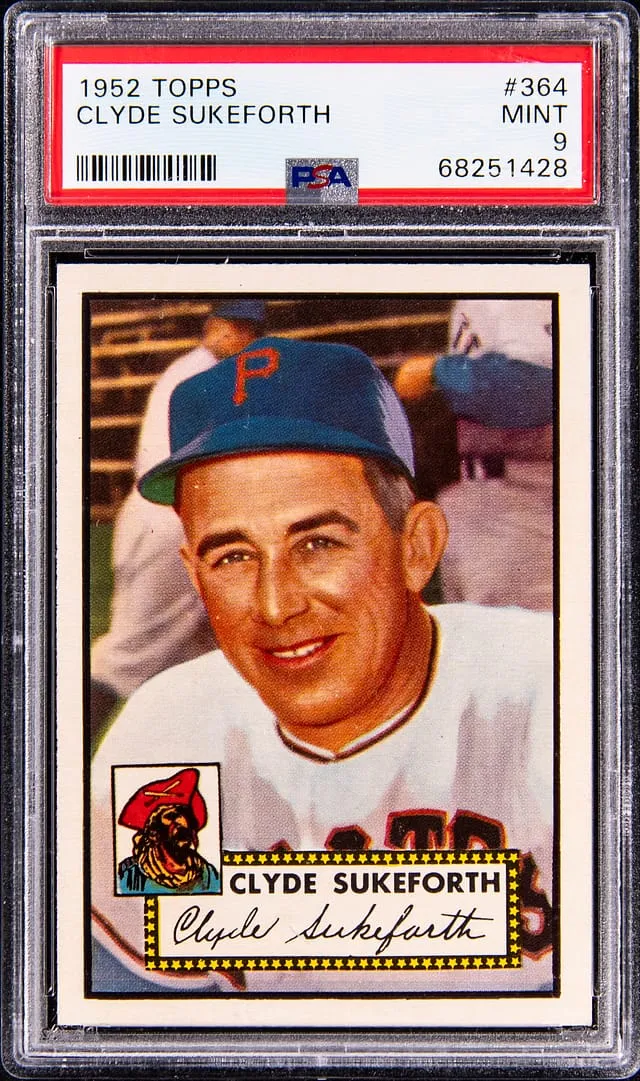
1952 Topps Clyde Sukeforth PSA 9 sells for $15.6K
Goldin sold a 1952 Topps #364 Clyde Sukeforth PSA 9 high number for $15,555. See the pop data, context, and what it means for vintage collectors.
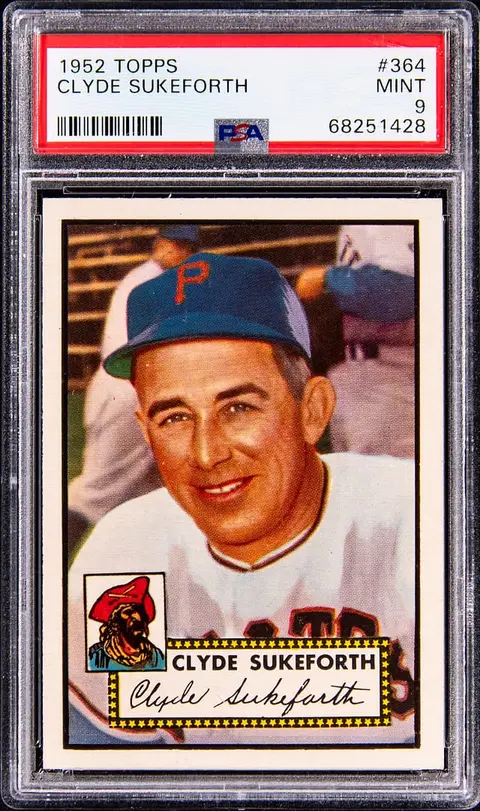
Sold Card
1952 Topps #364 Clyde Sukeforth - High Number - PSA MINT 9 - Pop 7; Only One Higher PSA Copy
Sale Price
Platform
Goldin1952 Topps #364 Clyde Sukeforth PSA 9 Sells for $15,555 at Goldin
The 1952 Topps baseball set is one of the true cornerstones of the vintage hobby, and it continues to produce eye‑opening sales well beyond the iconic Mantle. A recent example is the February 22, 2026 Goldin sale of a 1952 Topps #364 Clyde Sukeforth, graded PSA MINT 9, which closed at $15,555.
For a seemingly modest name, that’s a serious result. Let’s break down why this card matters and how this sale fits into the broader vintage market.
Card overview
- Player: Clyde Sukeforth
- Team: Brooklyn Dodgers
- Year / Set: 1952 Topps Baseball
- Card number: #364
- Subset / variation: High‑number series (no known parallel or image variation for this base card)
- Rookie or key issue? Not a rookie card, but a key high‑number from a landmark set
- Grading company: PSA (Professional Sports Authenticator)
- Grade: PSA MINT 9
- Population: PSA population report shows 7 copies in PSA 9, with only 1 copy graded higher (a PSA 10).
This is a standard base card, not an autograph, memorabilia, or serial‑numbered card. The appeal here is driven almost entirely by:
- The importance of the 1952 Topps set itself.
- The difficulty of finding high‑number cards in top condition.
- The extreme scarcity of PSA 9 and PSA 10 examples.
Why 1952 Topps high numbers are a big deal
1952 Topps is widely viewed as Topps’ first full‑scale, modern‑style baseball release. It’s the set that helped define the visual language of the modern card: player photo, team logo, facsimile signature, and a substantial card size.
Within that already important set, the high‑number series (cards #311–407) occupies a special place. These high numbers are:
- Much tougher to find than low and middle numbers, partly due to regional distribution and smaller production runs.
- Scarcer in high grade because many were handled, pin‑holed, rubber‑banded, or stored poorly.
Collectors often treat high numbers as a project of their own. Completing the full 1952 Topps run in high grade becomes significantly harder once you enter the #311–407 range. Cards like Sukeforth’s #364 become important “checklist hurdles” even if the player isn’t a Hall of Famer.
Who was Clyde Sukeforth?
Clyde Sukeforth isn’t a household name for casual fans, but he has an under‑the‑radar historical importance:
- Longtime catcher and coach, best known for his work with the Brooklyn Dodgers.
- Deeply involved behind the scenes in the Dodgers’ scouting and integration efforts.
- Often noted in baseball history circles as one of the figures connected to Jackie Robinson’s early days with the Dodgers.
That behind‑the‑scenes historical role gives his 1952 Topps card a bit of extra interest to baseball historians and team collectors, even though his on‑field playing stats don’t drive big demand on their own.
Grading, population, and scarcity
A key part of understanding this sale is the PSA population report, sometimes called the “pop report.” This is PSA’s count of how many copies of a card they’ve graded at each grade level.
For the 1952 Topps #364 Clyde Sukeforth:
- PSA 9 (MINT): 7 copies
- Higher than PSA 9: 1 copy (a single PSA 10)
In practical collecting terms, this means:
- There are only seven examples at this elite MINT level.
- Anyone aiming for a near‑gem 1952 Topps high‑grade set has very few options.
- The true top of the market is effectively shared between the lone PSA 10 and these handful of PSA 9s.
In vintage, especially 1950s cardboard, PSA 9 is often considered “investment‑grade” or “registry grade.” Even mid‑level players can command strong prices once you combine a key set, high‑number status, and pop‑report scarcity.
Market context and recent sales
Publicly available sales data for this exact card in PSA 9 is sparse, largely because so few copies exist and they do not trade frequently. For niche high‑number commons and semi‑stars in PSA 9, sales often appear only every few years across major auction houses.
To frame this Goldin result:
This Goldin sale:
- Auction house: Goldin
- Date (UTC): February 22, 2026
- Final price: $15,555
Other high‑grade 1952 Topps high numbers:
While specific comps (comparable sales) for this exact card and grade are limited, it’s relatively common to see PSA 9 high numbers—especially for scarcer names—hammer from the mid‑four figures into the low‑five‑figure range, depending on player, centering, eye appeal, and timing.Lower‑grade examples of Sukeforth #364:
Lower‑grade copies (PSA 5 to PSA 7 range) typically sell at a much more accessible level. Those prices underline the premium that set‑registry and condition‑focused collectors are willing to pay for a card near the top of the pop report.
Because of the small population and infrequent movement, it’s hard to call this sale definitively “high” or “low” relative to some objective long‑term average. What we can say is:
- A $15K+ result for a non‑Hall of Famer high number shows how strong the market remains for top‑tier 1952 Topps examples.
- The pop 7, one higher status likely plays a central role. Cards with this kind of population profile can draw competitive bidding from set builders aiming for top positions on PSA’s Set Registry.
Vintage era dynamics
This card lives firmly in the vintage era, which is typically considered pre‑1980 in the hobby. Vintage has a few characteristics that affect pricing and demand:
- Natural scarcity: Printing practices, distribution, and decades of handling mean fewer well‑preserved copies.
- Condition sensitivity: Small flaws—centering, print quality, corner wear—make PSA 8, 9, and 10 examples especially rare.
- Set‑driven demand: Collectors are often chasing full runs (like the complete 1952 Topps set), not just stars. That lifts the value of better‑condition cards of role players and coaches.
Within this environment, a card like Sukeforth’s 1952 Topps #364 can become a “must‑own” piece for a small but dedicated group:
- High‑grade 1952 Topps set collectors trying to climb the PSA registry rankings.
- Brooklyn Dodgers team collectors who prefer uniform, high‑grade runs.
- Collectors of baseball history and integration era figures who look beyond superstar names.
How to read this result as a collector
For newer or returning collectors, a $15,555 sale for a non‑star might look puzzling at first glance. A few key takeaways help it make sense:
Set and series matter as much as the player.
1952 Topps is a flagship vintage set, and the high‑number series is famously tough. That structure drives demand beyond pure player popularity.Population and grade are critical.
With only 7 copies in PSA 9 and just 1 known PSA 10, this card is nearly at the top of its grading ladder. Registry competition and condition scarcity can create steep price tiers from PSA 7 to PSA 8 to PSA 9.Infrequent sales create wide bands of "normal."
When a card trades rarely, each auction becomes a small data point rather than a perfectly precise market reading. It’s more useful to see this Goldin result as a confirmation that high‑grade 1952 Topps high numbers remain healthy than as a rigid price anchor.This is not a short‑term speculation story.
Cards like this typically live in long‑term collections and set registries, not fast‑flipping cycles. The ultimate buyer is likely someone who values decades‑long significance of the 1952 set.
What this might mean for similar cards
This Goldin sale offers a few signals for those who own, or are looking at, comparable vintage pieces:
Other 1952 Topps high‑number PSA 9s:
The result supports the idea that well‑centered, clean PSA 9 high numbers—even of non‑stars—can justify strong price levels when they come to auction.PSA 8 examples:
When pop in PSA 9 is extremely low, PSA 8 often becomes the reachable “high‑end” grade for more collectors. Tracking PSA 8 sales of this card and similar ones can offer a more active market reference.Unslabbed raw copies:
Raw high numbers from 1952 Topps with strong eye appeal might be worth a closer look. Even if they grade below 9, understanding where the graded market lands can help collectors decide whether grading is sensible for their own collections.
Final thoughts
The February 22, 2026 Goldin auction of the 1952 Topps #364 Clyde Sukeforth PSA MINT 9 at $15,555 is another reminder that vintage set‑building and condition scarcity remain powerful forces in the hobby.
This isn’t a headline dominated by a superstar or a modern parallel; it’s a high‑number card of a historically interesting baseball figure from one of the most important sets ever printed. For collectors who focus on long‑term significance, pop‑report nuance, and the craft of building great vintage sets, it’s exactly the kind of sale worth noting.
As always, this information is best used as context rather than a prediction. Markets evolve, especially in thinly traded corners like high‑grade 1950s high numbers. But for now, sales like this show that the foundation of vintage baseball—led by sets like 1952 Topps—remains very much intact.