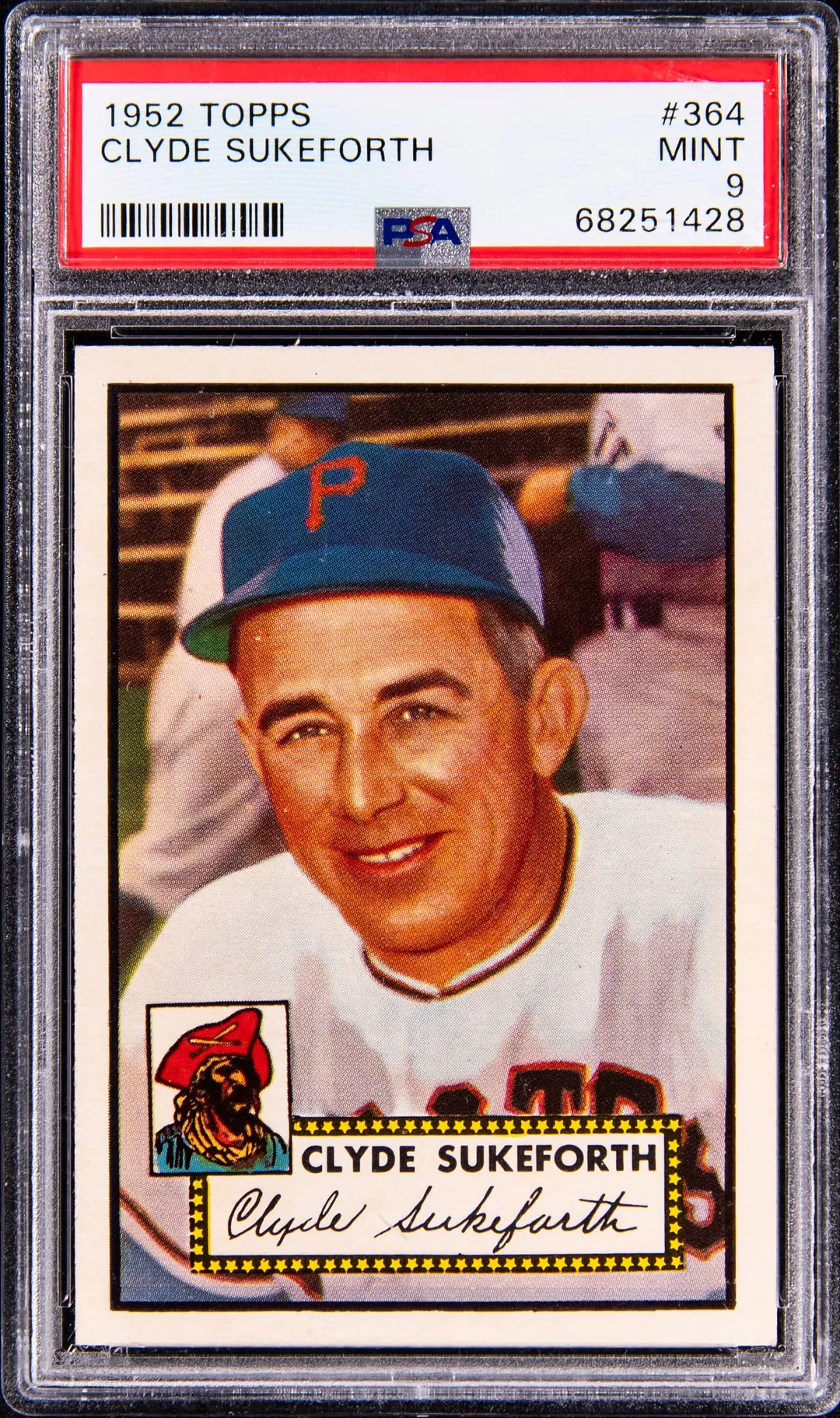
1952 Topps Clyde Sukeforth PSA 9 High Number Sale
Goldin sold a 1952 Topps #364 Clyde Sukeforth high-number PSA 9 for $15,555. Pop 7 with only one higher. Here’s what that means for collectors.
Sold Card
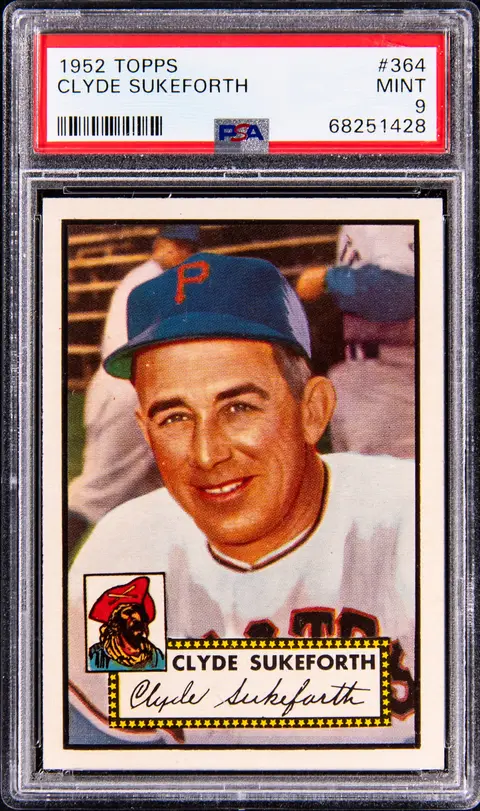
1952 Topps #364 Clyde Sukeforth - High Number - PSA MINT 9 - Pop 7; Only One Higher PSA Copy
Sale Price
Platform
GoldinA $15,555 sale for a non-star coach card from 1952 Topps is the kind of result that makes vintage collectors take a closer look at the fine print.
On February 22, 2026, Goldin sold a 1952 Topps #364 Clyde Sukeforth – High Number – graded PSA MINT 9 – for $15,555. The PSA population report lists just 7 copies in PSA 9, with only one example graded higher. For a set as heavily collected as 1952 Topps, that kind of grade scarcity matters as much as the name on the front.
The card at a glance
- Player: Clyde Sukeforth (Brooklyn Dodgers coach)
- Team: Brooklyn Dodgers
- Year / Set: 1952 Topps Baseball
- Card number: #364
- Subset: High-number series
- Grading company: PSA (Professional Sports Authenticator)
- Grade: PSA MINT 9
- Population (PSA): Pop 7 in PSA 9, with only 1 higher
- Attributes: Standard base card; no autograph or relic, but considered a tough high-number from a key vintage set
This is not a rookie card of a Hall of Fame player, and it is not a parallel or short-print variant. Instead, its importance comes from three factors that vintage collectors know well:
- It is part of the iconic 1952 Topps set.
- It sits in the tough high-number run (#311–407).
- It is a top-of-the-pop (near highest graded) example.
Why Clyde Sukeforth matters to collectors
Clyde Sukeforth himself is a deeper-cut name tied to baseball history more than hobby fame. He was a longtime coach and scout and is often remembered for his role in scouting and supporting Jackie Robinson’s signing with the Dodgers. That kind of historical connection gives the card a layer of appeal for collectors focused on baseball history, integration, and the Brooklyn Dodgers’ era.
For hobby purposes, though, this card’s demand is driven less by star power and more by:
- Team collectors chasing Brooklyn Dodgers cards from the early Topps years
- Set builders working on 1952 Topps in high grade
- High-number specialists who understand how much tougher the last series is to find clean
1952 Topps and the high-number challenge
1952 Topps is widely treated as the first true flagship Topps baseball release – essentially the company’s main annual set, with full player photos, stats, and a large checklist. It is best known for the Mickey Mantle #311, but the full checklist has become a cornerstone project for vintage collectors.
The set is split into multiple series. The high numbers (generally cards #311–407) are scarcer for several reasons, including late-season distribution and unsold stock that was reportedly destroyed. For collectors, that means:
- Fewer surviving copies overall
- A much smaller pool of well-centered, clean examples
- Large price gaps between mid-grade and top-grade copies
Clyde Sukeforth at #364 sits firmly in that high-number zone. Even if raw copies are not impossible to find, getting one that survives the grading process with a MINT 9 grade is extremely difficult.
Grade, pop report, and scarcity
A pop report (population report) is a grading company’s public count of how many copies of a card exist at each grade level. For this card, PSA currently shows:
- PSA 9: 7 copies
- Higher than PSA 9: Only 1 copy in the entire PSA census
In practical terms, that means every collector who prefers PSA slabs and wants a near-ideal example of this card is chasing a pool of just 8 realistically “elite” copies worldwide.
Because 1952 Topps is such a popular set, competition for those few premium-grade examples can be strong, especially when they surface at a major auction house like Goldin.
Market context and recent sales
Public sales data for this exact card in PSA 9 is relatively thin, which is typical when the population is so low. High-grade vintage commons and semi-commons in 1952 Topps tend to trade infrequently, often via auction rather than fixed-price listings.
Looking across available historical results for 1952 Topps high-number PSA 9s (especially non-star players), a few patterns show up:
- PSA 9 high numbers can range from a few thousand dollars into the mid five figures, depending on player, pose, centering, and timing.
- Star and key cards (Hall of Famers, hobby favorites) command a large premium over coaching or lower-profile subjects.
- Commons in PSA 9 from the high-number run can still surprise on price if they are particularly well-centered or rarely seen.
Within that context, the $15,555 result for this Clyde Sukeforth PSA 9 is notable but not shocking:
- It reflects the combination of 1952 Topps brand strength and high-number scarcity.
- It slots into the mid-range of what strong, high-grade high numbers can do when they surface in a major catalog auction.
- The very tight PSA pop at the top end (7 in 9, 1 higher) supports a premium over more plentiful 1952 Topps mid-numbers or low numbers.
Without a long list of recent, public PSA 9 comps for this exact card, it’s hard to say if this is a new record for Sukeforth in this grade, but the number is consistent with how the market has been valuing condition-sensitive high numbers in this set.
Vintage era dynamics
This card comes from the vintage era (roughly pre-1970s), where scarcity and condition play a larger role than modern insert-driven chase elements. A few dynamics help explain why a non-star can still reach five figures:
- True scarcity in high grade: Fewer cards were printed and fewer survived in pack-fresh condition. Mis-cuts, poor centering, and print defects were common in 1950s production.
- Set-building pressure: 1952 Topps master sets in high grade are long-term projects. When a missing high-number in PSA 9 pops up, set builders often compete aggressively.
- Stable nostalgia: Demand isn’t driven by short news cycles or hype; it’s based on the enduring historical importance of the set.
This is very different from the modern and ultra-modern eras (mid-2000s onward), where low-serial-number parallels, autographs, and patches act as the main chase. Here, the chase is the card’s condition within a historically important checklist.
Why this sale matters to collectors
For active hobbyists and small sellers, the Goldin sale of this 1952 Topps #364 Clyde Sukeforth PSA 9 on February 22, 2026 offers a few useful takeaways:
Condition can outweigh star power. A MINT 9 high-number common from a major vintage set can outperform many modern autograph or serial-numbered cards.
High numbers deserve closer inspection. If you own 1952 Topps (or similar era) cards, it is worth checking which ones are high numbers and whether the centering and corners might justify grading.
Population reports are key tools. When population is this low at the top, each copy that surfaces can influence the perceived market range. Pop data explains why two cards from the same set with similar eye appeal may have very different prices.
Auction houses amplify visibility. A rare grade and iconic set, when paired with a major auction platform like Goldin, can bring more bidders and clearer price discovery than smaller venues.
How newcomers can use this data
If you are newer or returning to the hobby, here are practical ways to use a sale like this without treating it as a price guarantee:
Use it as a benchmark, not a target. A single auction result shows where at least two motivated bidders were willing to meet. It does not guarantee the next copy brings the same number.
Compare across grades. Look at PSA 5–8 copies of the same card to understand how much of the price is tied to jumping into that top 1–2 grade tiers.
Study the card’s eye appeal. Centering, color, and print quality all matter, even within the same grade. High-end buyers will pay more for a strong example.
Think in terms of sets and eras. Instead of chasing just one sale, consider how 1952 Topps high numbers are behaving as a group. That often gives a more reliable picture than any single auction.
Final thoughts
The February 22, 2026 Goldin sale of the 1952 Topps #364 Clyde Sukeforth PSA MINT 9 at $15,555 is a concise snapshot of how the vintage market values rarity, condition, and set history over headline names.
For collectors, it reinforces a simple idea: in the right era and the right set, a seemingly modest subject can become an important card once you reach the very top of the grading scale. Understanding that dynamic is one of the keys to navigating – and appreciating – the vintage side of the hobby.