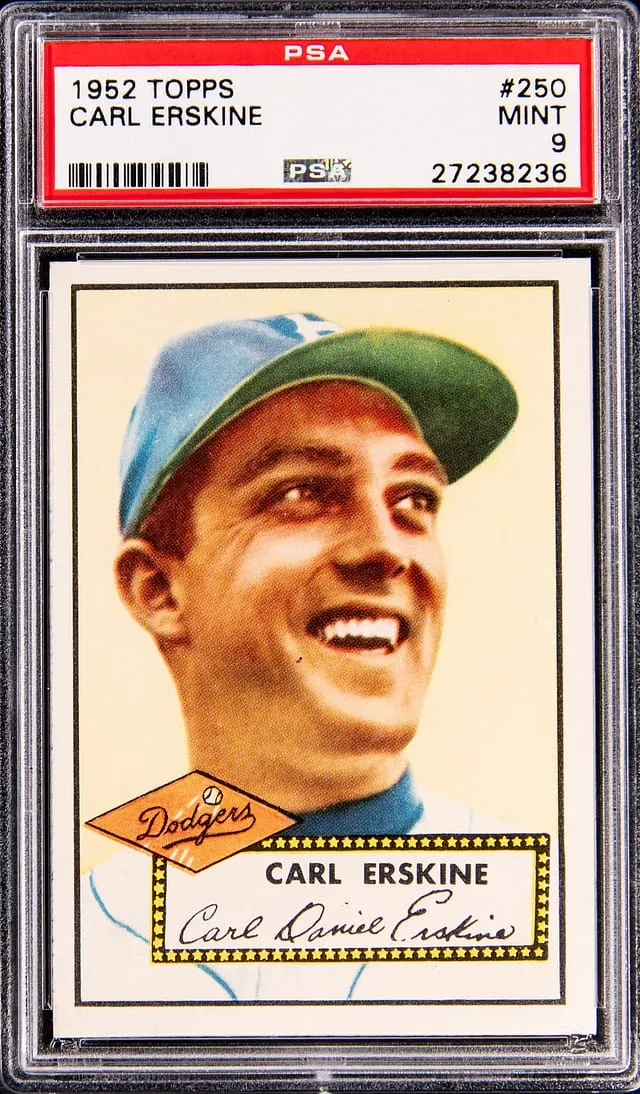
1952 Topps Carl Erskine PSA 9 sells for $30,500
Goldin’s $30,500 sale of a 1952 Topps #250 Carl Erskine PSA 9 pop 3 shows how top-pop vintage from iconic sets can command strong prices.
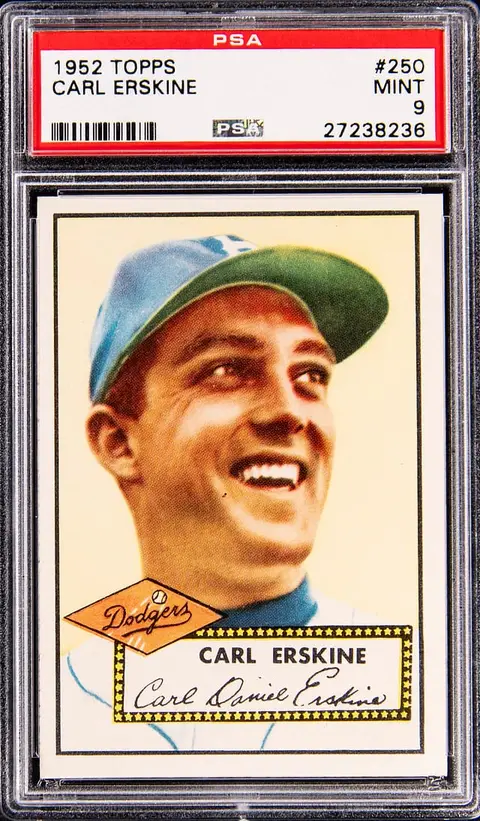
Sold Card
1952 Topps #250 Carl Erskine - PSA MINT 9 - Pop 3; Highest PSA Copy
Sale Price
Platform
Goldin1952 Topps Carl Erskine PSA 9 Sells for $30,500: Why This Pop 3 Mint Matters
On February 22, 2026, Goldin sold a 1952 Topps #250 Carl Erskine graded PSA MINT 9 for $30,500. For most collectors, Erskine is a beloved Brooklyn Dodgers pitcher, but not necessarily a headline name. So why did this card, in this grade, command that kind of number?
At figoca, we like to unpack these results in a way that’s useful for everyday collectors and small sellers: looking at the card itself, the population report, recent sales (“comps”), and the broader vintage market context.
The Card at a Glance
- Card: 1952 Topps Carl Erskine
- Card number: #250
- Player: Carl Erskine, Brooklyn Dodgers (pitcher)
- Year / Set: 1952 Topps Baseball
- Grading company: PSA (Professional Sports Authenticator)
- Grade: PSA MINT 9
- Population: Pop 3 in PSA 9, with no PSA 10s reported at the time of sale
- Rookie card? Not considered his true rookie; this is a key early Topps issue rather than a flagship rookie
The 1952 Topps set is one of the most important vintage baseball releases. It’s Topps’ first major, fully realized baseball issue and includes the famous Mickey Mantle #311, Jackie Robinson #312, and numerous Hall of Famers. Even non‑star players from this set draw steady attention because of the set’s historical weight.
Carl Erskine was a reliable starter for the Brooklyn Dodgers in the 1950s and pitched in multiple World Series. While not a Mantle‑level name, he is tied to an iconic franchise era and remains a favorite among Brooklyn Dodgers and vintage team collectors.
Why PSA 9 Matters So Much Here
When collectors talk about “pop report,” they mean the grading company’s population report: how many copies exist at each grade. For vintage, especially from the early 1950s, high grades are rare because of how cards were printed, handled, and stored.
For this card:
- PSA 9 population: 3 copies
- PSA 10 population: 0 copies
That makes PSA 9 the highest graded tier available and very tough to replace. For registry collectors—people trying to build the highest‑graded possible 1952 Topps set—this matters a lot. There are only three chances in the market to own the top‑graded example of this card.
In practical terms:
- Condition‑sensitive early Topps cards often show poor centering, print defects, and edge wear.
- A PSA 9 from 1952 means near‑perfect centering, color, and surface by vintage standards.
- With no PSA 10s, a PSA 9 is effectively the “best of the best” for this issue.
That combination of set importance + pop scarcity + registry demand is what allows a non‑Hall of Famer like Erskine to reach a five‑figure price.
Market Context and Recent Sales
When people talk about “comps” in the hobby, they mean comparable recent sales: the same card, or very close versions (different grades, same card), sold in public auctions or major marketplaces.
For the 1952 Topps Carl Erskine #250, public sales in PSA 9 are rare because there are only three graded at that level. Most comps come from:
- Lower PSA grades (PSA 7–8)
- Raw (ungraded) copies
- Occasional high‑grade vintage auction results
As of this sale:
- Mid‑grade copies (PSA 5–6) have typically traded in the low hundreds of dollars, depending on eye appeal and auction venue.
- High‑grade copies (PSA 7–8) tend to move into the upper hundreds or low four‑figure range when well‑centered, reflecting the overall demand for clean 1952 Topps examples.
- MINT 9 copies appear so infrequently that there isn’t a tight, predictable range of public comps. Each appearance becomes something of a price discovery event.
The $30,500 result at Goldin is therefore best viewed as:
- A top‑of‑market, registry‑driven price for a non‑star in a legendary set.
- A reflection of how collectors value the very highest grades of 1952 Topps, even when the player is not a Hall of Famer.
- A reminder that pop‑3, top‑pop vintage can move in a very different price band than the same card only one or two grades lower.
It’s not accurate to compare this price directly to a PSA 7 and say the card is “over” or “under” some formula. From PSA 8 to PSA 9 in vintage, the market often applies a premium that’s disproportionate to the visual difference, because the supply drops so sharply.
Why Collectors Care About 1952 Topps
The 1952 Topps baseball set has several things going for it:
- Historical importance: It’s the first full‑scale, modern‑feeling Topps baseball set.
- Design: Large format, colorful portraits, and a clean layout that still feels classic.
- Roster: Anchored by stars like Mickey Mantle, Jackie Robinson, Willie Mays (in other sets that year), and many memorable Dodgers and Yankees.
- Condition scarcity: Many cards were poorly centered or printed on imperfect stock. High‑grade survivors are tough.
Because of that, collectors often build 1952 Topps sets in graded form. The PSA Set Registry, where collectors compete to assemble the highest‑graded sets, is a major demand driver. A pop‑3 PSA 9 with no 10s effectively functions as a bottleneck: if you want a top‑ranked set, this is one of the few cards you must secure at the highest known grade.
Carl Erskine himself adds a softer but real layer of appeal:
- Member of the “Boys of Summer” Brooklyn Dodgers teams.
- Pitched in multiple World Series during the Dodgers’ golden era.
- A popular figure in Brooklyn Dodgers history and among team collectors.
So while this is not a Mantle, the combination of set, team, and grade makes it a meaningful piece for certain collectors.
Reading the $30,500 Result
The Goldin sale on February 22, 2026, at $30,500 sits at the intersection of three forces:
Vintage scarcity in top grades
Early 1950s cards in PSA 9 or better are thinly supplied. When they surface, they can reset expectations for what non‑star vintage can bring in elite condition.Set registry competition
Pop‑3 with no 10s means any one of a small number of advanced collectors can decide the final number if they need the card to improve or complete a high‑ranking set.Stable interest in iconic sets
While the overall modern and ultra‑modern markets can be cyclical, cornerstone vintage sets like 1952 Topps tend to attract steady attention. Prices may move up or down over time, but the underlying collector base is deep and long‑term.
For active hobbyists and small sellers, the key takeaway is not that every 1950s non‑star is a hidden five‑figure card. Rather, it’s that condition and population are central to vintage pricing:
- A PSA 5 and a PSA 9 of the same card can live in completely different market worlds.
- Population reports and registry demand can matter as much as the player’s name.
What This Means for Collectors and Small Sellers
If you’re exploring vintage or already own early 1950s Topps:
- Check the pop report. Even for non‑Hall of Famers, a low population in top grade can drive strong auction results.
- Look closely at centering and surface. Submitting a truly sharp raw 1952 Topps might unlock significant value if it grades well, especially PSA 8 or better.
- Use comps carefully. For thinly traded high grades, a single sale (like this $30,500 result) is a data point, not a guaranteed benchmark.
- Think in tiers, not single numbers. Instead of assuming “this is now a $30k card,” think of it as a card that can attract high‑end interest in PSA 9 under the right conditions.
For newcomers, this sale is also a helpful illustration of how vintage differs from modern:
- In ultra‑modern, you might see huge prices for low‑serial shiny parallels or autograph patches.
- In vintage, plain cardboard—no autograph, no patch, no serial number—can reach high prices when it sits at the very top of the grading ladder in an important set.
Final Thoughts
The February 22, 2026 Goldin sale of the 1952 Topps #250 Carl Erskine PSA MINT 9 at $30,500 highlights how powerful set importance and grade scarcity can be in vintage baseball.
For most collectors, this isn’t a target card in the way Mantle or Jackie Robinson are. But for set builders and Brooklyn Dodgers specialists, a pop‑3 top‑of‑the‑line example is a meaningful piece—and the market responded accordingly.
As you evaluate your own collection or potential pickups, this result is a reminder to look beyond the player’s name and into the details: year, set, grade, and population. That’s where a lot of the vintage story—and value—really lives.