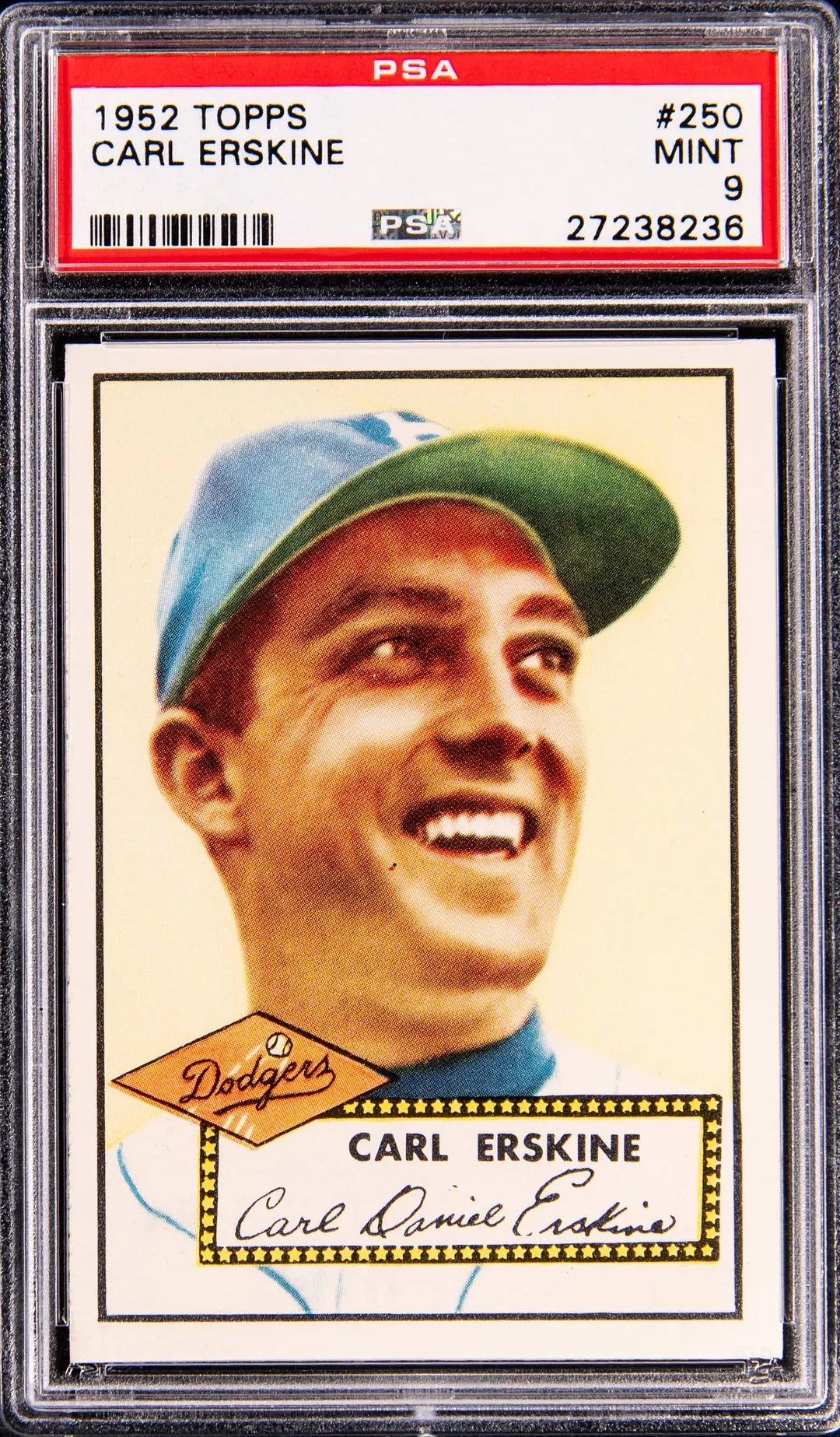
1952 Topps Carl Erskine PSA 9 Sale at Goldin
A PSA 9 1952 Topps Carl Erskine, pop 3 and highest graded, sold for $30,500 at Goldin on Feb 22, 2026. Here’s what it means for vintage collectors.
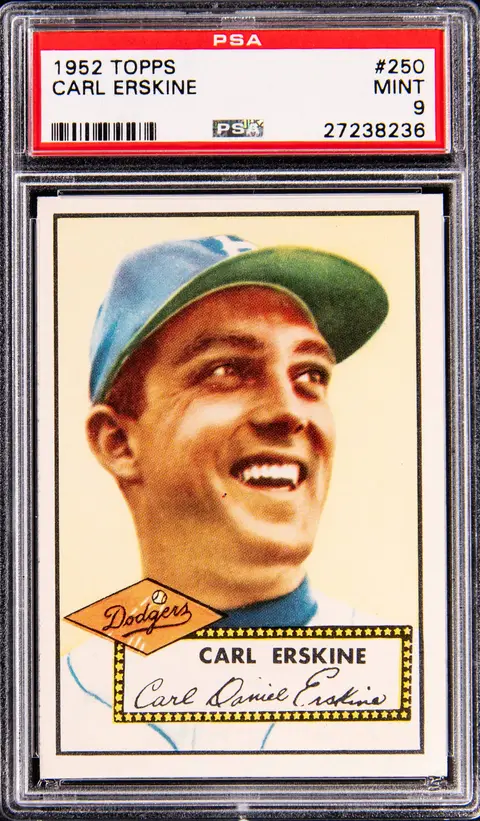
Sold Card
1952 Topps #250 Carl Erskine - PSA MINT 9 - Pop 3; Highest PSA Copy
Sale Price
Platform
Goldin1952 Topps baseball is one of those sets that quietly anchors the vintage hobby. When a truly elite copy changes hands, it gives collectors new data on how the market values condition, scarcity, and historical importance.
On February 22, 2026, Goldin auctioned a 1952 Topps #250 Carl Erskine graded PSA MINT 9 that realized $30,500. For a Brooklyn Dodgers pitcher who isn’t usually at the center of hobby headlines, this is a meaningful result—especially when you look at the population and context.
The card at a glance
- Card: 1952 Topps Carl Erskine
- Set: 1952 Topps Baseball (2nd series)
- Card number: #250
- Team: Brooklyn Dodgers
- Player: Carl Erskine (right-handed pitcher)
- Rookie status: Not a rookie card (Erskine’s RC is generally accepted as earlier Bowman issues), but a key early Topps card
- Grading company: PSA (Professional Sports Authenticator)
- Grade: PSA 9 (MINT)
- Population: Pop 3 in PSA 9, with no PSA 10s recorded at the time of sale
- Copy status: Tied for the highest graded examples in the PSA population
There are no special inserts or parallels here—no autograph, patch, or serial numbering. The appeal comes from classic vintage factors: the 1952 Topps design, Brooklyn Dodgers history, and an extremely high grade in a tough early-’50s issue.
Why 1952 Topps still matters
The 1952 Topps set is widely considered Topps’ first truly full-scale modern baseball release. It’s best known for the Mickey Mantle card, but the entire checklist carries historical weight:
- Design and format: Full-color portraits, team logos, and player facsimiles helped set the template that modern Topps would follow for decades.
- Era: Early 1950s cardboard is less plentiful in high grade than most modern issues, due to original printing, distribution, and storage conditions.
- Condition sensitivity: Centering, print quality, and edge chipping make true MINT copies of non-superstar players surprisingly difficult.
Within that context, a mid-number Brooklyn Dodger in PSA 9 represents the upper edge of what is realistically attainable for many collectors trying to build high-end runs.
Carl Erskine’s place in hobby history
Carl Erskine isn’t a Hall of Fame headliner, but he is firmly embedded in Dodgers and baseball history:
- Key pitcher for the Brooklyn Dodgers during the Boys of Summer era
- Threw two no-hitters (1952 and 1956)
- Part of multiple pennant-winning Dodgers teams
- Frequently appears in team-set builds for Brooklyn collectors
In the hobby, that usually translates into:
- Steady interest from Dodgers and vintage team collectors
- Occasional spikes when high-grade examples surface, because they’re relatively thin on the market
- Long-term respect tied more to team and era than to short-term performance
Because he isn’t a Mantle- or Robinson-level headliner, Erskine’s cards are often used as benchmarks for how the market is valuing high-grade non-superstar pieces from 1952 Topps.
Population and grading context
When collectors talk about a “pop report,” they’re referring to the population report from a grading company—essentially a count of how many copies exist at each grade.
For the 1952 Topps #250 Carl Erskine at the time of this sale:
- PSA 9 population: 3 examples
- PSA 10 population: 0 examples
That means this card is tied for the highest-graded example in PSA holders. With no Gem Mint 10s available, PSA 9 functions as the top of the mountain for this issue.
For vintage collectors, that matters because:
- High grades from early ’50s Topps are disproportionately scarce compared with modern cards.
- Registry-focused collectors (those building graded set registries) are often willing to pay a premium to secure best-available copies.
- Even for a non-superstar, “Pop 3, highest graded” is enough to draw serious attention when one comes to auction.
Market context and recent sales
When we talk about “comps,” we mean comparable recent sales—similar cards in the same or nearby grades that help provide price context.
For 1952 Topps Carl Erskine:
- Lower-grade copies (PSA 4–6 range) have tended to sell in a more accessible range, reflecting typical vintage commons and semi-stars from this set.
- Mid-high grades (PSA 7–8) usually command a stronger premium due to the set’s condition sensitivity.
- PSA 9s very rarely appear publicly, simply because there are so few and many are locked into long-term collections.
The $30,500 sale price at Goldin on February 22, 2026, fits into a broader pattern we’ve seen across the 1952 Topps run:
- Top-of-pop commons and semi-stars are often realizing multiples of what their lower-grade counterparts sell for.
- The gap between PSA 8 and PSA 9 in this era has remained substantial—collectors pay heavily for that last bump in eye appeal and scarcity.
Because PSA 9 copies sell so infrequently, there may not be a long list of direct, recent public comps at this exact grade. Instead, collectors typically triangulate from:
- Historical PSA 9 sales from several years back
- Current prices for PSA 8s and below
- Relative relationships between Erskine and similar-level players from the same set
Within that framework, $30,500 signals continued respect for top-condition vintage, even for non-marquee names.
Why this sale matters for collectors
For many hobbyists, this sale is notable less for the specific dollar figure and more for what it says about the market for early Topps condition rarities.
1. Confirmation of condition premiums
The result reinforces a familiar pattern:
- Scarce high grades in iconic vintage sets are holding their own.
- Collectors are still willing to pay a meaningful premium when a best-available example appears.
- Even outside of Mantle, Robinson, and the biggest stars, there is healthy demand for top-of-pop vintage cards.
2. Set-building and registry pressure
Set registries reward collectors for assembling graded runs, often with extra emphasis on higher grades. When a pop-3, top-of-the-line card like this surfaces:
- Registry-focused set builders may bid aggressively, especially if they’re missing this slot.
- A strong result can subtly influence how similar cards are priced privately and at future auctions.
3. Brooklyn Dodgers and era-specific collecting
Brooklyn Dodgers collectors usually think in terms of team sets and era runs, not just individual stars. A card like this links several key themes:
- Early Topps
- Pre-relocation Brooklyn history
- A core contributor to a beloved Dodgers era
When one of the finest known copies hits the open market, it can reset how collectors think about what a truly premium Brooklyn piece should cost.
Reading this sale without overreacting
It’s important not to treat any single auction as a forecast. Instead, this Goldin sale is one more data point collectors can layer into their understanding of the 1952 Topps ecosystem.
A few grounded takeaways:
- This is not a typical Erskine price. It reflects a specific combination of set, grade, and population scarcity.
- Lower-grade examples of this card remain far more accessible and are driven more by general vintage demand than by registry pressure.
- High-grade vintage continues to behave differently from most modern inserts and parallels, with stability rooted in long-standing collector interest.
For newcomers, it’s a reminder that in vintage:
- Player fame is only one part of the equation.
- Set importance, era, and condition often matter just as much.
How small sellers and collectors can use this information
If you’re building or breaking vintage collections, this sale offers a few practical lessons:
- Check the pop report. Before you price or list a card—especially from sets like 1952 Topps—look at how many exist in your grade.
- Don’t overlook non-stars. In flagship vintage sets, commons and semi-stars in elite grades can surprise you.
- Segment your expectations. Prices for PSA 9s and 10s in vintage are often on a different planet from PSA 5–7 copies of the same card.
For many collectors, this $30,500 Goldin sale on February 22, 2026, won’t change their buying plans. But it does reinforce a steady theme: when it comes to early Topps, the best of the best—especially top-of-pop examples—continue to command serious attention, even when the name on the card isn’t a Hall of Fame headliner.
As more 1952 Topps cards in top grade surface over time, results like this Carl Erskine PSA 9 will remain useful markers for how the hobby values condition, scarcity, and the enduring pull of Brooklyn-era cardboard.