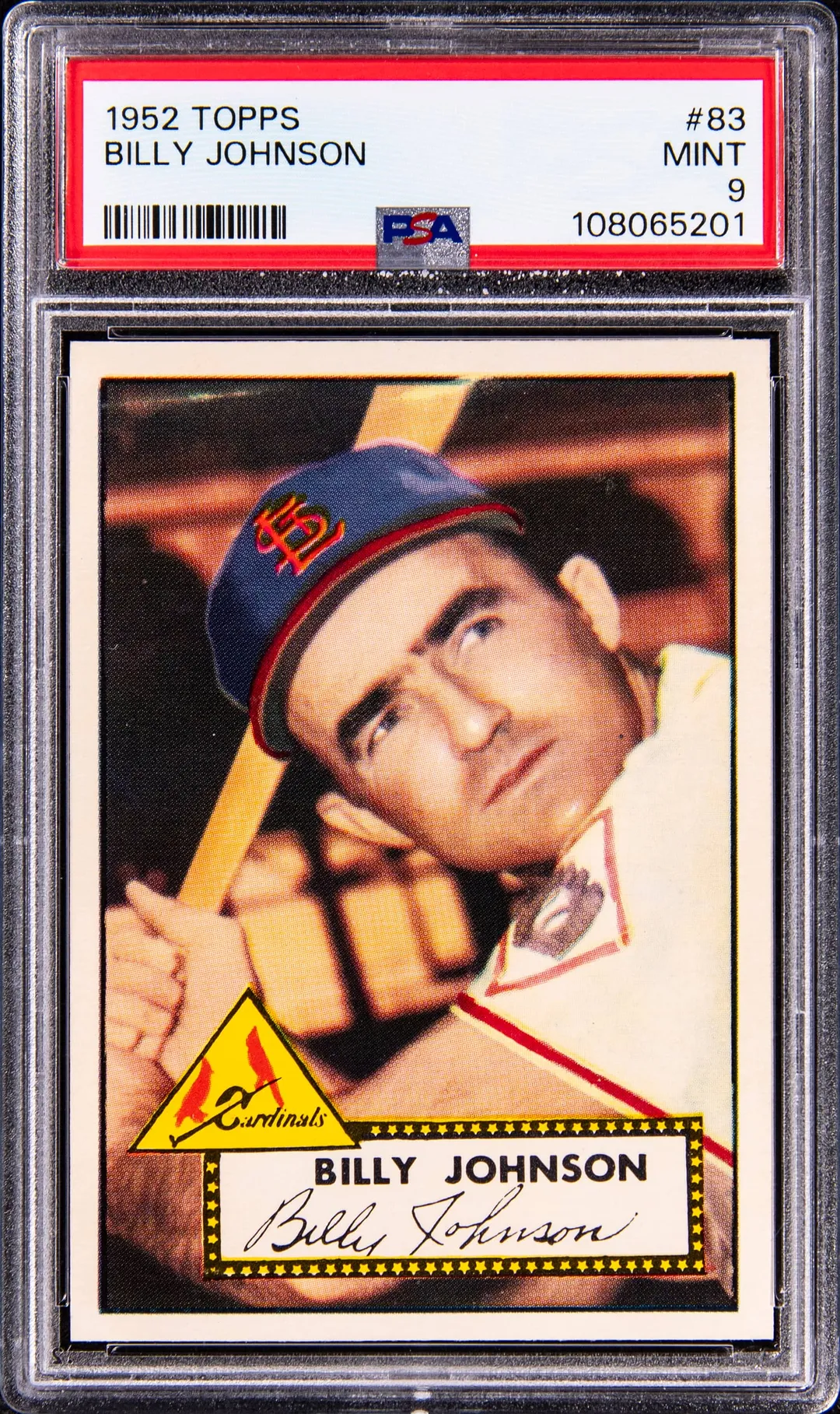
1952 Topps Billy Johnson PSA 9 sells for $29,585
Goldin sold a 1952 Topps #83 Billy Johnson PSA 9 for $29,585. Explore pop, condition scarcity, and what this means for vintage collectors.
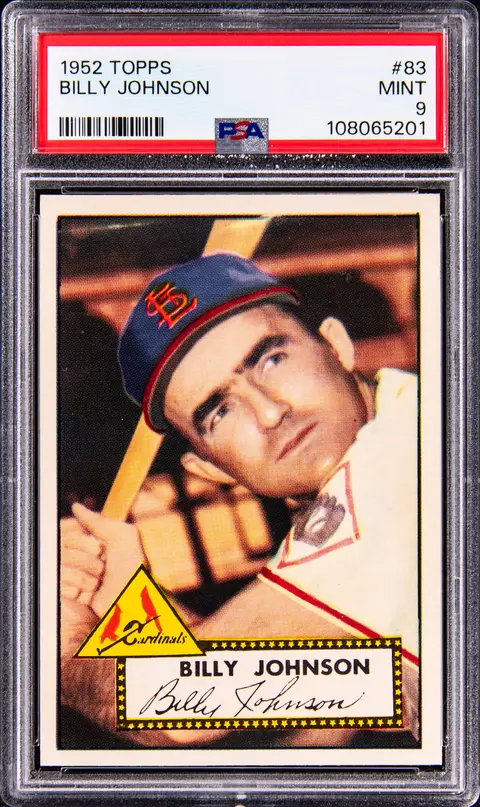
Sold Card
1952 Topps #83 Billy Johnson - PSA MINT 9 - Pop 2; Highest PSA Copy
Sale Price
Platform
Goldin1952 Topps #83 Billy Johnson in a PSA 9 just quietly reminded vintage collectors how thin the top of the population report can be.
On February 22, 2026, Goldin sold a 1952 Topps #83 Billy Johnson graded PSA MINT 9 for $29,585. For a non-star role player in one of the hobby’s cornerstone sets, that’s a meaningful data point.
Below, we’ll break down what this card is, why it matters, and how this sale fits into the broader market for high‑grade 1952 Topps.
The card at a glance
- Player: Billy Johnson (3B)
- Team: New York Yankees
- Year / Set: 1952 Topps Baseball
- Card number: #83
- Parallel/variant: Standard base issue (no parallel)
- Grading company: PSA (Professional Sports Authenticator)
- Grade: PSA 9 (MINT)
- Population: Pop 2 in PSA 9, none higher noted in the sale description
- Rookie or key issue: Not a rookie card, but an important example from the most famous Topps baseball set
1952 Topps is widely considered the first true "modern" Topps baseball release. Even commons and semi‑stars from this set in top grades are heavily pursued because of the combination of early Topps history, post‑war nostalgia, and genuine condition scarcity.
Billy Johnson is not a Hall of Famer, but he was a solid contributor on powerhouse Yankees teams. In 1952 Topps, the player’s star status is only one part of the equation—set, era, and condition carry a lot of the weight.
Why 1952 Topps matters so much
For newer or returning collectors, it helps to understand why a non‑iconic name from 1952 Topps can still bring five‑figure prices in top grade.
Key points about the set:
- Historical importance: 1952 is seen as Topps’ first fully realized, large baseball set with full player photos, stats, and bios. It’s a cornerstone for set builders and vintage specialists.
- Era: This is a vintage set (generally, pre‑1970). Vintage cards tend to have real scarcity: lower print runs than later decades and decades of wear.
- Condition difficulty: Many 1952 cards suffer from poor centering, print defects, and corner wear from being handled by kids. High‑grade survivors are genuinely rare.
- Set‑building culture: A lot of serious collectors try to assemble 1952 Topps in high grade, so even non‑star cards are important puzzle pieces.
Because of these factors, when a tough card appears near the top of the grading scale, the price is driven as much by set scarcity and registry competition as by the player’s career.
The PSA 9 factor and population report
A population report (or “pop report”) is a grading company’s public count of how many copies of a card they’ve graded at each grade level.
For this Billy Johnson:
- PSA 9 MINT: Pop 2
- Higher grade: None noted at PSA—this sale was described as the highest PSA copy
For collectors who compete in the PSA Set Registry (where collectors build graded sets and receive rankings), a Pop 2 with no PSA 10s effectively makes the PSA 9 the top of the food chain. Owning one of only two “best known” examples of a card from 1952 Topps is significant, even if it’s not a star name.
Market context and recent sales
A note on research: vintage comps (short for “comparables,” or recent, similar sales) can be thin for ultra‑low population grades. That’s the case here. Pop 2 PSA 9s from 1952 Topps simply don’t change hands often.
While direct, recent public sales of this exact card in PSA 9 are scarce, we can still place this $29,585 result in context by looking at patterns:
- 1952 Topps commons and semi‑stars in PSA 9: Non‑marquee names in this grade can range widely based on pop, centering, and registry demand, from the mid‑four figures into the low‑to‑mid five figures.
- Low‑pop PSA 9s: Cards with populations under 5 in PSA 9, especially when they are the highest grade, often push to the upper end of that range because set builders are competing for very few available copies.
Against this backdrop, $29,585 for a Pop 2, highest‑graded 1952 Topps card of a Yankees player sits toward the strong side but not unreasonable for the profile. The result appears consistent with:
- The historical importance of the 1952 Topps set
- Registry‑driven demand for top‑pop examples
- Limited supply of fresh, high‑grade vintage material entering the market
In other words, this looks more like an informed, registry‑driven price than an outlier based on sudden player hype.
Why collectors care about this specific card
Even though Billy Johnson isn’t a headliner, several factors make this card appealing:
Yankees uniform in the golden era
Johnson played on some classic Yankees teams. For team collectors, high‑grade Yankees from 1952 Topps are always in demand.Condition scarcity over name value
In ultra‑high grade vintage, collectors often prioritize the set and the grade over the player’s fame. A Pop 2, top‑graded 1952 Topps is going to be on the radar of:- PSA registry competitors
- Master team set builders
- High‑end vintage specialists focusing on condition
1952 Topps as a long‑term collecting focus
Many hobbyists spend years working on 1952 Topps runs. Some start with mid‑grade examples and slowly upgrade. When a tough PSA 9 surfaces, it can accelerate multiple collectors’ plans—and that competition shows up in auction results.
What this sale tells us about the current market
From a market‑watching perspective, this Goldin sale on February 22, 2026, supports a few broader observations about vintage baseball:
- Registry competition is still a powerful force. When the highest‑known graded copy of a set card hits the market, bidding often reflects competition among a small group of determined buyers.
- Vintage condition scarcity remains respected. Even in a hobby with more modern releases and numbered parallels, collectors continue to assign real value to truly high‑grade vintage pieces.
- 1952 Topps still commands a premium as a set. While the spotlight usually goes to Mantle and a handful of stars, this result underlines that the set’s status lifts values for lesser names in exceptional condition.
At the same time, it’s important not to over‑generalize from a single auction. Pop 2, top‑graded vintage cards are, by definition, unusual cases. A card like this can trade at a premium because the right collector happened to need it at the right moment.
Takeaways for collectors and small sellers
If you’re building or upgrading a 1952 Topps run, or you’re holding vintage inventory, a few practical lessons emerge from this sale:
Know the pop report, not just the player.
A non‑star with a very low population in high grade can bring strong prices, especially if it’s the top grade. Checking population data is crucial when assessing potential value.Grade sensitivity is extreme in vintage.
The gap between PSA 7, 8, and 9 in 1952 Topps can be dramatic. Even if you don’t own PSA 9s, understanding how rare they are can help you frame the value of your lower‑grade copies.Auction houses matter for thinly traded cards.
For a Pop 2, top‑pop vintage card, a major auction platform like Goldin is often where serious registry and vintage buyers are already watching. That visibility can help the card find its natural market level.Treat one big sale as a data point, not a forecast.
This $29,585 sale is a useful reference, but it’s still just one comp. Thin markets can move quickly in either direction the next time a similar card appears.
Final thoughts
The 1952 Topps #83 Billy Johnson PSA 9 sale at Goldin on February 22, 2026, is a clear reminder that in vintage, the story isn’t only about star power. It’s about:
- The historical weight of the set
- The genuine difficulty of finding high‑grade survivors
- The focused, long‑term goals of registry and set collectors
For anyone paying attention to the upper end of the vintage market, this is another data point reinforcing how tightly held top‑pop 1952 Topps cards have become—and how much competition still exists when one finally surfaces.