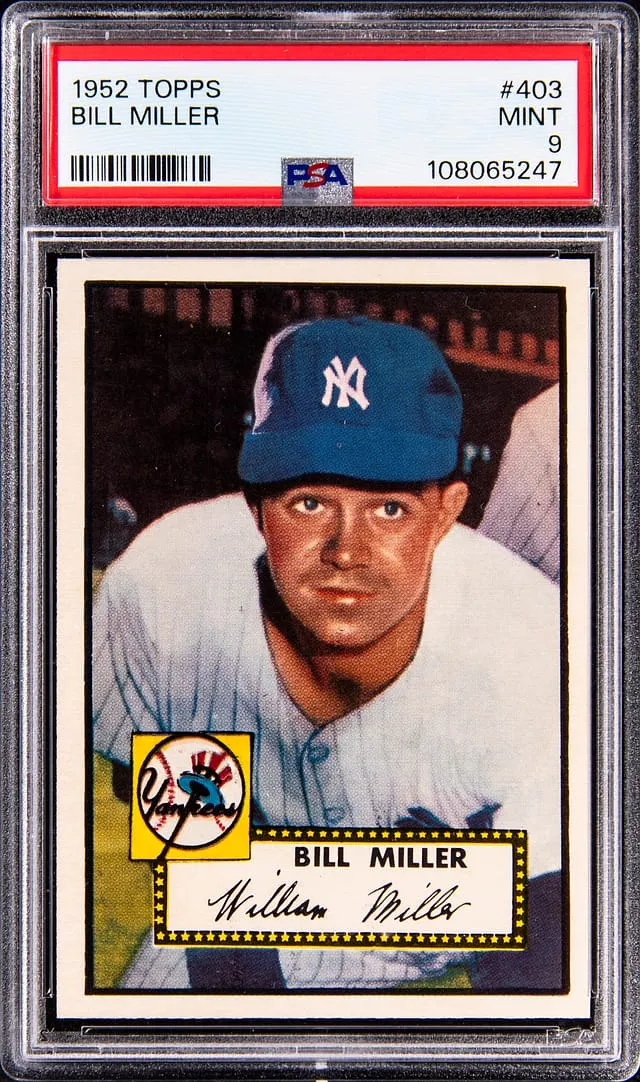
1952 Topps Bill Miller PSA 9 High-Number Sells for $24K
Goldin sold a 1952 Topps #403 Bill Miller high-number PSA 9, pop 4 and highest graded, for $24,400 on Feb 22, 2026. Here’s the context for collectors.
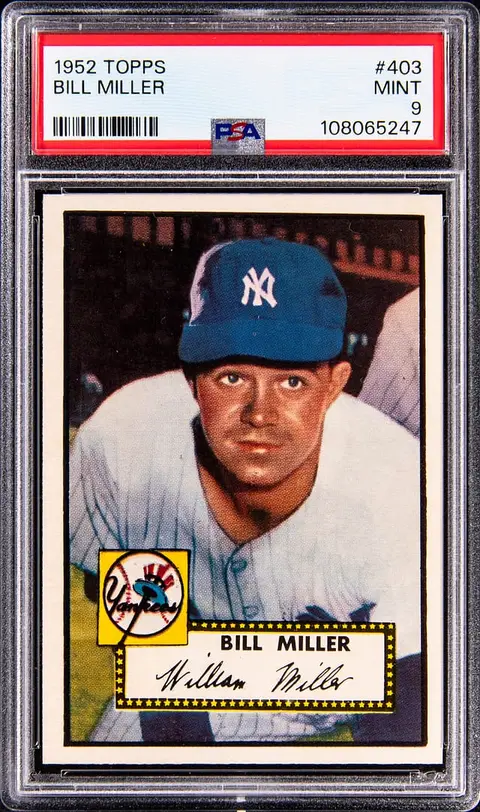
Sold Card
1952 Topps #403 Bill Miller - High Number - PSA MINT 9 - Pop 4; Highest PSA Copy
Sale Price
Platform
Goldin1952 Topps cards sit at the center of vintage baseball collecting, and high-number commons in elite grades are far tougher than their names suggest. A recent result at Goldin underlined that reality.
On February 22, 2026, Goldin sold a 1952 Topps #403 Bill Miller – High Number – PSA MINT 9 for $24,400. The card is a PSA population 4 in this grade, with no PSA 10s listed, making it the highest graded copy in the PSA census at the time of sale.
In this post, we’ll walk through what this card is, why high-number 1952 Topps cards matter, and how this $24,400 sale fits into the broader market context.
Card overview: 1952 Topps #403 Bill Miller, PSA 9
Key details
- Player: Bill Miller (pitcher)
- Team: New York Yankees
- Year / Set: 1952 Topps Baseball
- Card number: #403
- Subseries: High Number series (cards #311–407)
- Rookie/key issue? A non-star “common,” but a condition rarity and important piece of the 1952 high-number run.
- Grading company: PSA (Professional Sports Authenticator)
- Grade: PSA MINT 9
- Population: Pop 4 in PSA 9, with none higher at PSA at the time of sale (the listing notes it as the highest PSA copy).
There are no parallels, autographs, or memorabilia versions here. Like most vintage, this is a straightforward base card, and its appeal is driven by the set, the high-number status, and the condition.
Why 1952 Topps high numbers are so important
The 1952 Topps set is often described as Topps’ true flagship debut: a larger card size, strong design, and a checklist that includes the iconic Mickey Mantle, Jackie Robinson, Willie Mays, and more.
Within that set, the high-number series (#311–407) is notoriously tough. Collectors care about these cards for a few reasons:
Scarcity in circulation
High numbers were printed later in the year and, according to long-standing hobby history, a portion of the unsold stock was dumped rather than fully distributed. The result: fewer survivors in nice shape.Condition sensitivity
The 1952 Topps design has colored borders near the edges, easily showing wear, chipping, and poor centering. That makes PSA 9s (MINT) significantly harder to find than lower grades, especially for high numbers.Set-building pressure
Many advanced collectors build 1952 Topps sets by grade. When they get deep into the project, high-number commons often become the bottleneck because they are scarce in top grades.
Bill Miller is not a star, but in a high-number 1952 Topps card, the player name is only part of the equation. The scarcity and grade do much of the heavy lifting.
Market context and comps for 1952 Topps #403 Bill Miller
Reliable public data for this exact card in PSA 9 is limited because the population is only four and examples don’t come up often. When a card is this thinly traded, “comps” (comparable recent sales used as reference points) can be sporadic.
A few grounded observations based on the 1952 Topps market and typical pricing patterns:
Low pop, low turnover
With just four PSA 9s, this card may go multiple years between public offerings in that grade. Many sit long-term in set registries or private collections.High-number premium
Among condition-focused vintage collectors, a high-grade high number often commands a meaningful premium over a similarly graded low-number common from the same set. The premium isn’t just about the player; it’s about how tough the card is to source in the desired grade.Relationship to star pricing
The sale price here, $24,400, is well below the headline numbers we see on 1952 Topps stars (like Mantle or Jackie Robinson) in comparable grades, but it’s substantial for a non-star pitcher. That gap makes sense: stars carry brand-level demand, while high-grade commons serve a different role, mainly for set builders and registry competitors.
Without a long line of recent public PSA 9 sales for #403 specifically, it’s hard to call this hammer price typical or aggressive in strict numerical terms. What we can say clearly is that the result sits in the higher tier of prices for 1952 Topps high-number commons, reflecting both the pop count and the ongoing respect for the set.
How this sale fits into the broader 1952 Topps trend
A few broader points help frame this Goldin sale:
Continued demand for blue-chip vintage
Even as modern and ultra-modern cards draw attention, core vintage issues—especially early Topps—remain a foundational lane in the hobby. High-grade examples from 1952 are treated as long-term collection pieces.Registry and condition-focused collecting
PSA’s Set Registry allows collectors to compete on who has the best-graded set. In that environment, high-number PSA 9s act like puzzle pieces: a collector may wait years for the right one to appear. When it does, competition can push prices beyond what a pure “player value” model would suggest.Tight supply supports price stability
With a pop of 4 and no PSA 10s, the supply side is extremely limited. Even in periods when overall hobby volume cools, a card like this doesn’t tend to flood the market simply because there aren’t many copies to begin with.
Takeaways for collectors and small sellers
For newer or returning collectors, a $24,400 sale for a non-star pitcher might look surprising at first glance. A few practical lessons emerge:
Set and series matter as much as the player
In vintage, especially 1950s Topps, the combination of set importance and series difficulty (like the 1952 high numbers) can outweigh the individual player’s fame.Grade drives value in condition-sensitive eras
The jump from PSA 7 to PSA 8 to PSA 9 can be steep when the card is hard to find centered and clean. Small improvements in eye appeal can translate into large price differences.Population reports are a key reference
A “pop report” is the grading company’s count of how many copies have been graded at each grade level. When you see “Pop 4; none higher,” it signals that you’re looking at the top end of the supply curve.Thinly traded cards require context, not just a single comp
With cards that rarely sell, a single auction price is better treated as a data point rather than a firm benchmark. Looking at the broader 1952 Topps high-number market, and at other PSA 9 commons, can help you understand whether a result is in line with hobby behavior.
Summary
The February 22, 2026 Goldin sale of the 1952 Topps #403 Bill Miller High Number in PSA MINT 9 for $24,400 showcases how deeply collectors value top-condition vintage from iconic sets. While Bill Miller himself is not a headline name, the combination of 1952 Topps, high-number scarcity, a PSA 9 grade, and a population of just four copies with none higher at PSA makes this card a meaningful target for advanced set builders and registry competitors.
For collectors and small sellers, it’s a reminder that in vintage, the story of a card is often written just as much by its set, series, and condition as by the player on the front.
If you’re tracking vintage results like this, keeping an eye on auction houses such as Goldin and cross-referencing their outcomes with population data and recent comps can help you build a clearer, data-informed view of the market—whether you’re piecing together a 1952 Topps set or just starting to explore the era.