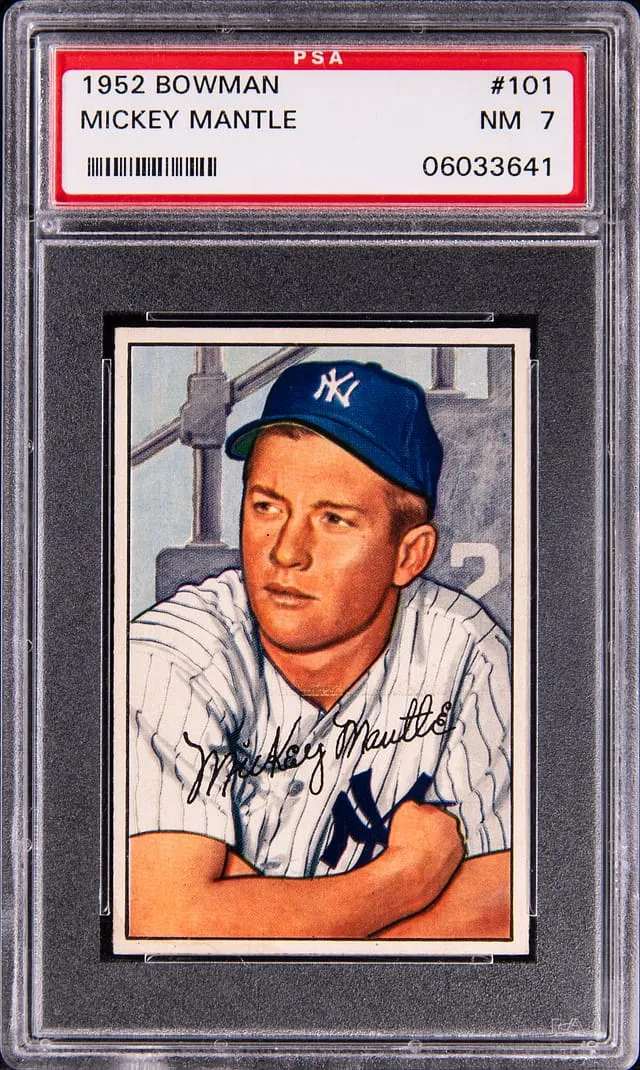
1952 Bowman Mickey Mantle PSA 7 sells for $18,300
A 1952 Bowman #101 Mickey Mantle PSA NM 7 sold for $18,300 at Goldin. See how this vintage Mantle fits into recent comps and the wider Mantle market.
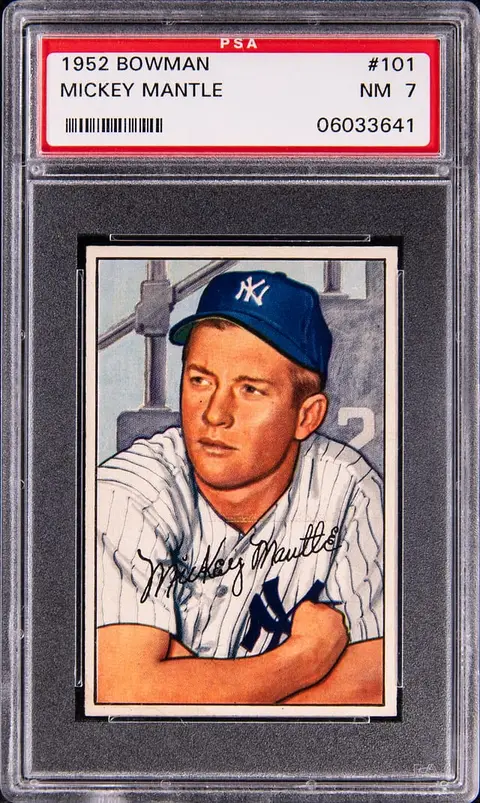
Sold Card
1952 Bowman #101 Mickey Mantle - PSA NM 7
Sale Price
Platform
Goldin1952 Bowman Mickey Mantle cards sit in an interesting space for vintage collectors. They are not quite as famous as Mantle’s 1952 Topps card, but they still come from one of the most important early-1950s sets and remain a core target for serious Mickey Mantle and Yankees collectors.
A recent sale at Goldin on 2026-03-15 highlighted that status: a 1952 Bowman #101 Mickey Mantle graded PSA NM 7 closed at $18,300.
In this post, we’ll walk through what this card is, why it matters, and how this sale fits into the broader market for Mantle’s early playing-days cards.
Card Snapshot: 1952 Bowman #101 Mickey Mantle – PSA NM 7
Card details
- Player: Mickey Mantle
- Team: New York Yankees
- Year: 1952
- Set: 1952 Bowman Baseball
- Card number: #101
- Rookie status: Not a rookie card (Mantle’s recognized rookie is 1951 Bowman)
- Era: Vintage (pre-1970)
Grading details
- Grading company: PSA (Professional Sports Authenticator)
- Grade: NM 7 (Near Mint)
- Attributes: Standard base card (no autograph, no memorabilia patch, no serial numbering)
Within Mantle’s catalog, the 1952 Bowman is his second-year card and sits right between the rookie 1951 Bowman and the iconic 1952 Topps. That makes it a key “early Mantle” issue that many collectors use as a more attainable way to add a high-quality vintage Mantle to a collection.
Why the 1952 Bowman Mantle Matters
1. Second-year Mantle from a classic early-50s set
The 1952 Bowman release is one of the last major Bowman sets before Topps became the dominant brand in the mid‑1950s. The artwork-driven design, smaller card size, and relatively modest print run make it a favorite among vintage set builders.
Mickey Mantle appears in this set as a rising young Yankees star, just after his 1951 rookie season. While the 1951 Bowman is the key rookie, this 1952 Bowman is still firmly in Mantle’s early career window, which is where much of the long-term demand tends to concentrate.
2. Relationship to the 1952 Topps Mantle
Most collectors know Mantle’s 1952 Topps card as one of the hobby’s most iconic postwar cards. The 1952 Bowman Mantle offers a different lane:
- More traditional painting-style artwork
- Smaller overall footprint than 1952 Topps
- Typically lower cost than the 1952 Topps in comparable condition
Because of that, many Mantle collectors aim to assemble the early trio: 1951 Bowman, 1952 Bowman, and 1952 Topps. The 1952 Bowman often becomes the “affordable early Mantle” relative to the 1951 rookie and the flagship 1952 Topps.
3. Vintage era scarcity and condition
As a vintage card from the early 1950s, this Mantle is naturally more limited in high grade. Cards were handled, flipped, traded, and stored in ways that make well-centered, sharp-corner copies harder to find.
PSA’s population report (often called the "pop report," essentially a census of graded copies by grade) for 1952 Bowman Mantle shows a meaningful drop-off as you move into higher grades. While exact population counts change over time as more cards are submitted, NM 7 and above typically represent a relatively small share of all graded examples.
The Goldin Sale: $18,300 on 2026-03-15
On 2026-03-15, Goldin sold a 1952 Bowman #101 Mickey Mantle – PSA NM 7 for $18,300.
For context, this is a straight, base-copy PSA 7 with no autograph or parallel. The price reflects the intersection of several factors:
- Second-year Mantle status
- Vintage Bowman set appeal
- Solid eye appeal associated with the NM grade
- Ongoing interest in Mantle among vintage baseball and Yankees collectors
As always, individual auction results can move up or down a bit based on centering, color, surface quality, and how many comparable cards are on the market at the same time.
Recent Market Context and Comps
When collectors talk about "comps" (short for "comparables"), they mean recent sales of the same card or close variants, used as a rough price reference.
For the 1952 Bowman Mantle, a typical structure of comps in recent periods has looked something like this:
- PSA 5–6 range: Generally well below the NM level, with pricing reflecting more obvious wear, corner rounding, or centering issues.
- PSA 7 (NM): A meaningful step up from mid‑grade. Prices often cluster in a band where eye appeal and auction timing can move the final hammer within that range.
- PSA 8 and above: A much smaller population, and prices can jump sharply relative to PSA 7, reflecting both scarcity and demand from high‑end vintage collectors and set registries.
Within that continuum, a sale at $18,300 for a PSA 7 lines up with the idea that this card fills an important “mid‑high” tier in the Mantle hierarchy—expensive, but still well below the sums commanded by 1951 Bowman and especially 1952 Topps in the same or higher grades.
Because markets move, exact dollar figures for recent comps can vary across auction houses and platforms (Goldin, Heritage, Memory Lane, PWCC, and major fixed‑price marketplaces). But the pattern has held fairly consistently: Mantle’s early Bowman and Topps issues maintain strong collector demand and tend to trade within a recognizable band by grade.
How Collectors Think About This Card
1. A centerpiece for focused Mantle collections
For Mantle‑focused collectors, the 1952 Bowman is usually considered one of the “core” playing-days cards. The typical priority list often looks like:
- 1951 Bowman (rookie)
- 1952 Topps
- 1952 Bowman
Depending on budget and collecting goals, some collectors start with 1952 Bowman as an entry point into early Mantle rather than jumping straight into the deeper end of 1951 Bowman and 1952 Topps pricing.
2. A key card in 1952 Bowman set builds
For vintage set builders working on a full 1952 Bowman run, Mantle is one of the central chase cards along with other stars of the era. Securing a presentable Mantle often becomes one of the last big steps toward completing the set.
3. Long-standing demand, less tied to short-term news
Unlike modern or ultra-modern cards where prices can move sharply on short-term performance or hype cycles, Mantle’s vintage cards tend to respond more slowly and are anchored in decades of hobby history.
Recent hobby interest in vintage as a whole, plus ongoing coverage of record Mantle sales (especially high‑grade 1952 Topps copies), continues to keep the spotlight on Mantle’s earlier issues, including this 1952 Bowman.
What This Sale Suggests to Collectors
The Goldin sale on 2026-03-15 doesn’t redefine the Mantle market by itself, but it reinforces a few practical takeaways:
Stability in key vintage Mantle pieces
Early Mantle cards, especially in graded mid‑to‑high condition, continue to find ready buyers at established price levels.Grade and eye appeal matter
Within PSA 7, individual copies can still vary significantly. Centering, color, and surface quality are major drivers of where a given card lands within the typical pricing band.Role as an alternative to 1952 Topps
For collectors who want an early Mantle that feels significant but not at flagship 1952 Topps price levels, the 1952 Bowman in PSA 7 continues to function as a strong alternative.
None of this is a prediction about the future. It’s simply a snapshot of how one notable sale fits into a longer‑term pattern of demand for early Mantle cards.
Closing Thoughts
The 1952 Bowman #101 Mickey Mantle – PSA NM 7 that sold at Goldin for $18,300 on 2026-03-15 is a clean example of how the market continues to value core vintage pieces.
For newcomers and returning collectors, this card illustrates a few useful themes:
- Early‑1950s Bowman cards still carry strong historical appeal.
- Second‑year cards of all‑time greats can offer a balance between significance and relative affordability (in a vintage context).
- Grading, condition detail, and auction venue all play measurable roles in final prices.
If you’re studying Mantle’s market or thinking about where a 1952 Bowman fits in your collecting goals, tracking sales like this one—across grades and auction houses—can help you build a grounded view of how these cards trade over time, without relying on hype or short-term headlines.