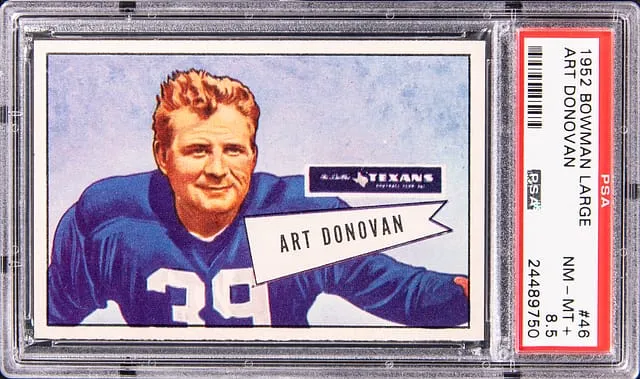
1952 Bowman Large Art Donovan Rookie PSA 8.5 Sale
Goldin sold a 1952 Bowman Large #46 Art Donovan SP rookie PSA 8.5 for $15,860 on Feb 22, 2026. See what this means for vintage football collectors.
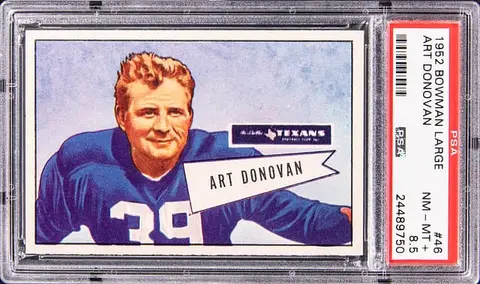
Sold Card
1952 Bowman Large #46 Art Donovan SP Rookie Card - PSA NM-MT+ 8.5
Sale Price
Platform
Goldin1952 Bowman Large football is one of those sets that quietly anchors the vintage gridiron market, and this card sits right in the middle of that history: the 1952 Bowman Large #46 Art Donovan short‑print (SP) rookie card, graded PSA NM‑MT+ 8.5, which sold at Goldin on February 22, 2026 for $15,860.
In this post, we’ll walk through what this card is, why it matters to collectors, and how this $15k‑plus result fits into the broader market for early 1950s football.
Card at a glance
- Player: Art Donovan (Pro Football Hall of Fame, Class of 1968)
- Team: Dallas Texans (AAFC/NFL – pre‑Colts era)
- Year / Set: 1952 Bowman Large Football
- Card number: #46
- Key status: Recognized rookie card and a short print (SP) within the set
- Grading company: PSA (Professional Sports Authenticator)
- Grade: NM‑MT+ 8.5
- Attributes: Vintage base issue; no parallel, no autograph, no memorabilia – pure cardboard era
The 1952 Bowman Large set is notable for its oversized format and strong Hall of Fame checklist. For football collectors, it functions much like 1952 Topps does in baseball: an early‑1950s cornerstone set where high‑grade Hall of Fame rookies command long‑standing attention.
Art Donovan’s #46 is his recognized rookie card and one of his most sought‑after pieces, especially in higher grades. Being an SP (short print) means it was printed in lower quantities relative to other cards in the set, adding another layer of scarcity on top of natural vintage attrition.
Why Art Donovan matters to vintage football collectors
Before diving into pricing, it’s worth remembering why Donovan shows up so consistently in vintage want‑lists:
- Hall of Fame defensive standout: Donovan was a dominant defensive lineman and a key part of early Baltimore Colts success, earning multiple All‑Pro nods and a Hall of Fame induction.
- Vintage era personality: Beyond his play, Donovan became something of a cult figure thanks to his storytelling and media appearances. That off‑field personality keeps his name familiar to collectors well beyond his playing era.
- Limited early cardboard: 1950s football production was far smaller than modern print runs. Donovan does not have a long list of early mainstream issues; this 1952 Bowman Large rookie is one of his foundational cards.
All of this helps keep demand steady among vintage Hall of Fame player collectors, team collectors, and set builders.
The set: 1952 Bowman Large vs. Small
Bowman issued two football sets in 1952: Large and Small. The Large cards, including Donovan’s #46, measure roughly 2½" x 3¾" and are prized for their artwork and display presence.
Key points about 1952 Bowman Large:
- Oversized, colorful artwork: These cards feel more like mini art pieces than simple photos, which appeals to collectors who like display‑ready vintage.
- Condition sensitivity: Corners and edges are vulnerable due to the size, and centering can be a challenge. This keeps gem‑level grading populations thin.
- Hall of Fame density: The set includes several important Hall of Fame players and early cards, making it essential for vintage football builders.
Because of these condition challenges, a PSA 8.5 in 1952 Bowman Large is significantly tougher than the grade number alone might suggest if you’re used to modern ultra‑high‑grade cards.
Grading and scarcity: what a PSA 8.5 means here
A quick note on grading context:
- PSA’s 8.5 (NM‑MT+) sits between PSA 8 and PSA 9. In many vintage sets, 8.5s are genuinely scarce “tweener” grades with a meaningful premium over straight 8s.
- For 1952 Bowman Large, high‑grade Hall of Fame rookies (8, 8.5, 9) typically show low population counts – that’s the number of copies PSA has graded at or above a certain level, often called the pop report.
While the exact pop report numbers can move as new cards are graded, the overall picture is stable: Donovan’s rookie in PSA 8.5 is a true high‑end copy for this card, and population at 8.5 and above remains limited.
Market context and recent sales
This Goldin result closed at $15,860 on February 22, 2026.
When we talk about market context, we’re essentially looking at comps – recent comparable sales of the same or closely related cards – to understand where a new sale sits within a realistic range.
For the 1952 Bowman Large Art Donovan rookie, here’s the general pattern seen across major auction houses and marketplaces:
- PSA 7 – PSA 8 range: Typically sells in the low‑ to mid‑thousands, depending on eye appeal (centering, color, registration) and auction venue. Prices here can move with broader vintage sentiment, but generally remain accessible compared to the very top grades.
- PSA 8.5: Historically has sat above PSA 8 and below PSA 9, reflecting the scarcity of high‑end copies without fully entering the top‑of‑the‑registry bidding wars.
- PSA 9 and above: When they appear, PSA 9 copies tend to command a strong premium, driven by registry‑minded collectors chasing the best available examples from this era.
Against that backdrop, $15,860 for a PSA 8.5 at Goldin places this sale firmly in the upper tier of the established range for high‑grade Donovan rookies. It’s consistent with the idea that:
- There is a real premium for high‑grade, SP, Hall of Fame rookies in 1950s football.
- Auction houses with deep vintage followings, like Goldin, can concentrate motivated bidders, especially when eye appeal is strong.
Because truly direct comps in PSA 8.5 don’t appear frequently, each new sale helps refine the current range rather than simply repeating it. This result doesn’t look like an outlier spike; instead, it fits the pattern of steady, data‑supported demand for premium vintage football.
Why this sale matters for collectors
A single auction doesn’t redefine a market, but it can highlight trends. This Donovan result points to a few ongoing themes:
1. Vintage football continues to hold collector attention
Even without a new milestone season or media surge around Donovan, his key rookie in a top tier grade still drew healthy bidding. That suggests:
- Vintage Hall of Fame position players, especially in foundational sets, remain a core target for many collectors.
- The market isn’t solely chasing modern hype; it continues to reward proven historical significance.
2. Condition and set quality drive the premium
This isn’t a rare insert, autograph, or serial‑numbered parallel. It’s a base card from an early 1950s set, yet:
- The combination of short print status, oversized format, and difficult high‑grade survival creates supply constraints.
- When a visually strong PSA 8.5 surfaces at a well‑publicized auction, it can attract multiple serious bidders.
For newer collectors, this is a good reminder that in vintage, relative scarcity plus condition can be just as important as any modern chase card feature.
3. Incremental data point for 1950s Hall of Fame rookies
For those building long‑term collections or tracking price history, this sale adds to the reference points around:
- Where high‑grade 1952 Bowman Large Hall of Fame rookies are sitting today.
- How much of a premium the market is willing to pay when you combine SP status, Hall of Fame pedigree, and a PSA 8.5 grade.
It doesn’t signal a sudden shift on its own, but it does reinforce a pattern of measured, data‑driven demand in this part of the hobby.
Takeaways for different types of collectors
New or returning collectors
- This sale is a good example of how a “simple” vintage base rookie can reach five figures when you mix Hall of Fame status, a key early‑1950s set, short print status, and high grade.
- If you’re just starting with vintage, you don’t need to jump straight to PSA 8.5. Lower grades can offer the same history and artwork at more accessible entry points.
Active hobbyists
- For those tracking comps, this $15,860 result helps update the mental pricing map for high‑grade 1952 Bowman Large stars.
- When evaluating similar cards, it’s helpful to compare not only the numeric grade but also centering, color, and the specific auction house, since those factors can move final hammer prices.
Small sellers and traders
- If you handle vintage football, this sale is a reminder that strong examples of Hall of Fame rookies from pre‑1960 sets remain highly liquid at the right venues.
- Even if your inventory is in mid‑grade, comps like this help you frame the relative value ladder when discussing cards with buyers.
Final thoughts
The 1952 Bowman Large #46 Art Donovan SP rookie card in PSA NM‑MT+ 8.5 that sold at Goldin for $15,860 on February 22, 2026 isn’t a shock headline. Instead, it’s a clear, steady signal: high‑grade, short‑printed Hall of Fame rookies from historically important football sets continue to command respect and real bidding power.
For collectors who appreciate the early 1950s game, this card is a textbook example of how history, set design, and condition intersect to create lasting demand.
At figoca, we’ll keep tracking these kinds of results so you can see where your vintage football cards sit in today’s market—without the noise, just the context.