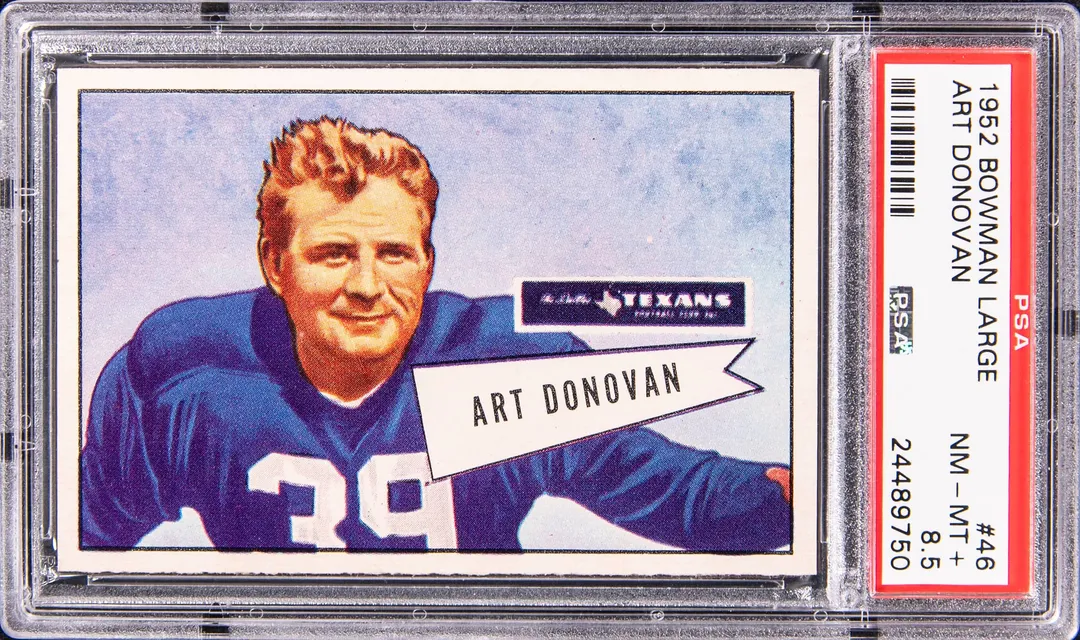
1952 Bowman Art Donovan SP Rookie PSA 8.5 Sale
Goldin sold a 1952 Bowman Large #46 Art Donovan SP rookie PSA 8.5 for $15,860. See what this vintage Hall of Fame card means for the football card market.
Sold Card
1952 Bowman Large #46 Art Donovan SP Rookie Card - PSA NM-MT+ 8.5
Sale Price
Platform
Goldin1952 Bowman Large #46 Art Donovan SP Rookie Card - PSA NM-MT+ 8.5 Sells for $15,860 at Goldin
Vintage football collectors have quietly respected Art Donovan’s 1952 Bowman Large rookie for years. On February 22, 2026, that respect translated into a strong auction result when a PSA NM-MT+ 8.5 copy of his short-print rookie sold for $15,860 (USD) at Goldin.
This sale offers a useful snapshot of where high-end vintage football, and this Hall of Famer in particular, currently sit in the market.
Key card details
- Player: Art Donovan (Pro Football Hall of Fame defensive tackle)
- Team: Dallas Texans (NFL franchise that played only in 1952)
- Year: 1952
- Set: 1952 Bowman Large Football
- Card number: #46
- Designation: Short Print (SP) Rookie Card
- Grading company: PSA (Professional Sports Authenticator)
- Grade: NM-MT+ 8.5
There are no autos, patches, or serial numbering here. The value is driven by era, scarcity, condition, and Hall of Fame significance—classic vintage fundamentals.
Why the 1952 Bowman Large set matters
The 1952 Bowman Large football set is a cornerstone in vintage football collecting:
- Era: Early 1950s, firmly in the vintage category.
- Design: Larger format cards with rich color artwork, often praised for their eye appeal compared to many contemporaries.
- Historical context: This is one of the key early post-war football issues, alongside 1948 Leaf and 1950–1951 Bowman.
Collectors often target 1952 Bowman Large for three reasons:
- Hall of Fame rookies and key cards. The set features several important early cards of players who helped define the 1950s NFL era.
- Condition difficulty. The larger format, age, and typical handling mean high-grade examples are noticeably harder to find.
- Team and league history. The set captures defunct or short-lived franchises, adding an extra layer of historical interest.
Art Donovan’s #46 is one of the better-known rookies in the checklist, made tougher by its short-print status.
Art Donovan: Hall of Famer and hobby profile
Art Donovan, a dominant defensive lineman and member of the Pro Football Hall of Fame, is widely respected in football history circles. His on-field resume and later media presence help keep his name familiar, even to newer fans of the sport.
From a hobby standpoint:
- Key rookie: This 1952 Bowman Large #46 is considered his premier rookie card.
- Defensive player effect: Defensive stars traditionally lag behind offensive legends in pricing, but established Hall of Fame names often benefit from steady, historically anchored demand.
- Story value: Donovan’s reputation as both a fierce player and memorable personality gives his rookie some added charm for collectors who value narrative as much as stats.
Short print + high grade: why the PSA 8.5 matters
In hobby language, a short print (SP) is a card that was printed in lower quantities than most of the set, making it harder to find. The 1952 Bowman Large #46 Donovan is recognized as an SP, which naturally reduces available supply.
On top of that, the card is graded PSA 8.5 NM-MT+, which sits in a premium tier for vintage:
- Vintage grading context: For early 1950s football, anything PSA 8 or better is notably scarce. Many surviving copies show heavy wear, miscuts, or surface issues.
- Half-grade premium: PSA 8.5 often commands a noticeable step up from PSA 8, especially when population reports show only a small number of cards at that level or higher.
A pop report (population report) is the grading company’s count of how many copies they’ve graded at each grade level. While exact numbers shift as more cards are submitted, the general pattern for this issue is:
- Modest total population overall (not a common card).
- Very limited examples in the 8–9 range.
- PSA 8.5 sitting near the top of the grading curve, behind only a handful of 9s (and potentially 10s, if any exist).
In short: this sale involved a combination of a key Hall of Fame rookie, an SP card, and a high-end vintage grade. That’s a recipe for strong—but usually not speculative—demand.
Market context and recent sales
While individual auction results can move around due to timing and bidder competition, a few patterns consistently appear when looking at recent comps (comparable sales used to estimate current value):
- Mid-grade copies (PSA 5–6) typically sit at a more accessible level, drawing set builders and collectors who want a presentable vintage example without chasing registry-level grades.
- Upper-mid to high grades (PSA 7–8) tend to see sharper jumps in price, reflecting how much more difficult clean examples are for early-50s football.
- Top-end grades (PSA 8.5–9) usually attract registry competitors—collectors trying to build the highest-graded possible set on grading company leaderboards.
Against that background, the Goldin sale at $15,860 for a PSA 8.5:
- Sits firmly in the high-end tier for this card.
- Aligns with how the hobby typically values short-print Hall of Fame rookies in high grade from major early-1950s sets.
- Reflects the combination of SP scarcity and top-tier eye appeal rather than any sudden spike driven by contemporary on-field performance.
Where available, prior sales of PSA 8 and PSA 9 copies show the usual pattern: each half-step or full-step up in grade can carry an outsized premium, especially when population counts are low. This 8.5 result fits neatly into that structure.
Why this sale matters for collectors
For collectors, a single auction never tells the whole story—but it does offer useful signals.
1. Vintage football remains stable and selective
This result reinforces a theme many hobbyists have noticed:
- Truly key vintage pieces—especially Hall of Fame rookies in big sets—tend to hold collector interest even when the broader market feels uneven.
- Demand concentrates in cards with strong fundamentals: historic sets, top players, and high grades supported by low pop counts.
The Donovan checks all those boxes.
2. Condition sensitivity is real in early-50s issues
The spread between mid-grade and high-grade examples underscores how much condition matters for this era. For collectors just getting into vintage football, this sale is a reminder that:
- Minor improvements in centering, corners, and surface can translate into major differences in graded value.
- Raw (ungraded) copies that look strong to the eye can be worth a careful pre-grading review.
3. Short prints reward patient hunting
The SP designation on Donovan’s #46 is more than a footnote. Short printed cards:
- Appear less frequently in auction cycles.
- Can show sharper moves when a strong copy finally hits the market.
- Often become bottleneck cards for set builders trying to complete 1952 Bowman Large in higher grade.
This sale highlights how SP Hall of Famers can command sustained interest even without modern-style flash such as autographs or patches.
Takeaways for different types of collectors
New or returning collectors
If you’re just getting your footing in vintage football:
- Use results like this to understand the hierarchy: set importance, player legacy, card scarcity, and grade all feed into price.
- You don’t need a PSA 8.5 to participate. Lower-graded Donovan rookies and other Hall of Famers from 1952 Bowman Large offer a more affordable entry point while keeping the same historical appeal.
Active hobbyists
For more experienced collectors and small sellers, this Goldin sale on February 22, 2026 is a useful data point:
- It reinforces what the top of the market will pay for a registry-caliber copy of a key vintage SP rookie.
- It can serve as a benchmark when evaluating raw or mid-grade examples: understanding how much value concentrates in the top grades helps you decide where to focus your search or grading dollars.
Set builders and registry competitors
If you’re building 1952 Bowman Large in high grade:
- Donovan’s #46 is clearly one of the cards that can define your total set value.
- Tracking high-grade SP sales like this is important for planning: these cards don’t appear in every auction cycle, and when they do, competition can be stiff.
What this means going forward
This $15,860 sale at Goldin doesn’t rewrite the vintage football market, but it does confirm a few steady realities:
- Hall of Fame rookies from key early-1950s sets remain steady, especially when condition, scarcity, and eye appeal line up.
- Short-print status and grading scarcity matter just as much as they always have in vintage.
- Results in PSA 8.5 and above serve as useful anchors when you evaluate lower grades and raw examples.
For collectors, the 1952 Bowman Large #46 Art Donovan SP Rookie Card in PSA NM-MT+ 8.5 is a reminder of why vintage football continues to reward patience, knowledge, and attention to detail. It’s not about chasing the latest headline—it’s about understanding the long, quiet arcs of hobby history, one data point at a time.
As more 1952 Bowman Large cards surface at auction over the coming years, sales like this one will help define the long-term price context for Art Donovan and his peers, giving collectors a clearer map of where this iconic set sits in the broader landscape of vintage football cards.