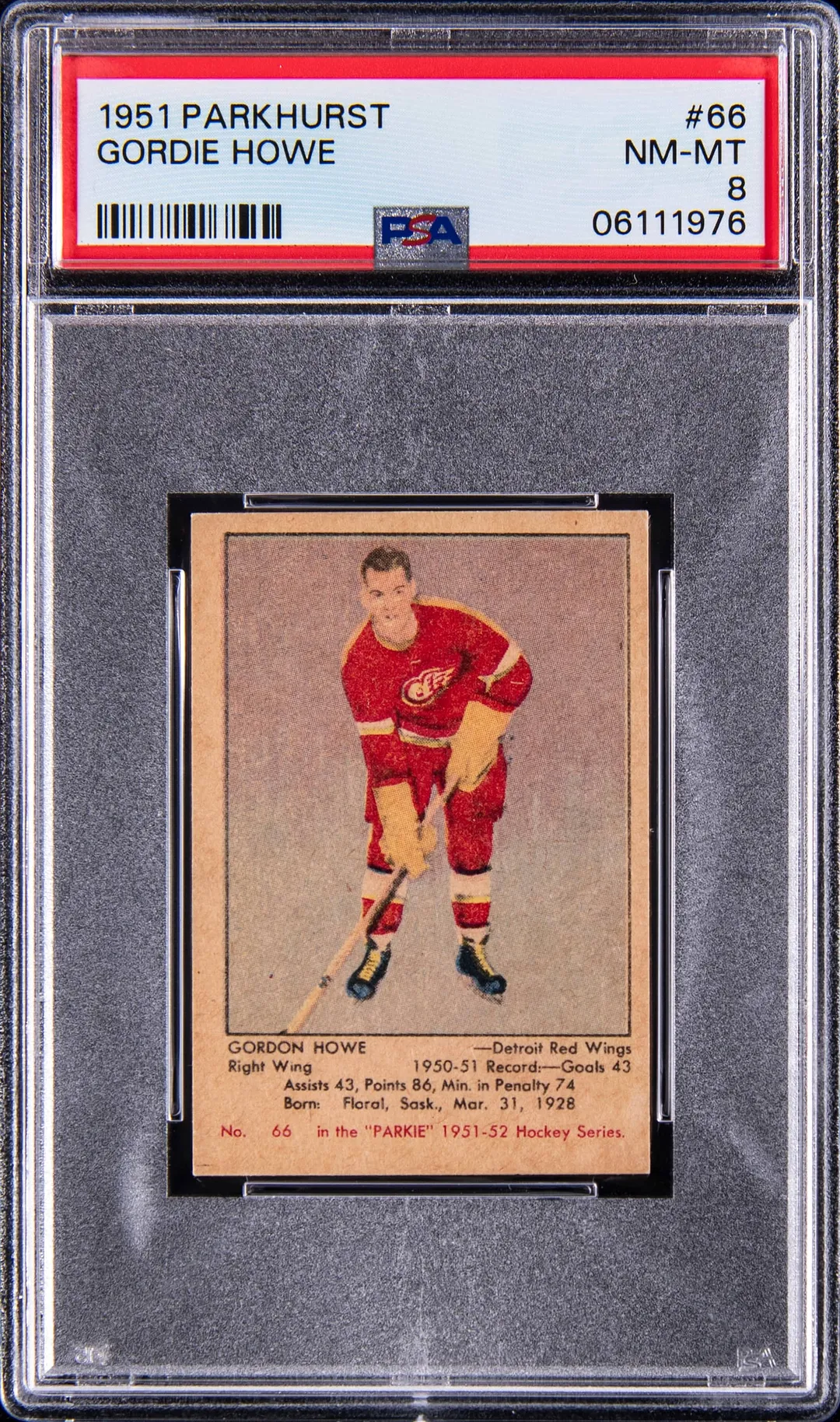
1951 Parkhurst Gordie Howe Rookie PSA 8 Sells for $56K
Goldin sold a 1951–52 Parkhurst #66 Gordie Howe rookie PSA 8 for $56,242 on Feb 22, 2026. Here’s what that means for vintage hockey collectors.
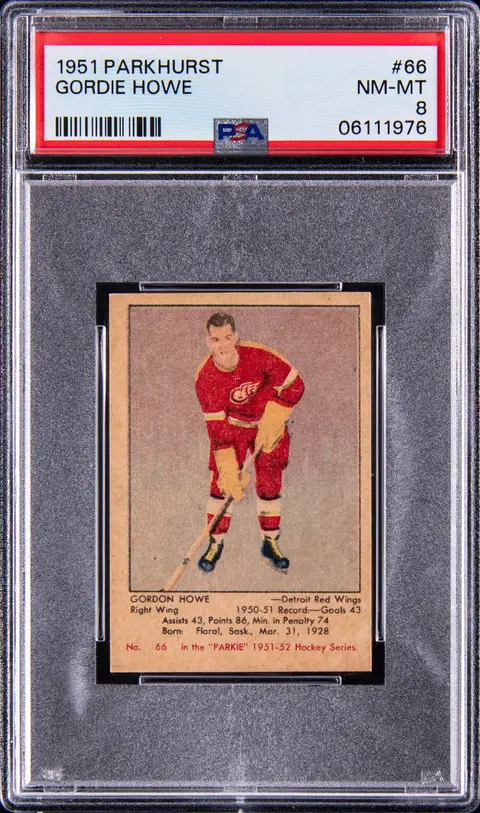
Sold Card
1951-52 Parkhurst #66 Gordie Howe Rookie Card - PSA NM-MT 8
Sale Price
Platform
GoldinA PSA 8 Gordie Howe rookie just changed hands at Goldin, and it’s a useful moment to pause and look at what this card means for the hobby.
On February 22, 2026, Goldin sold a 1951–52 Parkhurst #66 Gordie Howe Rookie Card, graded PSA NM-MT 8, for $56,242. For vintage hockey collectors, this is one of the cornerstone cards in the entire market.
The card: 1951–52 Parkhurst #66 Gordie Howe RC
Let’s start by identifying the card clearly:
- Player: Gordie Howe
- Team: Detroit Red Wings
- Year: 1951–52
- Set: Parkhurst Hockey (often called “’51 Parkhurst”)
- Card number: #66
- Type: True rookie card (Howe’s first widely recognized mainstream issue)
- Era: Vintage
- Grading company: PSA (Professional Sports Authenticator)
- Grade: NM-MT 8 (Near Mint–Mint)
There are no parallels, serial numbers, patches, or autographs here. Like most early 1950s cards, this is a simple, small-format cardboard card with a classic portrait. The appeal is all about era, scarcity, condition, and player legacy.
Why this card matters to collectors
Gordie Howe is one of the defining names in hockey history. For many collectors, his 1951–52 Parkhurst rookie sits in the same conversation as:
- 1951–52 Parkhurst Maurice “Rocket” Richard
- 1966–67 Topps Bobby Orr rookie
- 1979–80 O-Pee-Chee Wayne Gretzky rookie
The 1951–52 Parkhurst set itself is historically important. It marked the return of major hockey trading cards after World War II and is considered the beginning of the modern hockey card era. Printing quality and centering were rough by today’s standards, and the cards are smaller than standard modern issues. That combination makes high-grade examples much harder to find.
Because of that, condition is everything. A clean, well-centered copy with strong corners in PSA 8 or better is meaningfully scarcer than raw or low-grade versions. When collectors talk about “chasing a vintage key,” this Howe rookie is the kind of card they mean.
Grade scarcity and pop context
A “pop report” (population report) is a grading company’s count of how many copies of a card they’ve graded at each grade level. For the 1951–52 Parkhurst Gordie Howe, the overall PSA population is modest compared with modern stars, and the number of PSA 8 copies is a small fraction of total submissions. Higher grades (PSA 8.5, 9, and up) are increasingly rare.
Even within the same grade, eye appeal matters. Centering, print quality, and color can push a specific example to the high or low end of the price range for that grade.
Market context: where $56,242 fits
This Goldin sale at $56,242 on February 22, 2026 sits in the upper tier of the vintage hockey market but below the headline numbers you see for the very finest Howe rookies.
Recent public sales over the last few years have shown a clear structure:
- Top grades (PSA 9 and above) can reach well into six figures when they surface, reflecting extreme scarcity.
- Mid–high grades (PSA 7–8 range) tend to land in the mid–five-figure band, with strong examples stretching higher depending on centering and timing.
- Lower grades and graded-authentic copies trade for much less, but even those usually command a premium because of the card’s importance.
Within that framework, a PSA 8 at $56,242 is consistent with the card’s status as a premier vintage hockey piece. It doesn’t represent an outlier record for the Howe rookie overall, but it’s in line with the idea that clean PSA 8 copies are firmly established as high-end collectibles.
When collectors talk about “comps,” they mean comparable recent sales used to understand price context. Looking across recent comps:
- This sale lands solidly in the typical range for a strong PSA 8, reflecting steady demand rather than an extreme spike.
- The broader vintage hockey market has shown more gradual movement than the sharp swings seen in some ultra-modern issues, and this result fits that more measured pattern.
Factors behind demand
Several long-term factors tend to support consistent interest in this card:
Player legacy
Howe’s on-ice résumé—multiple Hart Trophies, Stanley Cups, and decades of elite play—keeps him in the absolute top tier of hockey legends. He’s a fixture in Hall of Fame and “Mount Rushmore of hockey” conversations.Set importance
1951–52 Parkhurst is the first major hockey set of the postwar era. For set builders and vintage specialists, it’s non-negotiable. The Howe rookie is one of its key anchors.Vintage scarcity
Unlike modern cards with very high print runs and many parallel versions, this era has natural scarcity, especially in higher grades. Surviving copies often show heavy wear, so anything near mint or better is meaningfully tougher.Condition sensitivity
Small card size, rough cutting, and period handling mean that sharp corners and strong centering are uncommon. That’s a key reason a bump from PSA 7 to PSA 8 can represent a big price difference.
What this sale can tell collectors
For active collectors and small sellers, this Goldin sale offers a few takeaways:
Price confirmation, not a reset
The $56,242 result reinforces where strong PSA 8 copies sit in the market without rewriting the record books. It’s useful as one more data point when looking at comps.Emphasis on quality within the grade
As more collectors focus on eye appeal, well-centered PSA 8 examples with good color tend to perform better than technically similar but weaker-looking copies. That nuance often shows up in auction results.Vintage stability vs. modern volatility
Compared with modern prospect and ultra-modern chase cards, iconic vintage rookies like this Howe often move in a more gradual, fundamentals-driven way—player legacy, set importance, and condition.
None of this should be taken as financial advice or a guarantee of future prices. Markets change, and even the most established cards can move up or down over time.
How different types of collectors might view this card
- Newcomers and returning collectors may see this as a reference point. Even if a PSA 8 Howe rookie is out of budget, understanding its place in the hobby helps frame other vintage targets.
- Active hobbyists often treat results like this as a signal about overall confidence in vintage hockey—especially when the sale comes from a major auction house like Goldin on a specific, verifiable date.
- Small sellers and investors sometimes use these benchmark sales to refine how they think about condition premiums, especially if they’re deciding whether to grade raw vintage cards or upgrade an existing copy.
Final thoughts
The February 22, 2026 Goldin sale of a 1951–52 Parkhurst #66 Gordie Howe Rookie Card in PSA NM-MT 8 at $56,242 underlines why this card remains a core piece of the vintage hockey market. It combines an all-time player, a historically important set, true rookie status, and genuine high-grade scarcity.
As with any card, individual copies, eye appeal, and timing can shift results, so it’s worth looking at multiple recent comps and pop data when you’re making your own collecting decisions. But as a snapshot, this sale reinforces the Gordie Howe rookie’s role as one of the defining blue-chip cards in hockey collecting.