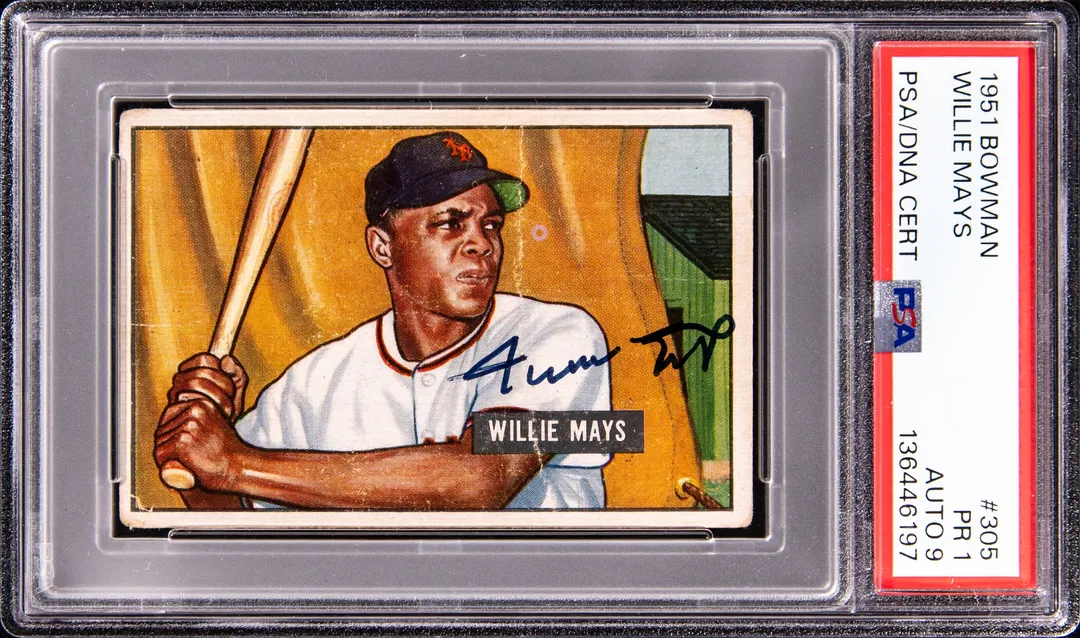
1951 Bowman Willie Mays Signed Rookie Sells for $27K
Goldin sold a 1951 Bowman #305 Willie Mays signed rookie (PSA 1, PSA/DNA 9) for $27,450. See how this result fits recent vintage baseball card sales.
Sold Card
1951 Bowman #305 Willie Mays Signed Rookie Card - PSA PR 1, PSA/DNA MINT 9
Sale Price
Platform
GoldinA $27,450 sale for a poor-condition vintage card might surprise new collectors, but the story behind this copy explains why it matters.
We’re looking at a recently sold:
- Card: 1951 Bowman Willie Mays Rookie
- Set: 1951 Bowman Baseball
- Card number: #305
- Player: Willie Mays, New York Giants
- Type: True rookie card (generally accepted first mainstream card)
- Attributes: On‑card autograph, PSA/DNA certified
- Card grade: PSA PR 1 (Poor)
- Autograph grade: PSA/DNA MINT 9
- Sale price: $27,450 (converted from 2,745,000 cents)
- Auction house: Goldin
- Sale date (UTC): 2/08/26
For vintage collectors, this is one of the essential post‑war baseball cards: the recognized rookie of an inner‑circle Hall of Famer and a top‑five all‑time player. Even in a low technical grade, it commands strong interest—especially when paired with a high‑quality autograph.
Why the 1951 Bowman Willie Mays matters
The 1951 Bowman set is a cornerstone of early 1950s baseball:
- It features rookie cards of both Willie Mays and Mickey Mantle, making it one of the most important post‑war issues.
- The artwork is small but colorful, with a classic, almost hand‑painted look.
- The print run is limited compared with modern products, so high‑grade copies are legitimately scarce.
For Willie Mays specifically, #305 is widely accepted as his flagship rookie card. That means it’s his first major, mass‑distributed card and the one that usually carries the most long‑term hobby significance.
Collectors also pay attention to the era:
- Vintage era (pre‑1970): Fewer cards exist, many survived in poor condition, and high grades are very tough.
- Eye appeal vs. technical grade: Even low‑grade vintage can be highly collectible if the overall look is strong.
In this case, the card is a PSA 1, which signals heavy wear, but the autograph is graded PSA/DNA MINT 9, meaning the signature itself is extremely strong.
Card details: condition vs. autograph
This copy combines two different grading angles:
Card grade – PSA PR 1 (Poor)
- Indicates major flaws: creases, heavy rounding, surface wear, or other damage.
- For 1951 Bowman Mays, a PSA 1 is not rare, but demand remains steady because many collectors simply want any authentic example.
Autograph grade – PSA/DNA MINT 9
- The card is signed by Willie Mays and authenticated by PSA/DNA, PSA’s autograph division.
- A MINT 9 grade means the autograph is bold, well‑placed, and nearly flawless in PSA’s view.
This creates a familiar vintage scenario:
- The card itself is at the low end of the technical scale.
- The autograph is near the top of the scale.
Collectors often value this kind of pairing because high‑quality, on‑card signatures on true rookies are much harder to replace than low‑grade base copies.
Market context: how does $27,450 fit in?
In hobby conversations, you’ll often hear people talk about “comps”—short for comparables. These are recent, similar sales used to understand current pricing.
For the 1951 Bowman Willie Mays, non‑autographed copies provide some baseline context:
- PSA 1 (unsigned) examples have generally traded well into the five‑figure range in recent years, depending on eye appeal and market conditions.
- Mid‑grade unsigned copies (PSA 4–6) typically bring significantly more, as condition drives large price steps in vintage.
Autographed copies form a smaller, more specialized segment:
- Signed 1951 Bowman Mays rookies are much less common than unsigned ones, especially with strong placement and third‑party grading.
- High‑grade autographs (PSA/DNA 9–10) on low‑grade cards often fall in a price band where the auto premium partly offsets the poor technical grade.
Within that broad context, a $27,450 result for a PSA 1 / PSA/DNA 9 auto is consistent with what you’d expect for:
- A true rookie of a top‑tier Hall of Famer
- A low card grade but elite signature quality
- A major auction platform with strong vintage bidding
While exact sales for the same grade/auto combination can vary from auction to auction, this figure sits in a range that feels in line with the card’s position in the market rather than a major outlier.
Why signed vintage rookies draw attention
Most 1951 Bowman Mays rookies that survive are unsigned. Many were pulled from packs, handled by kids, and stored without the idea that future signatures would matter.
Key factors that make signed copies interesting to collectors:
On‑card, period‑appropriate signature
The autograph is directly on the original rookie card, not on a modern reprint or a sticker.Authenticity and grading
PSA/DNA’s involvement reduces uncertainty about whether the signature is genuine and how it presents.Shrinking supply
With Willie Mays now part of baseball history rather than the present, no new on‑card rookie autographs can be added. What exists is all the hobby will ever have.Dual appeal
The card appeals both to rookie card collectors and to autograph collectors, broadening its potential audience at auction.
Figuring out value: eye appeal, not just numbers
For newcomers, it’s easy to over‑index on the numeric grade. With vintage, the picture is more nuanced:
- Two PSA 1s can be very different. One might be heavily creased with paper loss; another might have a big crease but strong color and centering.
- Autograph placement matters. A bold signature that sits cleanly across the image, without heavy smudging or fading, tends to be more desirable.
This sale’s PSA/DNA MINT 9 signature suggests:
- Strong ink saturation
- Clean lines
- Little to no visible skipping or smearing
That kind of autograph can help offset the limitations of a poor card grade in the eyes of many collectors.
Where this sale fits in the broader Willie Mays market
Willie Mays cards, especially his rookie, have long been treated as foundational pieces in a vintage baseball collection.
Some broad hobby context:
- High‑grade 1951 Bowman Mays rookies (unsigned) have crossed into very high six‑figure territory at times, especially in PSA 8 and above.
- Mid‑grade examples remain highly contested in auctions because they balance condition with relative affordability.
- Lower‑grade copies offer an entry point to owning the card while still carrying the historic significance of the issue.
Signed copies, particularly with strong autograph grades, sit in their own lane:
- They won’t directly track unsigned PSA price ladders, but they often hold collector interest well because they’re harder to replace.
- Auction results like this one help define a reference point for future buyers and sellers when they talk about “recent sales” instead of guessing at value.
Takeaways for collectors and small sellers
A few practical lessons from this Goldin sale on 2/08/26:
- Don’t dismiss low‑grade vintage. A PSA 1 can still be a five‑figure card if the player and issue are important enough.
- Autograph grade can be a major lever. For signed vintage rookies, a high autograph grade (like PSA/DNA 9) can materially influence what bidders are willing to pay.
- Know your segment. Unsigned, signed, and reprint markets behave differently. Compare like with like when looking at comps.
- Context matters more than single headlines. One sale is a data point, not a guarantee. Watching multiple auctions over time gives a clearer view of how demand is trending.
For anyone tracking blue‑chip vintage, this 1951 Bowman #305 Willie Mays Signed Rookie (PSA 1, PSA/DNA 9) at $27,450 via Goldin on 2/08/26 is another useful marker: even at the bottom of the technical scale, historically important rookies with top‑tier signatures continue to draw serious attention.
As always, think about your goals—whether collecting, consolidating, or selling—and use results like this as information, not as promises. The market for a card like this is built on history, scarcity, and long‑term respect for Willie Mays’ place in the game, not short‑term speculation.