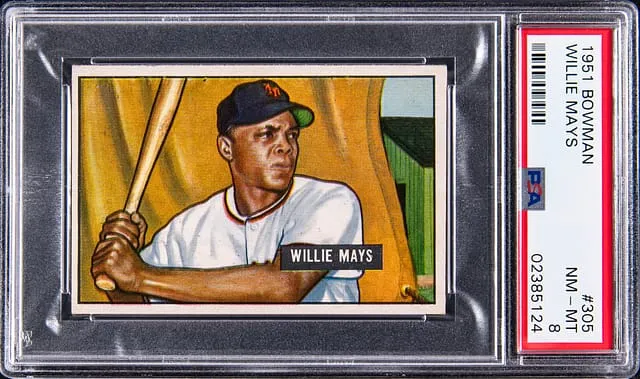
1951 Bowman Willie Mays Rookie PSA 8 Sells for $209K
Goldin sold a 1951 Bowman #305 Willie Mays rookie PSA 8 for $209,840 on Feb 22, 2026. See what this means for vintage baseball card collectors.
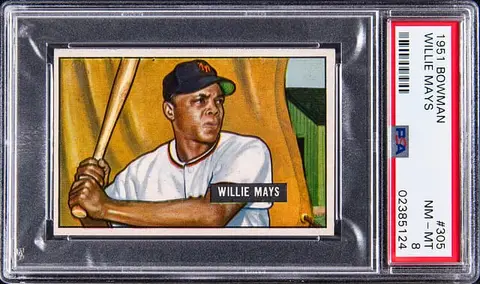
Sold Card
1951 Bowman #305 Willie Mays Rookie Card - PSA NM-MT 8
Sale Price
Platform
Goldin1951 Bowman #305 Willie Mays Rookie Card (PSA NM-MT 8) Sells for $209,840 at Goldin
Willie Mays’ 1951 Bowman rookie is one of the pillars of post‑war vintage collecting, and a recent sale has quietly reinforced its status.
On February 22, 2026, Goldin sold a 1951 Bowman #305 Willie Mays Rookie Card graded PSA NM-MT 8 for $209,840. For collectors who track this card, the result sits within the established range for strong examples in this grade and confirms ongoing, steady demand.
In this post, we’ll break down what this card is, why it matters, and how this sale fits into the broader market.
Card breakdown: what exactly sold?
- Player: Willie Mays, New York Giants (Hall of Famer)
- Year & set: 1951 Bowman Baseball
- Card number: #305
- Key designation: Widely recognized as Willie Mays’ flagship rookie card
- Era: Vintage (post‑war, pre‑Topps dominance)
- Grading company: PSA (Professional Sports Authenticator)
- Grade: PSA 8 – NM-MT (Near Mint–Mint)
- Attributes: Standard base card, no autograph, no memorabilia, no serial numbering
The 1951 Bowman issue predates Topps’ major 1950s runs and includes rookie cards of both Willie Mays and Mickey Mantle. Within the Bowman run, card #305 is the cornerstone Mays card and is treated as his primary, mainstream rookie.
Why the 1951 Bowman Willie Mays matters
A foundational vintage rookie
Willie Mays is firmly in the conversation for greatest player of all time. For many baseball collectors, his 1951 Bowman rookie is the definitive way to collect him in the vintage lane.
Several factors drive the importance of this card:
- First major-issue card: It’s his earliest broadly distributed, fully recognized rookie in a mainstream set.
- Historic set: 1951 Bowman is one of the last major Bowman issues before Topps reshaped the hobby. The set includes premier rookies and is a key target for set builders.
- Era scarcity: Production was modest by modern standards, and surviving high-grade copies are relatively limited compared to post‑1980 issues.
- Visual appeal: The painted artwork and classic Giants uniform give the card strong eye appeal, which matters a lot to vintage collectors.
Vintage, condition, and scarcity
In modern and ultra‑modern cards, scarcity often comes from serial numbering, rare parallels, or case hits. In vintage, scarcity is mostly about surviving condition.
The 1951 Bowman Mays is not impossible to find in low to mid grades, but it becomes meaningfully scarce as you climb the grading ladder. Centering, print quality, and decades of handling make high‑end copies tough.
That’s where PSA 8 and above become the real battleground for advanced collectors.
Grading context: what does a PSA 8 mean here?
PSA uses a 1–10 scale, where 10 is Gem Mint. For a 1951 card, a PSA 8 is a high grade and typically reflects:
- Strong centering (though some tolerance for minor shifts)
- Sharp corners with only light touches
- Clean surfaces with minimal print defects
- Bright color and solid overall presentation
While exact PSA population (pop) numbers can change over time as more cards are submitted, the general pattern is consistent:
- Lower grades (PSA 1–4): More common; accessible entry point into owning the card.
- Mid grades (PSA 5–6): Popular balance between price and eye appeal.
- Upper mid/high grades (PSA 7–8): Noticeably scarcer; significant step up in price.
- Top grades (PSA 9–10): Extremely limited; often headline‑making when they sell.
A “pop report” is the grading company’s census that shows how many copies exist at each grade level. For key vintage rookies like Mays, collectors often study the pop report to understand how rare the higher grades really are.
Market context and recent sales
Because auction data changes month to month, it’s useful to focus on directional context rather than a single “correct” value.
Recent public sales data for the 1951 Bowman Willie Mays in PSA 8 and nearby grades show:
- PSA 8 examples in recent years have generally landed in the low‑ to mid‑six‑figure range when the card has strong eye appeal and presents well for the grade.
- PSA 7 copies typically sell for meaningfully less, reflecting both grade difference and the tighter supply of true NM-MT examples.
- PSA 9 copies, when they appear, can sell for substantially more than PSA 8 and have historically produced some of the biggest public prices for this card.
Against that backdrop, the $209,840 sale at Goldin on February 22, 2026 is consistent with expectations for a presentable PSA 8. It’s neither a dramatic outlier low nor a clear record‑setting high, which is often what collectors like to see: confirmation that the market for a blue‑chip vintage card remains orderly.
How this sale fits into the longer history
The 1951 Bowman Mays has:
- Seen significant appreciation over multi‑year horizons, especially through hobby growth periods.
- Posted headline numbers in top grades (PSA 9 and above), occasionally drawing mainstream media coverage when records are set.
By comparison, this PSA 8 sale is best understood as a steady, high‑end comp rather than a record breaker.
A “comp” (comparable sale) is simply a recent, similar transaction that collectors and sellers use as a reference point. This Goldin result now becomes one of the more recent reference points for PSA 8 pricing.
Why collectors track this kind of sale
For newcomers and returning collectors, it can be helpful to understand why sales like this matter even if you’re not bidding at this level.
- Benchmark for the player: Mays is a core Hall of Famer. His flagship rookie’s performance often informs how the market treats his secondary cards.
- Vintage health check: Blue‑chip vintage rookies like this are one way hobbyists gauge the overall health of the vintage segment compared to modern and ultra‑modern.
- Grade‑to‑grade relationships: Watching how PSA 8 prices move relative to PSA 7 and PSA 9 helps collectors make informed decisions when trading across grades.
- Set building context: For collectors building 1951 Bowman sets or Hall of Fame rookie runs, understanding where the Mays rookie sits is essential for planning.
Eye appeal and why two PSA 8s aren’t always equal
One subtle but important point: not all cards with the same numerical grade command the same price.
Collectors often pay attention to:
- Centering: Stronger centering tends to draw more interest.
- Color and gloss: Rich color and clean surfaces can support stronger results.
- Print issues: Print lines, snow, or registration problems can hold a card back.
This is especially true at higher price points. When a PSA 8 sells for a premium relative to recent comps, it’s often because the card is a particularly strong example for the grade.
While the Goldin sale sits within an expected range, serious buyers would likely have evaluated the specific copy’s centering and overall presentation closely before bidding.
Takeaways for different types of collectors
New and returning collectors
- The 1951 Bowman Willie Mays is a foundational card in vintage baseball.
- You don’t need a PSA 8 to participate; lower‑grade copies offer a more accessible route into owning the same iconic image and historical moment.
- Watching PSA 8 and higher sales helps you understand the “top of the ladder,” which can inform how you see value in lower grades.
Active hobbyists and small sellers
- This $209,840 result reinforces PSA 8 as a key inflection point: meaningful scarcity compared to mid‑grades, but still more accessible than the ultra‑scarce top grades.
- When evaluating a PSA 8 you own or are considering buying, pay close attention to centering and overall eye appeal; the market clearly differentiates between average and exceptional examples.
- For dealers or small sellers, this sale is a useful recent comp when fielding offers on similar copies, while still leaving room to adjust based on specific card quality and timing.
Final thoughts
The February 22, 2026 Goldin sale of a 1951 Bowman #305 Willie Mays Rookie Card graded PSA NM-MT 8 at $209,840 is another data point affirming the card’s place among the hobby’s core vintage keys.
It doesn’t rewrite the record books, but it doesn’t need to. For many collectors, the steady performance of fundamental cards like this is exactly what they look for when trying to understand the long‑term shape of the market.
As always, individual decisions should be based on your own collecting goals, risk tolerance, and budget. Tracking sales like this can help you stay informed, whether you’re chasing a high‑grade example or simply appreciating one of the hobby’s most important rookie cards from a distance.