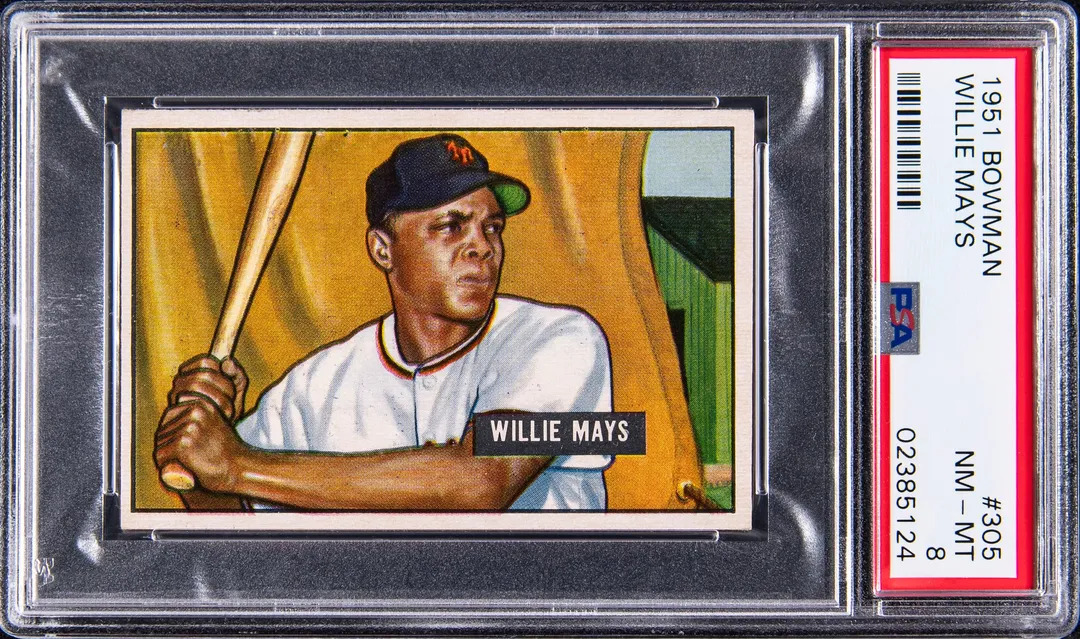
1951 Bowman Willie Mays PSA 8 Rookie Sells for $209K
Breakdown of the $209,840 Goldin sale of a 1951 Bowman #305 Willie Mays rookie card graded PSA 8 and what it means for vintage collectors.
Sold Card
1951 Bowman #305 Willie Mays Rookie Card - PSA NM-MT 8
Sale Price
Platform
Goldin1951 Bowman #305 Willie Mays Rookie Card (PSA 8) Sells for $209,840 at Goldin
When a cornerstone vintage rookie surfaces in a high grade, the hobby pays attention. That’s exactly what happened on February 22, 2026, when a 1951 Bowman #305 Willie Mays rookie card, graded PSA NM-MT 8, sold for $209,840 at Goldin.
In this breakdown, we’ll look at what this card is, how this price fits into recent market data, and why the 1951 Bowman Mays rookie remains one of the most respected vintage baseball cards in the hobby.
The card at a glance
- Player: Willie Mays
- Team: New York Giants
- Year: 1951
- Set: 1951 Bowman Baseball
- Card number: #305
- Type: True rookie card (first mainstream issue)
- Grading company: PSA (Professional Sports Authenticator)
- Grade: PSA 8 (NM-MT, Near Mint–Mint)
- Attributes: Standard base card, no auto or memorabilia; value driven by vintage scarcity, condition, and historical importance
The 1951 Bowman set is a key early-1950s release known for its hand-painted artwork and relatively small card size. Within that set, card #305 is the definitive Willie Mays rookie. Along with the 1952 Topps Mays, it anchors almost every discussion of post-war Hall of Fame rookie cards.
Why the 1951 Bowman Willie Mays matters
A flagship rookie of an inner-circle Hall of Famer
Willie Mays is widely considered one of the most complete players in baseball history. When collectors talk about post-war "inner-circle" legends—names like Mickey Mantle, Hank Aaron, Jackie Robinson, and Roberto Clemente—Mays is always in the conversation.
The 1951 Bowman #305 is:
- Mays’s first mainstream card, generally accepted as his true rookie.
- A cornerstone of vintage collecting, often included in lists of the most important post-war cards.
- A visual icon, with Bowman’s painted-style portrait capturing a young Mays as he breaks into the majors with the New York Giants.
Because of this, the card sits in the same conceptual tier as other hobby touchstones like the 1952 Topps Mantle and 1954 Topps Hank Aaron, even if the exact dollar levels differ.
Vintage era context
The early 1950s fall firmly into the vintage era, characterized by:
- Lower production compared with modern cards
- Fewer surviving high-grade copies
- Significant condition sensitivity: centering, print defects, and edge wear are common issues
That combination means that while the card itself is not impossibly rare, truly clean copies with strong eye appeal command a premium.
The importance of a PSA 8 grade
PSA uses a 1–10 scale, where 10 is Gem Mint. A PSA 8 (NM-MT) generally indicates:
- Sharp corners with only very minor touches
- Clean surfaces with minimal print defects
- Solid color and gloss
- Acceptable centering (though not always perfect)
For a 1951 card, that puts this copy well above the average survivor. The PSA 8 tier is often the “sweet spot” for many vintage collectors: high-end condition without the exponential price jumps of PSA 9 or PSA 10, which are exceedingly scarce for a card of this age.
Population (“pop report”) data from PSA typically shows that:
- Lower grades (PSA 1–5) are much more common.
- PSA 7 and 8 are significantly tougher.
- PSA 9 and especially PSA 10 examples are rare and tend to set headline-level records when they appear at auction.
While exact population numbers can change as new submissions are graded or re-graded, the overall pattern holds: a PSA 8 Mays Bowman rookie is a premium but still somewhat accessible tier for serious vintage buyers.
Market context: how $209,840 fits in
The Goldin sale closed on February 22, 2026 at $209,840, a strong, six-figure result for a PSA 8 copy.
Looking at recent comps
“Comps” (short for “comparables”) are recent, similar sales that help provide price context. For the 1951 Bowman Willie Mays, it’s helpful to look across major auction houses and marketplaces at:
- This exact card: 1951 Bowman #305 Willie Mays, PSA 8
- The next grades up: PSA 8.5 and PSA 9
- The next grade down: PSA 7 or PSA 6
Across the last few years, hobby-visible trends for this card have generally looked like:
- PSA 8 copies routinely selling in the low-to-mid six figures, depending on centering, eye appeal, and timing.
- PSA 7 copies landing meaningfully lower, often in the high five-figure to low six-figure range.
- PSA 9 copies appearing far less often and typically selling at a significant multiple of PSA 8 prices.
Within that framework, a $209,840 result in early 2026 places this sale squarely in the stronger portion of recent PSA 8 outcomes rather than at a deep discount or an unexpected outlier.
While each copy is unique—especially with vintage centering and print characteristics—the sale level aligns with the card’s long-established position as a blue-chip vintage rookie.
How this compares to historical highs
Over the last decade, this card has:
- Climbed substantially from earlier hobby eras when six-figure prices for most vintage rookies were less common.
- Seen notable spikes in periods of broader market enthusiasm, followed by periods of consolidation where prices stabilize and track more closely with supply and demand.
Higher-grade examples (particularly PSA 9) have achieved headline-grabbing results, reinforcing the Bowman Mays rookie’s status as a key measuring stick for the vintage market. Against that backdrop, a strong six-figure PSA 8 sale at Goldin continues the pattern of sustained demand rather than sudden, speculative movement.
Why collectors chase this card
Historical and hobby significance
Several factors keep the 1951 Bowman Willie Mays near the top of many want lists:
- Hall of Fame pedigree – Mays’s all-around excellence (power, average, speed, defense, and arm) makes his rookie a long-standing hobby target.
- Post-war importance – The early 1950s mark a foundational era for modern baseball cards, and 1951 Bowman is one of the key sets of that period.
- Artwork and aesthetics – Many collectors favor the painted Bowman look and the compact design of the 1951 issue.
- Cross-collector appeal – It attracts player collectors, set builders, vintage specialists, and investors who focus on historically important cards.
Scarcity in high grade
1951 cards have had more than seven decades to pick up wear: rubber bands, shoe boxes, and years of handling. That’s why:
- Lower-graded copies are easier to track down.
- Eye-appealing PSA 8s are less common and command a significant premium.
- Centering and overall presentation can swing prices even within the same numerical grade.
Collectors who focus on condition often view a PSA 8 as a long-term “keeper” grade for a vintage anchor card like this, especially when the centering and registration (print clarity) are strong.
Factors influencing interest today
For a card of this historical stature, demand is driven more by long-term hobby fundamentals than short news cycles. However, several ongoing factors support collector attention:
- Persistent respect for vintage icons – Even when modern and ultra-modern markets fluctuate, demand for legendary Hall of Famers tends to remain more stable.
- Continued institutional interest – Major auction houses like Goldin regularly featuring this card in high-profile sales helps keep it visible and validated as a key piece of the vintage landscape.
- Education of newer collectors – As more people learn the difference between rookie cards, reprints, and modern inserts, the 1951 Bowman Mays often surfaces as a “bucket list” example of what a cornerstone vintage rookie looks like.
What this sale tells us
The February 22, 2026 Goldin result does not radically rewrite the book on this card, but it does reinforce several themes:
- The 1951 Bowman Willie Mays rookie remains a priority target for advanced vintage collections.
- High-grade examples continue to justify strong, six-figure pricing, with PSA 8s firmly established as premium but still somewhat attainable compared with the ultra-rare PSA 9 tier.
- Auction venues like Goldin provide clear price signals for serious buyers and sellers watching the top of the market.
For newcomers, this sale is a reminder that some cards in the hobby are important less because of short-term moves and more because of decades of respect. For longtime collectors, it’s another data point confirming what they’ve known for years: the 1951 Bowman Willie Mays rookie in PSA 8 remains one of the pillars of post-war baseball card collecting.
As always, any single sale is best understood in context. Looking at a range of comps, population data, and the card’s place in hobby history provides a clearer picture than any one hammer price alone. This Goldin auction result simply adds another well-documented waypoint in the long story of one of vintage baseball’s most iconic rookie cards.