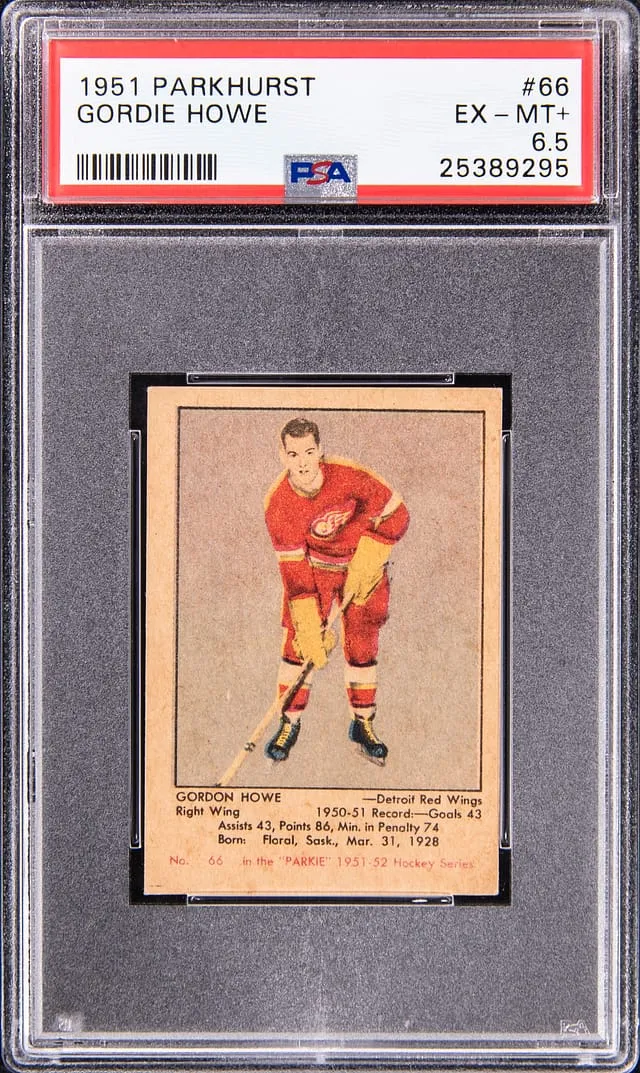
1951-52 Parkhurst Gordie Howe Rookie PSA 6.5 Sale
Goldin sold a 1951-52 Parkhurst #66 Gordie Howe rookie PSA 6.5 for $21,960 on Feb 22, 2026. See the market context and what it means for collectors.
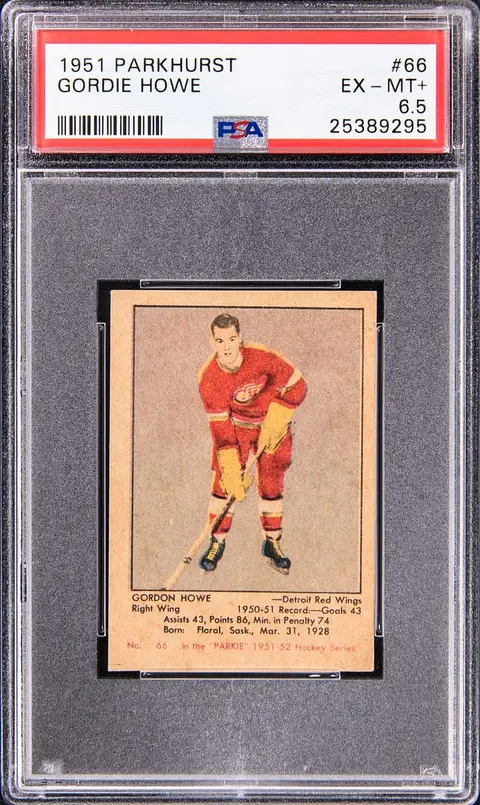
Sold Card
1951-52 Parkhurst #66 Gordie Howe Rookie Card - PSA EX-MT+ 6.5
Sale Price
Platform
Goldin1951-52 Parkhurst #66 Gordie Howe Rookie Card (PSA EX-MT+ 6.5) Sold for $21,960
On February 22, 2026, Goldin closed a notable vintage hockey sale: a 1951-52 Parkhurst #66 Gordie Howe Rookie Card, graded PSA EX-MT+ 6.5, realized $21,960.
For collectors who track key vintage hockey pieces, this is an important data point for one of the most historically significant Gordie Howe rookies in the market.
The card at a glance
- Player: Gordie Howe
- Team: Detroit Red Wings
- Year / Set: 1951-52 Parkhurst Hockey
- Card number: #66
- Status: Recognized rookie card and true hobby cornerstone
- Grading company: PSA (Professional Sports Authenticator)
- Grade: EX-MT+ 6.5
- Attributes: Standard issue (no autograph, no memorabilia), early-1950s cardboard with classic Parkhurst design
The 1951-52 Parkhurst set is widely viewed as one of the foundational post-war hockey releases. Production quality was modest by modern standards—off-centering, print defects, and rough cuts are common—so mid- to high-grade examples stand out.
Why this Gordie Howe rookie matters
Gordie Howe is one of the defining names in hockey history: a multi-time Hart Trophy winner, four-time Stanley Cup champion with the Red Wings, and the player who inspired the term "Gordie Howe hat trick." His rookie from 1951-52 Parkhurst is:
- A flagship rookie – It is among the most recognized and pursued Howe rookies in the entire hobby.
- A key vintage hockey anchor – Collectors building long-term vintage hockey collections often start with names like Howe, Richard, and Gretzky; this card sits on that short list of essentials.
- Condition-sensitive – Early-1950s Parkhurst cards often suffer from poor centering, soft corners, and surface wear, so anything in the EX range and above draws strong attention.
In hobby terms, this is a true "key"—a foundational card that many long-time collectors and set builders eventually target.
Understanding a PSA 6.5 in this context
A PSA EX-MT+ 6.5 grade indicates:
- Corners: Noticeable but moderate wear, still reasonably sharp for a 1951 issue.
- Surface: Some small flaws typical of the era, but no major creases that break the card’s overall eye appeal.
- Centering: Usually decent, though not necessarily within strict high-grade thresholds.
For early Parkhurst, the jump from mid-grade (PSA 3–4) into solid EX and above is meaningful. The population in these ranges is naturally lower because:
- Fewer cards survived in good condition.
- Many copies were stored loosely, handled by kids, or exposed to moisture and light over decades.
While exact PSA population numbers can change over time, the general pattern is consistent across vintage hockey: there are far fewer true mid-to-high-grade examples than well-loved lower-grade copies.
Recent market context and comparable sales
To place this $21,960 Goldin result in context, it helps to look at recent public auction data for the same card and closely related grades. Across major marketplaces and auction houses over the past couple of years, the pattern broadly looks like this (ranges are approximate and depend heavily on eye appeal and centering):
- Lower mid-grades (PSA 3–4) – Often trading in the low-to-mid five figures for solid-looking copies.
- Upper mid-grades (PSA 5–6) – Frequently push deeper into the mid-five-figure range, especially when centering and color are above average.
- PSA 7 and above – High-grade Howe Parkhurst rookies are meaningfully scarcer and can climb significantly, with strong examples drawing competitive bidding.
A PSA 6.5 sits in a narrow band between EX-MT 6 and NM 7. In vintage, that half-grade can matter because collectors often pay a premium for:
- Cleaner centering than typical for the grade.
- Strong color and registration (sharpness of the printed image).
- Fewer distracting print defects.
At $21,960, this specific sale lands in what appears to be a reasonable mid-to-upper range for a PSA 6–7 tier Howe Parkhurst rookie, based on recent publicly available comps ("comps" meaning comparable recent sales of similar cards). It does not look like an outlier record-breaker, but rather a healthy, data-rich result that confirms ongoing demand.
Because vintage markets move gradually compared with modern, the exact positioning of this price will be clearer as more PSA 6, 6.5, and 7 examples sell later in 2026. For now, it aligns well with the broader pattern of strong, steady interest in historically important hockey rookies.
How this sale fits into the broader vintage hockey trend
Several long-running dynamics are relevant here:
Stability of iconic vintage vs. modern volatility
Modern and ultra-modern cards (roughly 2010s onward) can be heavily influenced by short-term performance, hype cycles, or social media. Vintage pillars like Gordie Howe usually move slower. Prices tend to react more to long-term demand, overall hobby health, and availability than to week-to-week news.Supply characteristics
The 1951-52 Parkhurst set was not printed anywhere near modern levels, and many surviving copies would not meet today’s grading standards. As a result, each mid- to high-grade sale provides useful information about where the market currently values these cards.Collector crossover appeal
This card attracts several kinds of buyers:- Vintage hockey specialists.
- Cross-sport collectors who want a small group of historically important cards (Ruth, Jordan, Gretzky, Howe, etc.).
- Set builders targeting complete or near-complete 1951-52 Parkhurst runs.
Because demand comes from multiple directions, the card tends to remain relevant even as the hobby’s focus shifts between eras and sports.
Possible influences on current interest
While this sale is more about long-run historical importance than news headlines, a few factors help explain why Gordie Howe material continues to see healthy demand:
- Enduring legacy – Howe’s career spans eras and leagues, and his name still comes up whenever all-time greats are discussed.
- Ongoing spotlight on vintage hockey – As collectors who grew up in the 1980s and 1990s mature in the hobby, interest has broadened from 1979-80 Gretzky rookies into deeper vintage catalogs, including 1950s Parkhurst.
- Set-level prestige – 1951-52 Parkhurst is regarded as a historically important set, which tends to support demand for its key stars.
No single recent event fully explains this result. Instead, it fits a longer-term pattern: serious collectors continue to seek out strong examples of core vintage hockey rookies, especially when they surface in well-known auctions like Goldin’s.
Takeaways for collectors and small sellers
For collectors watching this market or considering a move into vintage hockey, here are some practical observations based on this sale:
Condition still drives spread within the same grade label
Two cards in the same numerical grade can trade differently if one has better centering or stronger overall eye appeal. That’s especially true in vintage sets like 1951-52 Parkhurst, where production quirks are common.Mid-grade isn’t a compromise in early 1950s issues
In a modern context, collectors often chase gem mint grades exclusively. In early-1950s hockey, cards in the EX to NM range (PSA 5–7) are often viewed as high-quality targets and can be more attainable than top-pop examples.Use multiple comps, not a single sale
The $21,960 Goldin result is a helpful data point, but it’s best understood alongside other recent sales in nearby grades and conditions. Looking at several comps across platforms and auction houses offers a clearer picture of current demand.Vintage timelines tend to be longer
Many collectors approach cards like this with multi-year horizons rather than short-term flips. When watching or participating in this segment of the market, that slower pace is worth keeping in mind.
Final thoughts
The February 22, 2026 Goldin sale of a 1951-52 Parkhurst #66 Gordie Howe Rookie Card in PSA EX-MT+ 6.5 at $21,960 reinforces the card’s status as a central pillar of vintage hockey collecting. It doesn’t rewrite price history, but it does confirm ongoing, serious interest in strong mid- to high-grade copies of this iconic rookie.
For collectors, it’s another useful reference point when evaluating their own buying, selling, or long-term collecting plans around Gordie Howe and the 1951-52 Parkhurst set as a whole.