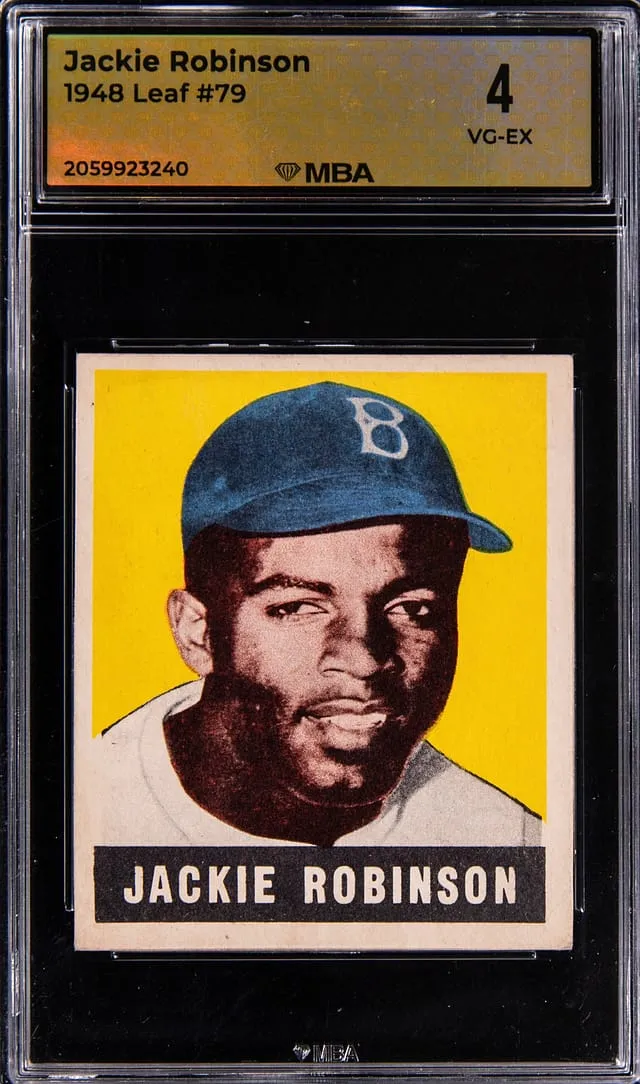
1948 Leaf Jackie Robinson Rookie Sells for $29K
Goldin sold a 1948 Leaf #79 Jackie Robinson Rookie (MBA VG-EX 4) for $29,433 on March 15, 2026. Here’s the price context and what it means for collectors.
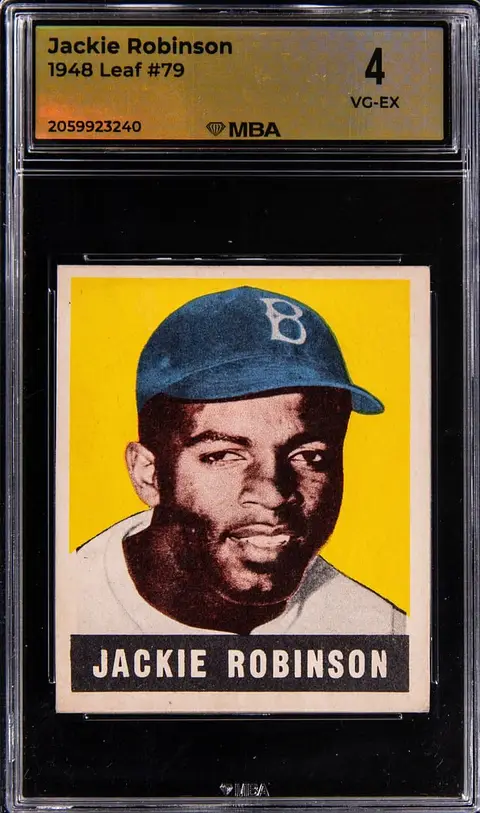
Sold Card
1948 Leaf #79 Jackie Robinson Rookie Card - MBA VG-EX 4
Sale Price
Platform
GoldinThe 1948 Leaf #79 Jackie Robinson Rookie Card has long been one of the pillars of vintage baseball collecting. On March 15, 2026, Goldin auctioned a copy graded MBA VG-EX 4 for $29,433, giving collectors another data point on where this historically important rookie currently sits in the market.
Card overview: 1948 Leaf #79 Jackie Robinson
For newer collectors, this is widely recognized as Jackie Robinson’s key mainstream rookie card and one of the defining post‑war vintage issues.
- Player: Jackie Robinson, Brooklyn Dodgers
- Year & set: 1948 Leaf Baseball
- Card number: #79
- Card type: Widely treated as Robinson’s flagship rookie card
- Era: Early post‑war vintage
- Grading company: MBA (graded VG‑EX 4)
- Attributes: Classic color portrait, no autograph, no serial numbering (typical for the era)
The 1948 Leaf set is known for bold colors, simple designs, and substantial print and centering issues. That combination makes eye appeal and condition especially important. Even mid‑grade copies can have significant value when the overall presentation is strong.
Why this card matters to collectors
Jackie Robinson is a central figure not only in baseball history but in American history. His breaking of MLB’s color barrier in 1947 makes his first widely available mainstream card a key target for:
- Vintage baseball collectors looking to build a post‑war Hall of Fame run
- Historically focused collectors who value cultural impact alongside on‑field performance
- Long‑term hobbyists who prioritize blue‑chip, historically significant cards
The 1948 Leaf Robinson sits in the same conversation as other iconic vintage rookies—like 1952 Topps Mickey Mantle or 1954 Topps Hank Aaron—though each has its own lane. Robinson’s card tends to attract buyers who want a combination of baseball greatness and broader historical significance.
The Leaf set itself is relatively tough compared to some later vintage issues. Common issues include:
- Off‑center fronts
- Print defects and color variations
- Chipping along the colored borders
Because of that, even cards in "VG‑EX" (Very Good to Excellent) range can be surprisingly competitive when they show solid color, an uncluttered image, and no major distractions.
Market context: where does $29,433 fit in?
This Goldin result at $29,433 for an MBA VG‑EX 4 lines up within the broader range that collectors have seen for mid‑grade Jackie Robinson Leaf rookies, especially when adjusted for grade label, eye appeal, and marketplace.
When talking about “comps” (comparable recent sales), collectors usually look across:
- Major auction houses (Goldin, Heritage, Memory Lane, etc.)
- Large fixed‑price and auction marketplaces
- Different grading companies (PSA, SGC, Beckett, and others)
Higher‑end examples in PSA or SGC holders, particularly strong 4s and 5s with clean centering and rich color, have historically brought a premium over more obscure grading labels. That means an MBA 4 will often be evaluated by:
- How the card looks compared to typical PSA/SGC 4s
- Whether a buyer might consider a future cross‑over to another grading company
Recent public sales show that:
- Strong mid‑grade copies in major grading company slabs (PSA/SGC) can often land well above the $20,000 mark, with especially nice 4s and 5s reaching meaningfully higher.
- Lower‑grade copies (for example, 1s and 2s) still attract consistent demand because they represent a more accessible entry point to this card.
This $29,433 result for an MBA VG‑EX 4 lands in a zone that makes sense when you weigh:
- The importance of the card
- The mid‑grade condition
- The grading label
- The reputation and reach of Goldin as the auction venue
It does not appear to be an outlier in either direction; instead, it adds another useful point on the curve of what solid mid‑grade Jackie Robinson Leaf rookies are bringing in a competitive, data‑aware market.
Grading, scarcity, and eye appeal
While the 1948 Leaf set is not short‑printed in a modern sense (no serial numbers, no pack odds), true high‑grade examples of Robinson’s rookie are not easy to find. Grading company population reports—often called a “pop report,” a count of how many copies exist in each grade—show a fairly steep drop‑off in higher grades.
For a mid‑grade 4 like this one, buyers typically focus on:
- Centering: The Leaf set commonly shows heavy tilt or border imbalance.
- Surface: Print snow, color loss, and stains can make a big difference.
- Edges and corners: Even wear is usually more desirable than one or two severely damaged corners.
- Registration: How sharp and aligned the image looks.
Because eye appeal can vary a lot within the same numerical grade, two VG‑EX 4s may sell for noticeably different amounts depending on how they present in hand and in auction photos.
Historical and hobby context
Jackie Robinson’s place in baseball and civil rights history gives this card a layer of demand that is less tied to the usual performance‑based cycles you might see for active players. While modern and ultra‑modern cards often move with short‑term news—awards, trades, playoff runs—the 1948 Leaf Robinson tends to behave more like a long‑term historical asset within the hobby.
A few factors that support consistent interest:
- Robinson’s continued visibility through MLB celebrations, museum exhibits, and educational efforts.
- Ongoing attention to barrier‑breaking athletes, which keeps his story at the forefront.
- A sustained collector base for vintage Hall of Famers.
This doesn’t mean prices move in only one direction; broader market cycles, macroeconomic conditions, and shifts in collector focus all matter. It does mean that demand for authentic, presentable copies of this card rarely disappears altogether.
What this Goldin sale tells collectors
This March 15, 2026 Goldin result offers a few practical takeaways for hobbyists:
Mid‑grade continues to be an active lane. The strong showing for a VG‑EX 4 reinforces that many collectors are comfortable targeting mid‑grade examples when high‑grade prices are out of reach.
Grading label and venue matter. Prices for this card can vary depending on the grading company and where it’s sold. A major auction house with broad reach—like Goldin—can help surface motivated bidders, even for cards in less common holders.
Condition details still drive outcomes. Within any 4 grade, better centering, color, and overall eye appeal can be the difference between a middling result and a standout one. Studying auction photos and past listings remains essential.
Useful data point, not a guarantee. This sale adds a fresh comp to the market, but it’s one datapoint among many. Future results will continue to depend on specific card quality, timing, and bidder pool.
How collectors might use this sale as a reference
If you are:
A buyer: This result can help you frame expectations for what a mid‑grade Jackie Robinson Leaf rookie might cost at a major auction house, adjusted for grading label and eye appeal.
A seller: This sale is a recent benchmark when evaluating whether to consign a similar card, or how to position a copy on fixed‑price platforms. It’s not a price promise, but it is a relevant reference.
A researcher or returning collector: This transaction confirms that the 1948 Leaf Jackie Robinson remains one of the hobby’s core vintage pieces, with sustained demand and well‑documented public sales.
Final thoughts
The March 15, 2026 Goldin auction of the 1948 Leaf #79 Jackie Robinson Rookie Card in MBA VG‑EX 4 at $29,433 fits cleanly into the larger story of this card: historically important, condition‑sensitive, and consistently followed by serious collectors.
For anyone building a vintage cornerstone collection, tracking results like this—across grades, grading companies, and venues—remains one of the most practical ways to understand where this iconic Jackie Robinson rookie sits in today’s market, without relying on speculation or short‑term hype.