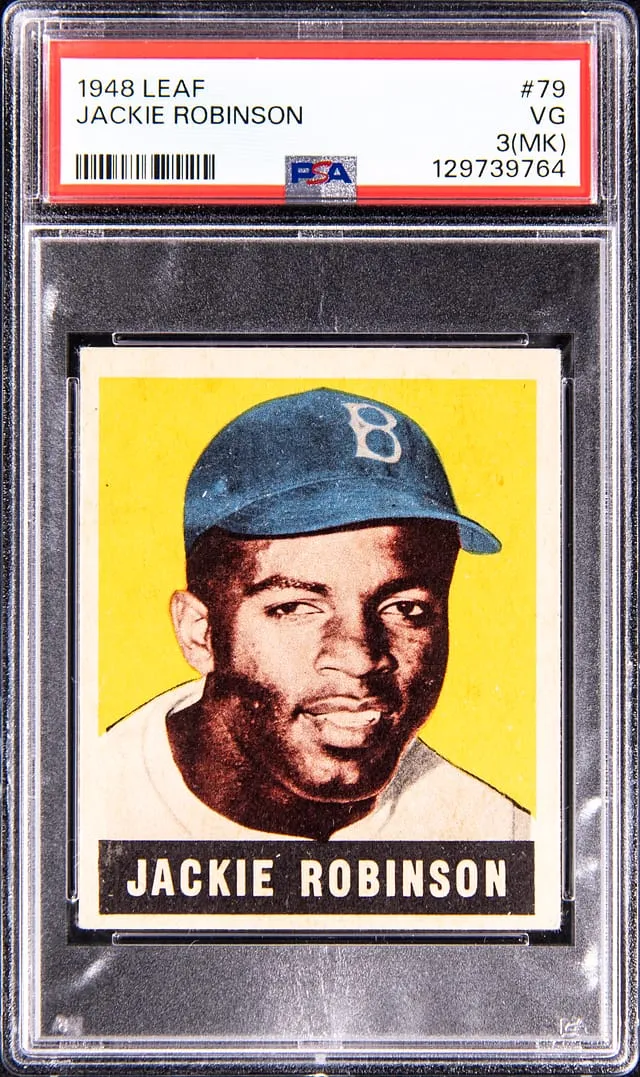
1948 Leaf Jackie Robinson PSA 3 Rookie Sells at Goldin
A 1948 Leaf #79 Jackie Robinson rookie PSA VG 3 (MK) sold for $14,640 at Goldin on Feb 22, 2026. See how this result fits recent vintage market trends.
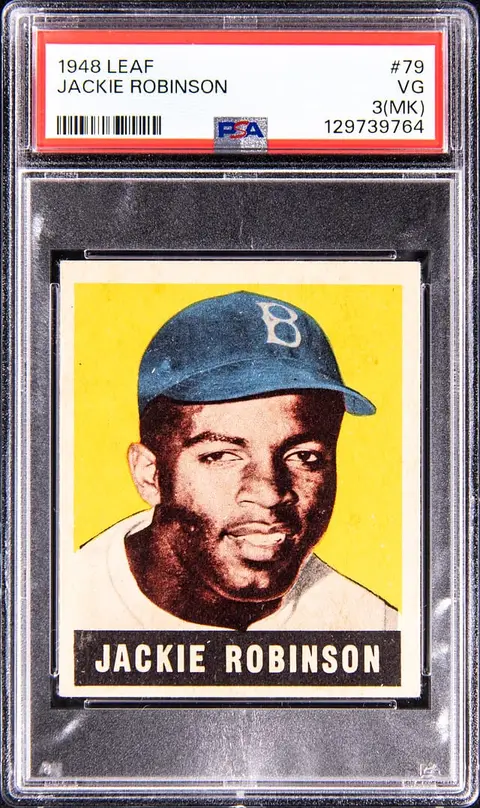
Sold Card
1948 Leaf #79 Jackie Robinson Rookie Card - PSA VG 3 (MK)
Sale Price
Platform
Goldin1948 Leaf #79 Jackie Robinson Rookie Card – PSA VG 3 (MK) Sells for $14,640 at Goldin
On February 22, 2026, Goldin closed the sale of a 1948 Leaf #79 Jackie Robinson rookie card graded PSA VG 3 (MK) for $14,640. For vintage baseball collectors, this is one of the cornerstone rookie cards in the entire hobby, and this result offers a useful snapshot of where mid‑grade copies are trading today.
The card at a glance
- Player: Jackie Robinson (Brooklyn Dodgers)
- Year: 1948
- Set: Leaf Baseball
- Card number: #79
- Card type: True rookie card and key Hall of Famer issue
- Era: Vintage (pre‑1960)
- Grading company: PSA (Professional Sports Authenticator)
- Grade: VG 3 (Very Good) with MK qualifier (notation/mark on the card)
The 1948 Leaf Jackie Robinson is widely considered one of the two essential Robinson rookies, alongside his 1949 Bowman. The bold, simplified portrait and solid‑color background make the card instantly recognizable, but they also tend to show flaws and print issues very clearly, which matters when we talk about condition and value.
What the “MK” qualifier means
PSA adds the MK qualifier when a card shows writing, ink, or another type of “mark” beyond normal wear—often a small name, price, or pencil notation. The base numeric grade (VG 3) still reflects overall wear (corners, surface, centering, creases), but the qualifier usually pulls prices below a straight, unqualified PSA 3.
Market context for this sale
The Goldin sale closed at $14,640. To understand that number, it helps to look at how similar copies have been trading recently:
- Unqualified PSA 3 examples of the 1948 Leaf Jackie Robinson have often sold in a noticeably higher band than qualified copies, reflecting collector preference for cleaner surfaces.
- Lower‑grade copies (PSA 1, PSA 1.5, PSA 2), especially with qualifiers like MK or ST (stain), can sell for a meaningful discount to mid‑grade examples but still command strong interest due to the card’s overall scarcity and importance.
- High‑grade examples (PSA 6 and above) and eye‑appeal outliers can reach very large auction numbers and have occasionally set headline‑making prices. Those record results create a wide range between low‑grade and top‑end copies.
Within that wider spectrum, a qualified PSA 3 (MK) at $14,640 sits in what appears to be a reasonable mid‑tier range for this card in the current market. It trades below a strong, unqualified PSA 3, but still reflects the card’s status as a premier vintage rookie.
Because this card trades infrequently relative to modern issues, day‑to‑day pricing can move quite a bit between auctions. Collectors tend to look at “comps”—recent comparable sales of the same card and grade—to estimate fair value, but each copy’s centering, color, and eye appeal can still push a result higher or lower.
Why this card matters to collectors
1. Jackie Robinson’s historical significance
Jackie Robinson broke Major League Baseball’s color barrier in 1947 with the Brooklyn Dodgers. Beyond his Hall of Fame resume on the field, his impact on American history and civil rights makes his cards stand apart from almost any other player.
That historical weight is a major reason his key issues—especially the 1948 Leaf rookie—draw interest from:
- Long‑time vintage baseball collectors
- Newer hobby participants who want one historically important card
- Collectors who focus on social and cultural icons, not just sports records
2. A cornerstone of vintage baseball
The 1948 Leaf baseball set is one of the landmark post‑war issues. It features bold colors, simple portraits, and several important Hall of Fame rookies. Production quality, however, was inconsistent:
- Color and print: Off‑registration (where colors don’t perfectly line up) and print dots are common.
- Centering: Left‑to‑right and top‑to‑bottom centering is often rough.
- Surface wear: The colored backgrounds show scratches, chips, and wear more easily.
All of this means truly clean examples are scarce. Even in modest grades, the Jackie Robinson rookie is considered a trophy card for many collections.
3. Vintage scarcity and grading realities
Unlike modern products with large print runs and sealed cases, late‑1940s cards were printed and distributed in a completely different era. Survival rates in collectible condition are much lower. Many copies that surface today show creases, writing, trimming, or other defects.
PSA’s population report (a public tally of how many copies they’ve graded at each grade level) shows that the 1948 Leaf Robinson has a relatively small graded population compared with modern stars. High‑grade examples (PSA 7 and above) are especially scarce.
In that context, even a PSA 3 (MK) sits in a competitive lane: it offers an authenticated, presentable copy of a globally recognized card at a fraction of elite‑grade prices.
How this Goldin sale fits into the bigger picture
Mid‑grade with a qualifier
The key nuance here is the combination of:
- A globally important rookie card
- A mid‑grade numeric assessment (3)
- A value‑impacting qualifier (MK)
Collectors often rank their preferences roughly as:
- Strong eye appeal, no qualifier
- Lower numeric grade with better eye appeal vs. higher grade with obvious flaws
- Qualified grades as a way to access a card at a lower entry point
At $14,640, this Goldin result reflects how the market is currently pricing that third lane—still significant, but accessible compared with a straight PSA 3 or above.
Why auction venue and timing matter
This sale ran through Goldin, one of the better‑known auction houses for high‑end sports cards and memorabilia. Established auction houses tend to:
- Attract a concentrated base of serious buyers
- Offer professional imaging and descriptions
- Provide some consistency in how key vintage cards are marketed
The closing date—February 22, 2026 (UTC)—places the sale in a period where vintage collecting has remained active, even as prices for some modern and ultra‑modern cards have cooled or fluctuated. Vintage Hall of Fame material like Jackie Robinson’s rookie often behaves differently than newer cards tied to short‑term performance or hype.
Takeaways for collectors and small sellers
For anyone tracking the 1948 Leaf Jackie Robinson market, this sale suggests a few practical points:
- Qualified vs. unqualified matters. A PSA 3 (MK) typically will not track one‑to‑one with a straight PSA 3. When checking comps, it helps to compare qualified copies to other qualified copies and weigh eye appeal carefully.
- Eye appeal can override the label. Two PSA 3 (MK) examples can still sell at different levels if one has better centering, stronger color, or a less distracting mark.
- Auction house choice influences results. Selling through a vintage‑friendly auction house like Goldin can put a card in front of the right bidders. For buyers, it also provides another comp source beyond fixed‑price marketplaces.
- This is a long‑term cornerstone card. While prices move, the 1948 Leaf Robinson has remained one of the most respected post‑war baseball cards. Many collectors who add one in any grade treat it as a long‑term collection piece rather than a short‑term flip.
Final thoughts
The $14,640 sale of a 1948 Leaf #79 Jackie Robinson rookie, PSA VG 3 (MK), at Goldin on February 22, 2026, reinforces how steady demand remains for historically important vintage cards—even when they carry qualifiers and mid‑tier grades.
For newcomers, this type of result is a clear reminder: in the vintage lane, story and significance often matter as much as the number on the label. For seasoned hobbyists, it’s another useful data point when mapping the price landscape of one of baseball’s most important rookie cards.