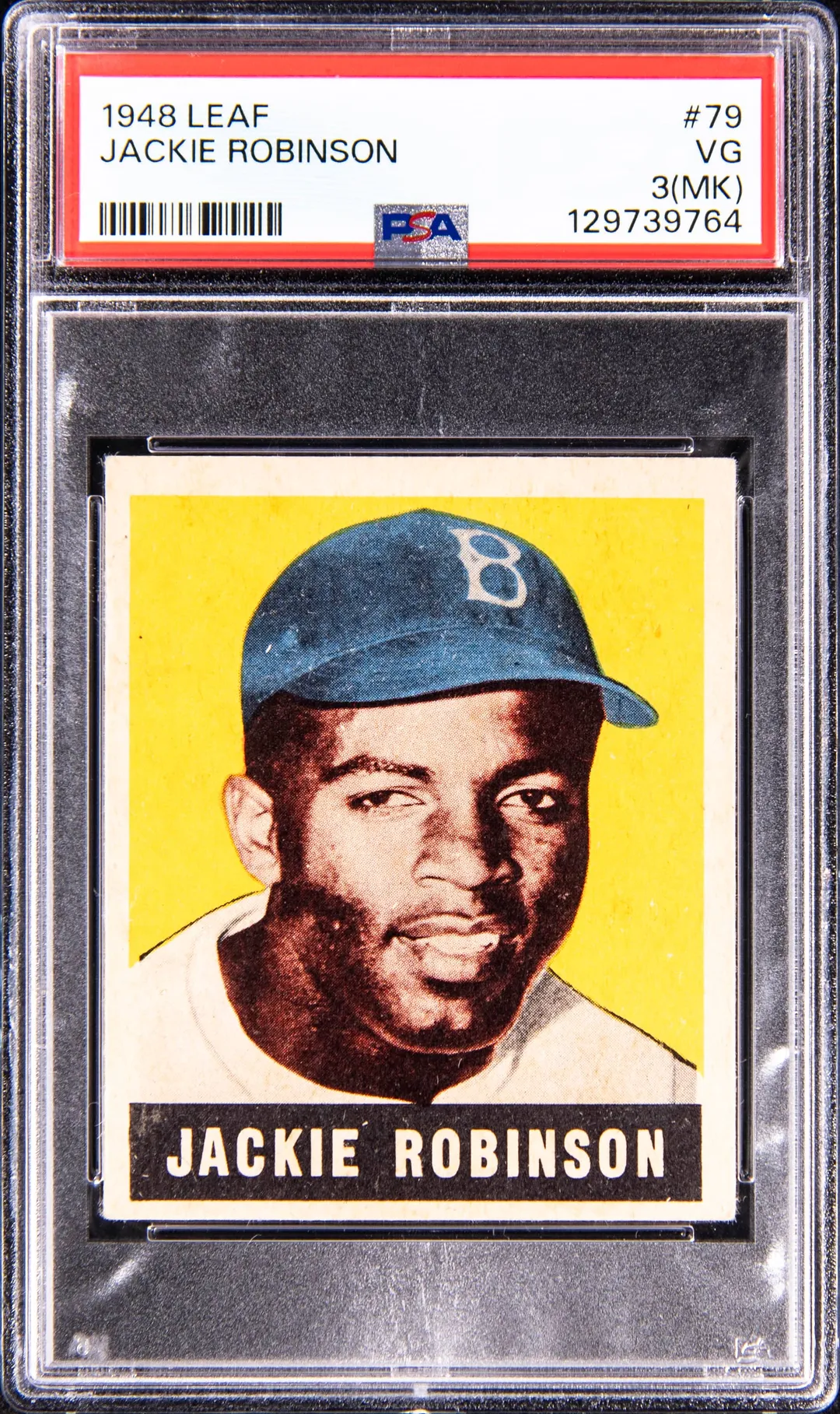
1948 Leaf Jackie Robinson PSA 3 (MK) sells for $14.6K
Goldin sold a 1948 Leaf #79 Jackie Robinson rookie PSA VG 3 (MK) for $14,640. See how this key vintage card’s price fits current market trends.
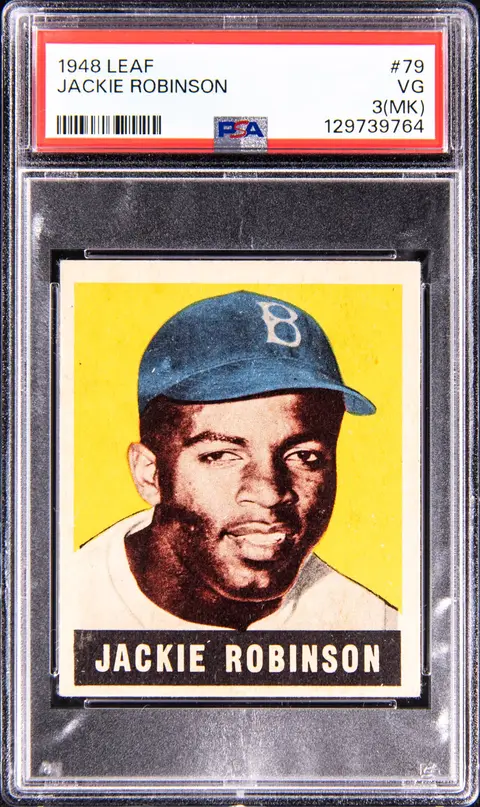
Sold Card
1948 Leaf #79 Jackie Robinson Rookie Card - PSA VG 3 (MK)
Sale Price
Platform
GoldinWhen a 1948 Leaf #79 Jackie Robinson rookie surfaces at public auction, the hobby pays attention. On February 22, 2026, Goldin sold a copy graded PSA VG 3 (MK) for $14,640, underscoring how steady demand remains for one of the most important vintage cards in the entire market.
In this breakdown, we’ll look at what this specific card is, why collectors care so much about it, and how this latest sale fits into the broader price picture.
The card at a glance
- Player: Jackie Robinson, Brooklyn Dodgers
- Year & set: 1948 Leaf Baseball
- Card number: #79
- Status: Widely recognized as Jackie Robinson’s premier rookie card
- Grading company: PSA (Professional Sports Authenticator)
- Grade: PSA VG 3 (MK)
- Special notation: “MK” indicates a mark on the card (often pen or pencil), which affects technical grade and eye appeal.
The 1948 Leaf Jackie Robinson is one of the true cornerstone rookie cards in the vintage baseball lane. It sits in the same historical tier as the 1952 Topps Mickey Mantle and 1933 Goudey Babe Ruth for many collectors who focus on baseball’s social and cultural impact, not just on-field production.
Why the 1948 Leaf Jackie Robinson matters
Historical significance
Jackie Robinson broke Major League Baseball’s color barrier in 1947 with the Brooklyn Dodgers. His debut changed not just the game, but American culture. The 1948 Leaf set captures Robinson at the beginning of his big-league career, which is why this card is typically treated as his key rookie issue.
For many collectors, this isn’t just a “player RC” (rookie card). It’s a cardboard link to a turning point in civil rights and sports history. That narrative keeps long-term demand resilient, even as broader market cycles rise and fall.
The 1948 Leaf set and condition challenges
The 1948 Leaf baseball set is known for:
- Rough production: Off-centering, print defects, and color variation are common.
- Chipping: The colored borders and relatively fragile stock make edge and corner wear very visible.
- Short prints and uneven distribution: Certain cards are tougher to find, and high-grade examples across the set are scarce.
These production and condition issues matter when reading population reports (often called “pop reports,” which are counts of how many copies a grading company has assigned to each grade). Even in mid‑grade, eye-appealing copies can be surprisingly tough.
What “PSA VG 3 (MK)” really means
PSA uses a 1–10 scale, with 10 as Gem Mint and 1 as Poor. A VG 3 or Very Good 3 is a well‑worn but still intact vintage card. Typical characteristics include:
- Noticeable corner and edge wear
- Creasing that may be visible but not completely overwhelming
- General surface/print wear
The (MK) qualifier means the card has some sort of mark—often writing, stamp, or ink—somewhere on it. Qualifiers like MK, OC (off-center), or ST (stain) typically pull a card’s market value down relative to a straight, unqualified grade, even when the numerical grade is the same.
With this Robinson, you’re looking at a card that is obviously not pristine, but still very collectible, especially for set builders and collectors who value owning an original Jackie rookie at a more approachable entry point than the high‑grade copies.
Market context: how $14,640 fits in
The Goldin sale price was $14,640 on February 22, 2026.
When hobbyists talk about “comps” (short for comparables), they mean recent verified sales of the same or very similar cards. For a card like this, useful comps include:
- The same 1948 Leaf #79 Jackie Robinson in PSA 3 without qualifiers
- The same card in nearby grades (PSA 2.5, PSA 3.5, PSA 4) from PSA, SGC, and sometimes BVG
- Other PSA 3 copies with qualifiers like MK, ST, or OC
Across the last few years, public auction results for this card have shown a pattern:
- Higher grades (PSA 5, 6, and up): These can push well into the mid‑five to six‑figure range, depending on eye appeal and market phase. Record sales for very high‑grade copies have reached deep into six figures at major auction houses.
- Mid‑grades (PSA 3–4): Prices have generally landed in the mid‑four to low‑five‑figure range, with non‑qualified PSA 3s and PSA 4s typically commanding a clear premium over marked or otherwise qualified copies.
- Lower grades (PSA 1–2): Even heavily worn examples remain strong due to historical importance, often selling for several thousand dollars depending on presentation and timing.
Against that backdrop, $14,640 for a PSA 3 (MK) sits in a range that aligns with what many collectors would expect:
- It’s below clean mid‑grade copies (PSA 3 without qualifiers, or PSA 4), as you’d anticipate for an MK-designated card.
- It’s typically above most heavily worn low-grade examples, especially those with more severe surface problems or poor eye appeal.
Put simply, this Goldin result fits the broader pattern: the market continues to value the Jackie Robinson Leaf rookie highly, with the MK notation and VG 3 technical grade keeping it in the mid‑tier price band for the card.
How population and eye appeal play into value
For key vintage cards, price is driven by more than just the number on the label.
Population ("pop")
The population report tells you how many copies a grading company has recorded in each grade. For the 1948 Leaf Jackie Robinson:
- The total population across all grades is modest compared to modern cards, reflecting the card’s age and survival rate.
- Higher grades have very low populations, which is why they attract record prices.
- PSA 3 and similar “collector grades” have more supply, but demand is also deeper at those price points.
While exact pop numbers can shift as new submissions are graded, the overall picture has been consistent for years: high-end examples are scarce, and even mid‑grade copies are not abundant once you filter for strong eye appeal.
Eye appeal
Two PSA 3 copies of this card can behave very differently in the market:
- Centering, color strength, and gloss can pull one example higher than another.
- The location and visibility of the MK (mark) can also matter—subtle pencil on the back is usually easier for buyers to accept than bold ink across the front.
Buyers of this tier often study the scans closely, looking for a copy that “presents” closer to a higher grade, even if the technical grade and qualifier say otherwise.
Why collectors still prioritize this card
Cultural and collecting importance
For many hobbyists, the Jackie Robinson Leaf rookie is a core collection goal—similar to owning at least one key Ruth, Mantle, or Mays card.
Collectors are drawn to it for several reasons:
- It represents a major historical milestone, not just a stat line.
- It’s one of the defining cards of the post‑war vintage era (roughly late 1940s–1960s).
- The design itself—bold color, stark portrait, and minimalist layout—has become instantly recognizable within the hobby.
Because of this combination of cultural weight and scarcity, demand for the card tends to be more stable than many modern, performance‑driven issues.
Vintage vs. modern dynamics
In modern and ultra‑modern cards (roughly late 2000s to present), prices can swing heavily around short-term performance, championships, or hype cycles. With a vintage icon like Jackie Robinson, there is no new performance data—only the long-term historical narrative.
As a result:
- Short-term volatility tends to be lower than what you see with active players.
- Long-term demand is driven by new collectors entering the hobby, set builders, and historically oriented collectors.
What this Goldin sale tells small collectors and sellers
If you’re a newer or returning collector, here are a few takeaways from this PSA VG 3 (MK) sale at Goldin on February 22, 2026:
- Historical icons hold deep collector interest. Even with a mark qualifier and mid‑low technical grade, this card still commanded $14,640.
- Qualifiers matter. A PSA 3 with MK typically sells for less than a straight PSA 3. When you look up comps, make sure you’re comparing qualifier to qualifier, not just the number grade.
- Eye appeal is critical. Two PSA 3s can have different centering, color, and level of visible marking, and those differences often show up in the final price.
- Auction house context helps. Established venues like Goldin often attract serious vintage buyers, which can support strong, but still realistic, realized prices.
None of this guarantees where prices will go next, but it does show how the market currently values one of the hobby’s foundational rookie cards.
How to approach this card as a collector
If the 1948 Leaf Jackie Robinson is on your long-term wish list, a few practical considerations:
- Define your priority: Are you aiming for the best eye appeal you can afford, or are you focused on owning any authenticated example of the card?
- Study the range of grades: Look at scans of PSA 1 through PSA 5 to understand how condition changes from level to level—and how that connects to price.
- Be precise with comps: When researching recent sales, match:
- Grading company (PSA, SGC, BVG)
- Numerical grade
- Qualifiers (MK, OC, ST, etc.)
- Eye appeal factors like centering and color
For many collectors, a VG‑range copy like this PSA 3 (MK) strikes a balance—still clearly vintage and well-loved, but not so worn that the design is lost.
Final thoughts
The February 22, 2026 Goldin sale of a 1948 Leaf #79 Jackie Robinson Rookie Card in PSA VG 3 (MK) for $14,640 reinforces the card’s standing as a centerpiece of vintage baseball collecting. While the MK qualifier keeps it below the prices of cleaner mid‑grade examples, it still commands a strong premium over lower-grade and more heavily compromised copies.
In a hobby that cycles through trends, the Jackie Robinson Leaf rookie remains a constant. It reflects the intersection of cardboard, history, and culture—one of the key reasons collectors keep returning to this card, regardless of where the broader market moves next.