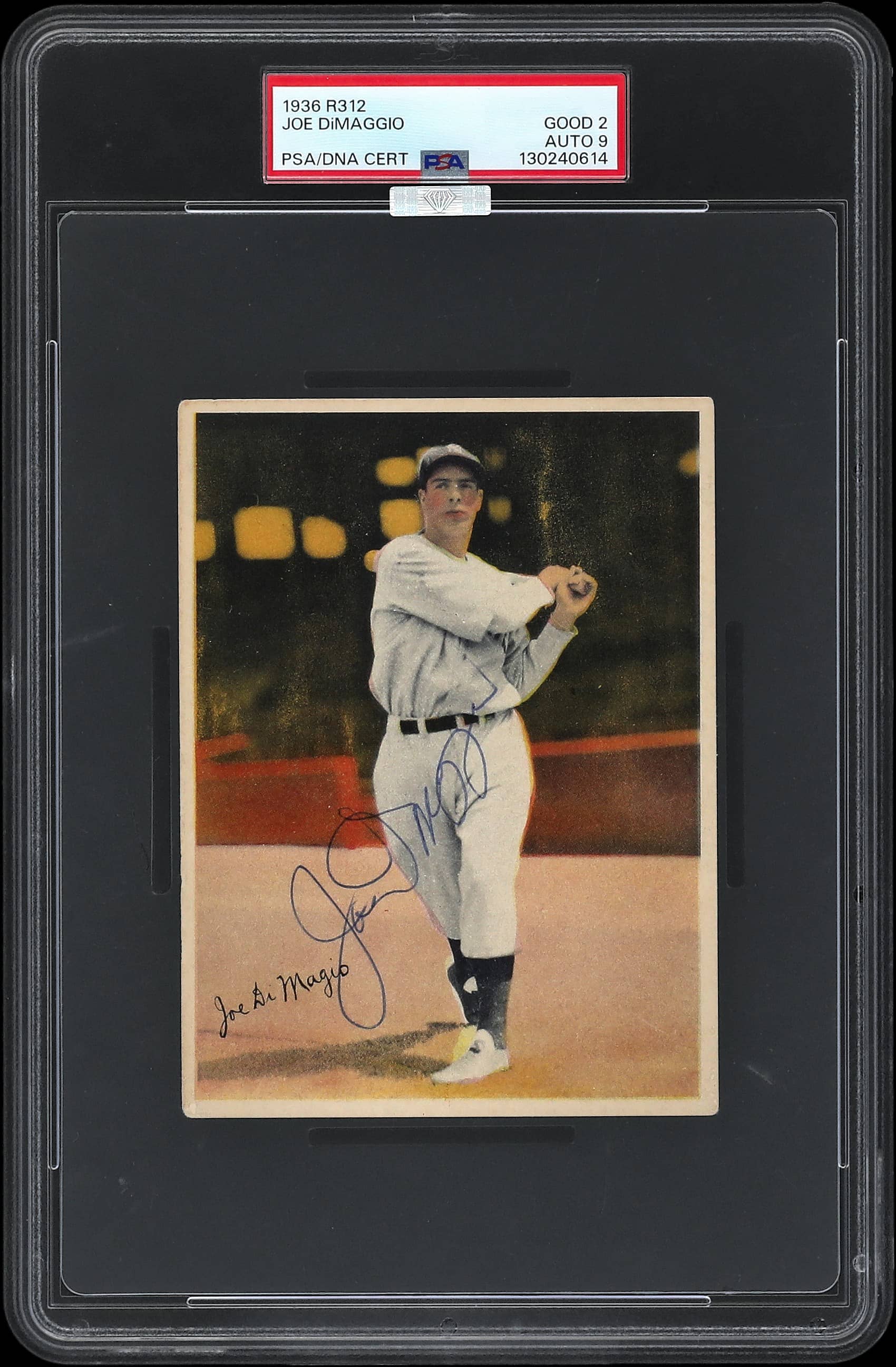
1936 R312 Signed Joe DiMaggio Rookie Sets Pop 1 Mark
Goldin sold a PSA 2, PSA/DNA 9 signed 1936 R312 Joe DiMaggio rookie for $26,840. Pop 1 and highest PSA signed copy make it a key vintage benchmark.
Sold Card
1936 R312 Signed Joe DiMaggio Rookie Card – PSA GD 2; PSA/DNA MINT 9 Autograph – POP 1; Highest PSA Signed Copy - MBA Silver Diamond Certified
Sale Price
Platform
Goldin1936 R312 Signed Joe DiMaggio Rookie Card – Why This PSA/DNA Pop 1 Matters
On February 22, 2026, Goldin quietly closed the books on one of the more interesting vintage hobby results of the year: a 1936 R312 Joe DiMaggio rookie card, signed, graded PSA GD 2 with a PSA/DNA MINT 9 autograph, realized $26,840.
For a piece that predates World War II and features a Hall of Fame icon at the very start of his career, the card’s appeal goes well beyond the final hammer price. For collectors who focus on vintage baseball, autographed rookies, or low‑population oddball issues, this sale checks several important boxes.
The Card at a Glance
- Player: Joe DiMaggio (New York Yankees)
- Year: 1936
- Set: R312 Pastel (often called the 1936 R312 issue)
- Card type: Oversized, premium photo card, considered a Joe DiMaggio rookie issue
- Autograph: On‑card Joe DiMaggio signature
- Card grade: PSA GD 2 (Good)
- Autograph grade: PSA/DNA MINT 9
- Population (signed in this configuration): Pop 1
- Note from the auction: Highest PSA‑graded signed copy
- Certification: MBA Silver Diamond Certified
The 1936 R312s are large, pastel‑tinted photo cards issued as a premium in the mid‑1930s. DiMaggio’s example is widely treated by vintage collectors as one of his key rookie issues, alongside his 1938 Goudey and a handful of other pre‑war appearances.
In this case, the card is not only graded by PSA, but the autograph is separately authenticated and graded MINT 9 by PSA/DNA. That combination—vintage rookie, on‑card signature, and high autograph grade—creates a niche but meaningful segment of demand.
Why the 1936 R312 Joe DiMaggio Matters
A pre‑war DiMaggio rookie
DiMaggio debuted with the Yankees in 1936, and his earliest broadly collected cardboard comes from this exact period. The R312 issue is significant because:
- It’s contemporary with his rookie season.
- It uses a large, portrait‑style format that presents the player more like a photograph than a small gum card.
- Surviving examples are often creased, trimmed, or heavily worn, which makes any straight‑graded example—let alone a signed one—uncommon.
In other words, this is not a modern, mass‑printed base rookie with an optional parallel. It’s one of a few surviving pre‑war pieces that connect directly to the start of DiMaggio’s career.
Signed vintage rookies: a niche within a niche
Autographed vintage rookies sit at the intersection of two collecting lanes:
- Player collectors and Hall of Fame specialists, who want the earliest possible representation of a legend.
- Autograph collectors, who emphasize signature quality and authenticity.
Many DiMaggio autographs out there are on balls, photos, or modern tribute cards. Signed examples of a pre‑war rookie issue are comparatively scarce, and most of them were signed decades after printing, often in less‑than‑ideal conditions. That’s why an autograph grade of PSA/DNA MINT 9 stands out—it signals a bold, clean, well‑preserved signature.
When you add in the fact that PSA’s population report (often shortened to “pop report” and used by collectors to track how many graded copies exist) shows this as a Pop 1 in its specific signed/graded configuration, the card becomes more of a one‑off opportunity than a commodity.
Market Context and Price
- Sale price: $26,840 (Goldin, February 22, 2026, UTC)
- Grading combo: PSA GD 2 card, PSA/DNA MINT 9 auto, pop 1
How this compares to related cards
Finding direct “comps” (short for comparables—similar recent sales used to contextualize a price) for this exact card is difficult because of its one‑of‑one population and the relative scarcity of signed R312 DiMaggios in any grade.
What we can say with reasonable confidence based on public auction records and broader DiMaggio market behavior:
- Unsigned 1936 R312 DiMaggio: Lower‑grade raw or graded copies tend to sell meaningfully below top‑end DiMaggio issues like high‑grade 1938 Goudeys, but they still carry a strong premium due to pre‑war status and rookie‑issue demand. Exact numbers move around based on eye appeal, creasing, and centering.
- Signed vintage DiMaggio cards in general: On‑card signatures on playing‑days items almost always command a premium over later‑era signed pieces. Clean signatures, strong provenance, and recognized third‑party authentication (PSA/DNA, for example) matter a lot.
- Autograph grade impact: A MINT 9 autograph grade is near the top of the scale. When the underlying card is scarce, that combination tends to push the result above what the card and autograph might individually suggest.
Because signed R312 DiMaggio rookies almost never appear in public auctions, the $26,840 result at Goldin functions less as a comparison to a long list of past sales and more as a new reference point for this specific lane: high‑grade autographed pre‑war DiMaggio rookies.
At this time, there isn’t a deep stack of public records for the same card in different card grades or lower autograph grades to draw a precise ladder of values. Instead, collectors will likely treat this result as:
- A confirmation that there is committed demand for autographed DiMaggio rookies.
- A benchmark for how much of a premium a MINT 9 autograph and Pop 1 status can command.
Why Condition and Population Matter Here
PSA GD 2 on a 1930s oversized issue
On modern cards, a PSA 2 typically signals a lot of damage and can heavily limit value. For a 1936 oversized premium, expectations are different:
- Many surviving copies were folded, pinned to walls, or stored poorly.
- Creases and edge wear are normal; the challenge is finding untrimmed, intact examples.
Within that context, a PSA 2 is still considered a collectible grade, especially when the card presents decently to the eye and carries a high‑grade autograph.
Pop 1, highest PSA signed example
“Pop 1” means PSA has only one example in its database in that exact configuration. Being described as the highest PSA signed copy suggests that, at least as of this sale, no better combined card/autograph graded example is known in PSA holders.
For collectors, that translates to:
- True scarcity: You can’t simply wait for another identical copy to show up in the next auction cycle.
- Leverage in negotiation: The next buyer or seller is working off this single data point.
This isn’t manufactured scarcity like a modern serial‑numbered parallel; it’s organic scarcity based on survival rates and the small subset that ended up signed, authenticated, and high‑grade.
What This Sale Signals for Collectors
For vintage and pre‑war hobbyists
This Goldin result underscores a couple of ongoing themes:
- Pre‑war Hall of Famers remain a stable focus. While modern cycles can swing quickly based on performance or hype, icons like DiMaggio rest on decades of history.
- Oddball and premium issues are gaining structured attention. Sets like R312 used to sit a bit outside the mainstream. As the hobby matures, more collectors are willing to research these issues and assign them clear spots in a player’s “rookie portfolio.”
For autograph collectors
The sale highlights the premium that a well‑graded autograph can add to a vintage piece. The separation between the card grade (PSA 2) and the autograph grade (MINT 9) shows how some collectors are willing to place significant weight on the visual impact and quality of the signature, even when the cardboard itself is heavily worn.
For newer or returning collectors
If you’re just getting back into the hobby or exploring vintage for the first time, this sale offers a few takeaways:
- Not all rookies are base cards. In the pre‑war era, rookies often appear in regional, oversized, or premium formats rather than standard gum sets.
- Population reports matter, but context is key. A Pop 1 in a niche category (signed, graded, specific auto grade) is very different from a Pop 1 in a mainstream flagship rookie set.
- Autographs on playing‑days cards aren’t guaranteed. Many stars from the 1930s didn’t sign huge volumes of cards at the time, and much of what we see today comes from signings decades later. That makes any surviving playing‑days piece with a strong signature a small market all its own.
How figoca Looks at Sales Like This
At figoca, we treat results like the February 22, 2026 Goldin sale of the 1936 R312 Signed Joe DiMaggio rookie as data points, not predictions. Because the card is a Pop 1 with layered scarcity (pre‑war, rookie‑era, autograph graded MINT 9), it functions more as a market signal than a formula.
Collectors can use this type of sale to:
- Understand the relative premium on autographed vintage rookies versus unsigned examples.
- Gauge demand for oddball or premium pre‑war issues.
- Place other DiMaggio key cards—such as his 1938 Goudey or later Bowman/Topps issues—into a broader price and demand framework.
As always, the right fit depends on your collecting goals. Some will prioritize eye appeal and unsigned vintage; others will chase rare autograph/grade combinations like this. The important part is having clear, grounded information, so results like this one can inform your decisions rather than dictate them.
For now, this $26,840 Goldin sale stands as the reference point for the highest PSA‑graded signed 1936 R312 Joe DiMaggio rookie card—a reminder that even in a modern, data‑heavy hobby, true pre‑war scarcity still commands attention.