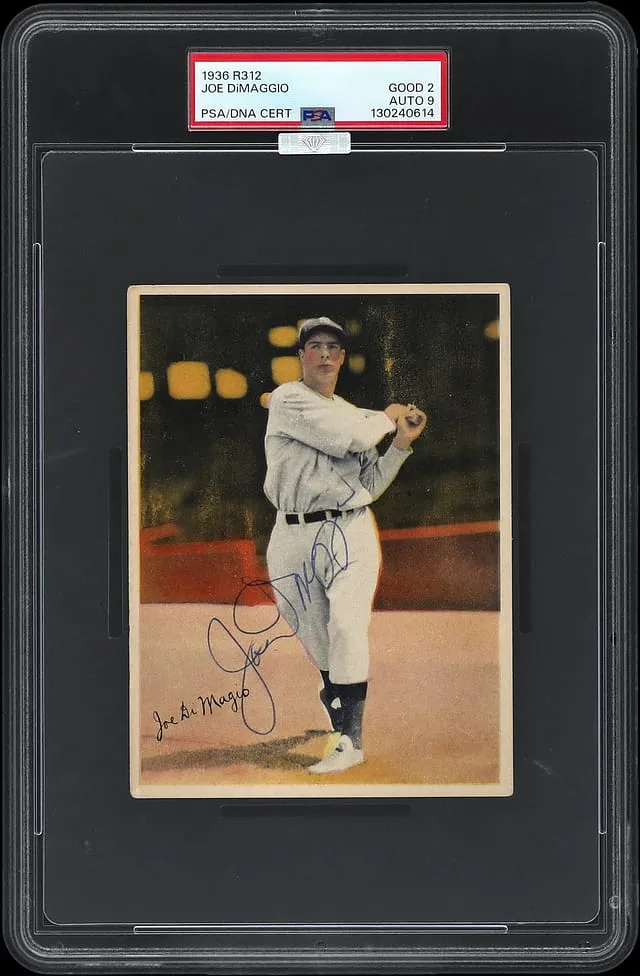
1936 R312 Joe DiMaggio Signed Rookie Sells for $26K
Breakdown of Goldin’s $26,840 sale of the POP 1, PSA/DNA 9 signed 1936 R312 Joe DiMaggio rookie card and what it means for vintage collectors.
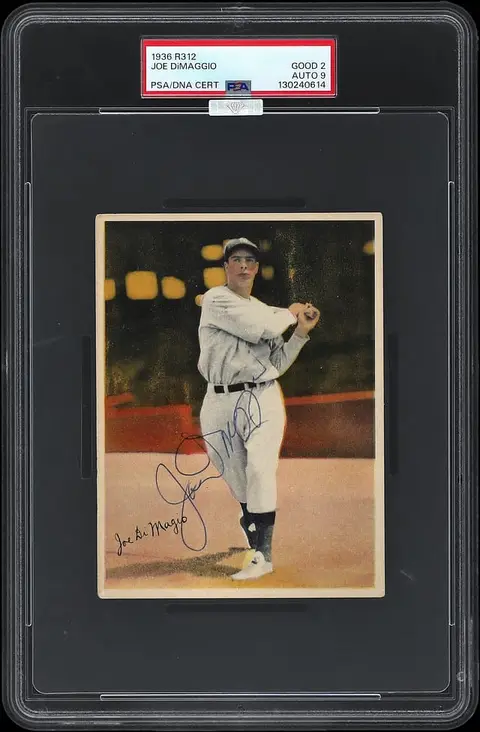
Sold Card
1936 R312 Signed Joe DiMaggio Rookie Card – PSA GD 2; PSA/DNA MINT 9 Autograph – POP 1; Highest PSA Signed Copy - MBA Silver Diamond Certified
Sale Price
Platform
Goldin1936 R312 Signed Joe DiMaggio Rookie Card Sells for $26,840 at Goldin
On February 22, 2026, Goldin auctioned a piece of pre-war baseball history that blends cardboard, ink, and provenance in a way few items can match: a 1936 R312 Joe DiMaggio rookie card, graded PSA GD 2 with a PSA/DNA MINT 9 autograph, realized $26,840.
For vintage autograph collectors and pre-war specialists, this card checks several important boxes at once: early DiMaggio, a scarce issue, and the highest graded signed example in the PSA population.
Card overview: what exactly sold?
Let’s break down the key details of the card:
- Player: Joe DiMaggio, New York Yankees
- Year / Issue: 1936 R312 “Color Photos” (National Chicle)
- Type: Rookie-era card (widely treated as a Joe DiMaggio rookie in the hobby)
- Format: Large premium-style issue (oversized compared with standard cards)
- Autograph: On-card, certified PSA/DNA MINT 9
- Card Grade: PSA GD 2 (Good)
- Population note: Listed as POP 1 and the highest PSA-signed copy currently in the PSA population report
- Third-party provenance: MBA Silver Diamond Certified (Memorabilia grading/provenance layer on top of PSA)
In hobby terms, “POP 1” means this is the only example in the PSA population at this exact grade/auto configuration, and “highest PSA signed copy” means no other PSA-graded, PSA/DNA–authenticated signed version is graded higher.
The 1936 R312 set: why this issue matters
The R312 set, issued in 1936, is an oversized, pastel-toned premium set that features a number of key players from the pre-war era. It’s not as widely known to newer collectors as sets like 1933 Goudey, but among vintage specialists, R312s are respected for:
- Era: Mid-1930s, a true pre-war, pre-Bowman, pre-Topps issue
- Condition sensitivity: The larger, thin paper stock makes these susceptible to creases, corner wear, and edge chipping
- Display presence: The bigger format and color presentation give them an almost mini-poster feel, which also makes autographed examples particularly attractive
Joe DiMaggio’s appearance in this set marks one of his earliest mainstream cardboard issues. When collectors talk about “rookie” or “rookie-era” DiMaggio cards, R312 is part of that conversation along with other 1936 issues.
Autographed vintage rookies: a niche within a niche
This card isn’t just a vintage DiMaggio rookie; it’s a vintage rookie with an on-card signature, graded MINT 9 by PSA/DNA.
For those newer to the term, PSA/DNA is PSA’s autograph authentication arm. The separate grade on the autograph (in this case, 9/10) reflects the quality of the signature itself—clarity, completeness, and overall eye appeal.
Why that matters:
- Signed pre-war cards are inherently scarce. Many players didn’t sign their cards in large quantities at the time, and autograph culture around cards wasn’t yet what it would become in later decades.
- Condition of the autograph is crucial. A clean, bold, well-placed signature on an 80+ year old piece of cardboard is not common.
- Card grade vs. auto grade. Vintage collectors will often accept a low to mid-grade card (like PSA 2) if the autograph is strong; the autograph can become the primary focus.
Here, the combination of a Good 2 card with a MINT 9 autograph, plus POP 1 / highest-graded status, turns this into a top-end specimen within its specific lane: signed vintage DiMaggio rookies.
Market context: how does $26,840 fit in?
This sale closed at $26,840 (USD) at Goldin on February 22, 2026.
When we look at market context for a card like this, there are three main comparison points:
- Unsigned 1936 R312 Joe DiMaggio cards
- Other signed DiMaggio rookie-era or early-career cards
- The broader DiMaggio high-end market (notably his 1938 Goudey and 1941 Play Ball)
Unsigned R312 DiMaggio comps
Unsigned 1936 R312 DiMaggio examples have historically traded at a noticeable discount to his more famous Goudey or Play Ball issues, but they’re still key vintage pieces. Prices depend heavily on condition because the oversized format is so fragile.
Recent public auction data (where available) suggest that:
- Low-grade unsigned R312 DiMaggio examples can trade in the low-to-mid five figures when eye appeal is strong.
- Mid-grade copies, when they surface, have historically gone higher, though volume is low enough that exact ranges can swing widely from sale to sale.
Compared with these, $26,840 for a Good 2 card that is also signed and POP 1 sits within a plausible range for a premium example, especially when you factor in the autograph and population data. The overall supply of high-quality R312 DiMaggio cards—signed or unsigned—is thin.
Signed DiMaggio rookies and early issues
Autographed examples of pre-war DiMaggio cards are far less common than his post-war signed items, where he signed a significant amount of memorabilia in his later years.
Publicly documented sales for signed, early DiMaggio cards tend to:
- Command a multiple over unsigned comps, particularly when the auto is graded 8 or better
- Show strong results for POP 1 or “top of the pop” copies, especially at premium auction houses like Goldin
Because public sales of signed 1936 R312 DiMaggio cards are so limited, exact comps for this specific configuration (PSA 2 / PSA/DNA 9, POP 1) are sparse. Instead, the sale slots into a small cluster of high-end, signed pre-war DiMaggio pieces that often trade in the mid-five-figure range, with outliers depending on card, grade, and signature quality.
Compared to DiMaggio’s broader market
DiMaggio’s blue-chip status in the hobby is anchored by iconic issues like:
- 1938 Goudey Heads-Up
- 1941 Play Ball
- Other early Yankees-era cards from the late 1930s and early 1940s
Those cards (especially in high grade) have recorded six-figure and, in special cases, higher results. In that context, $26,840 for a signed, pre-war, rookie-era R312 represents a strong but not record-shattering figure for high-end DiMaggio material. It’s aligned with the idea that R312 is a premium but somewhat more niche lane compared with the absolute flagship DiMaggio issues.
Why this sale matters to collectors
Even if you’re not actively chasing pre-war DiMaggio, this sale offers a few useful signals for the broader market.
1. Ongoing demand for signed vintage rookies
Collectors continue to show interest in:
- Pre-war and early post-war signed cards
- Rookie or rookie-era issues
- Documented POP 1 / top-of-the-pop examples
This card checks all three boxes. The result reinforces a pattern we’ve seen across multiple auction houses: when a documented best-known example appears—especially with a strong autograph—bidders are willing to step up.
2. Condition vs. eye appeal vs. scarcity
A PSA 2 grade on the card might sound low to newcomers, but for pre-war oversized issues, “Good” can be entirely acceptable when:
- The presentation still works well visually
- The autograph is high-grade and well-placed
- The combination is the best available in the market
This is a reminder that for vintage collectors, grade is one input, not the whole story. Eye appeal, scarcity, and configuration (signed vs. unsigned, certification layers) can matter just as much, if not more.
3. Goldin’s role in placing niche high-end pieces
For a card like this—narrow but important audience, pre-war, POP 1, multiple layers of grading and certification—placement matters. Goldin has built a track record as a venue for:
- High-end vintage
- Autographed rarities
- Population-leading examples across sports
This sale again shows that when a unique or near-unique early card comes to market with the right story and authentication, the major auction platforms remain effective at reaching the specialized buyer base that understands it.
Takeaways for different types of collectors
If you’re newer to vintage
- Don’t be put off by a “2” on the label for pre-war cards, especially oddball or oversized issues.
- Learn the difference between card grade and autograph grade; both matter, but not equally in every case.
- Population reports (“pop reports”) are worth checking—knowing that something is POP 1 and highest graded can explain why it sells above what a standard comp might suggest.
If you’re an active hobbyist or small seller
- Signed vintage rookies can command a premium even when card grades are modest.
- For rarer issues like R312, it’s hard to lean solely on price guides. Searching past auction archives can give better context.
- Documentation—PSA/DNA, additional provenance like MBA, and clear auction house descriptions—helps build confidence in the result.
If you’re a pre-war specialist
This sale won’t redefine DiMaggio’s market, but it does:
- Reaffirm the strength of premium signed examples
- Underscore how thin the supply is at the top of the population
- Add another data point for 1930s autograph + card combinations
Final thoughts
The February 22, 2026 Goldin sale of the 1936 R312 Signed Joe DiMaggio Rookie Card (PSA GD 2; PSA/DNA MINT 9, POP 1, highest PSA-signed copy, MBA Silver Diamond) at $26,840 is another reminder that:
- Pre-war issues still command respect and attention
- Signed vintage rookies occupy a stable, collector-driven niche
- Population-leading, fully authenticated examples can sit above simpler "grade-only" comparisons
For many collectors, this isn’t just a DiMaggio card; it’s a convergence of early-career cardboard, a high-grade signature, and documented scarcity. In a hobby that increasingly values story and provenance, that combination continues to matter.