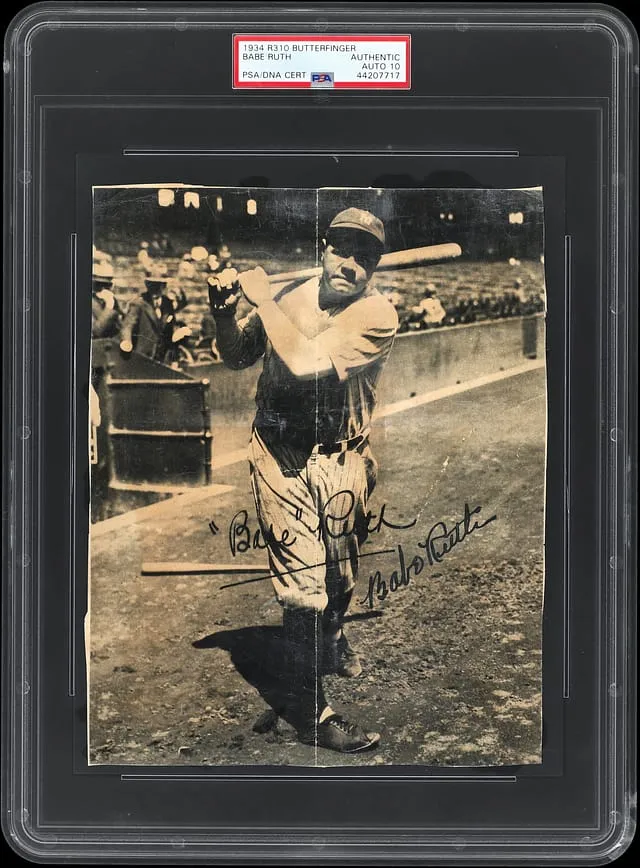
1934 R310 Butterfinger Babe Ruth Signed Sale
Figoca looks at Goldin’s $17,080 sale of a 1934 R310 Butterfinger Babe Ruth, PSA Authentic with PSA/DNA GEM MT 10 auto, one of two known signed copies.
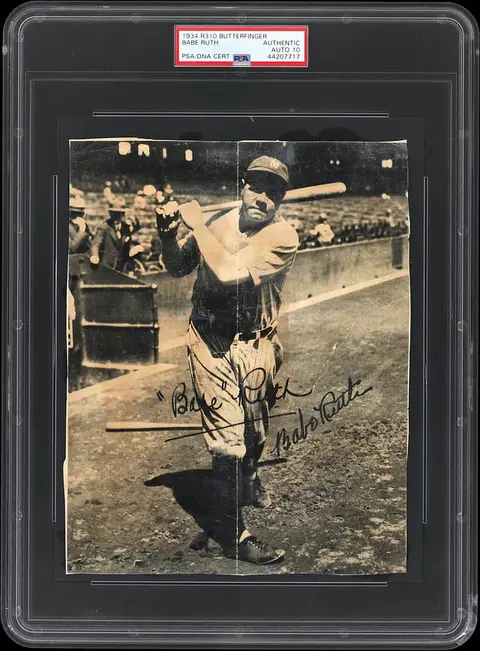
Sold Card
1934 R310 Butterfinger Signed Babe Ruth - Mile High Find Collection - PSA Authentic, PSA/DNA GEM MT 10 Autograph - One of 2 Known Signed Copies
Sale Price
Platform
Goldin1934 R310 Butterfinger Signed Babe Ruth: Why This $17,080 Mile High Find Matters
On February 22, 2026, Goldin sold a 1934 R310 Butterfinger Babe Ruth from the famous “Mile High Find Collection” for $17,080. The card was authenticated by PSA with a PSA/DNA GEM MT 10 autograph grade, and it represents one of only two known signed copies of this specific issue.
For vintage baseball and Babe Ruth specialists, this isn’t just another Ruth card. It’s a rare overlap of prewar food-issue scarcity and an elite-condition signature from the most collected player in the hobby.
Card Profile: 1934 R310 Butterfinger Babe Ruth
Let’s break down the card itself for collectors who may not be as familiar with this issue:
- Player: Babe Ruth
- Team: New York Yankees (the image is from his Yankees era, though 1934 is also the year he finished with the Boston Braves)
- Year: 1934
- Set: R310 Butterfinger (oversized premium issue)
- Card type: Large-format, thin-stock premium distributed with Butterfinger candy bars
- Autograph: On-card Babe Ruth signature
- Grading:
- Card: PSA Authentic (card encapsulated as authentic, no numerical grade)
- Autograph: PSA/DNA GEM MT 10 (a top-of-scale grade indicating an exceptionally clean, bold signature)
- Special note: Described as one of two known signed copies of this specific R310 Butterfinger Ruth.
Although R310 Butterfingers are not traditional rookie cards, they are considered a key prewar Ruth issue because of their distribution method (candy premium), oversized format, and relatively low survival rate.
What Is the 1934 R310 Butterfinger Set?
The 1934 R310 Butterfinger set is a large-format (roughly 7" x 9") issue tied to Butterfinger candy bars. These premiums were often folded, tacked to walls, or handled roughly, which has a major impact on condition today.
Key features of the set:
- Era: Prewar vintage (1930s)
- Distribution: Mail-in or in-pack premium tied to a consumer product (Butterfinger), not sold as traditional gum cards.
- Construction: Thin, fragile paper stock, making high-grade examples scarce.
- Subjects: Stars of the era, including Babe Ruth, Lou Gehrig, and other key names.
Because of their size and fragility, surviving examples typically show creases, edge wear, and surface wrinkles. That makes any presentable copy noteworthy—and a copy with a high-grade on-card Ruth autograph stands out even more.
The Mile High Find Connection
This card comes from what is described as the Mile High Find Collection. In hobby language, a “find” usually refers to a previously unknown or long-stored group of cards discovered in relatively original condition, often after decades in a home, attic, or collection.
While each find has its own story, the main market implications tend to be:
- Fresh-to-market material: Collectors often respond well to items that have not been cycled through auctions multiple times.
- Condition preservation: Long-term storage can result in better-than-expected condition for the era.
- Documentation: Named finds can become part of a card’s provenance (ownership history), which some collectors value.
Here, having “Mile High Find Collection” tied to the label helps position the piece as part of a notable discovery rather than a card that has been frequently traded.
Why the PSA/DNA GEM MT 10 Autograph Grade Matters
There are two separate elements in the slab:
- Card authentication (PSA Authentic): PSA confirms the card is genuine but does not assign a numerical grade to the cardboard itself.
- Autograph grade (PSA/DNA GEM MT 10): PSA/DNA evaluates the quality of the signature only. GEM MT 10 is their highest standard, indicating a bold, well-placed, and clean autograph.
For prewar signed material, high-grade autographs are significantly tougher than high-grade modern autos because:
- Many signatures were obtained in uncontrolled environments (ballparks, sidewalks, hotels).
- Storage conditions over decades often faded ink or introduced smearing.
- Owners rarely treated these as carefully as dedicated signed cards of the modern era.
A GEM MT 10 Babe Ruth autograph on a 1934 Butterfinger is therefore a substantial condition achievement, and a large part of the card’s appeal.
Market Context: How Does $17,080 Fit In?
The realized price was $17,080 at Goldin on February 22, 2026.
When people talk about “comps” in the hobby, they mean comparable sales—recent realized prices for the same or closely related items that give a rough sense of market range. For this piece, truly direct comps are limited because:
- It’s reported as one of just two known signed R310 Butterfinger Ruths.
- The autograph holds a GEM MT 10 grade, which further narrows comparability.
Instead of exact matches, collectors look at several related reference points:
- Unsigned 1934 R310 Ruths: These typically trade at lower price points, and their pricing is driven mostly by the card’s technical condition. Lower-grade unsigned examples tend to land well under five figures; stronger eye appeal or higher technical grades may push higher. The signed, GEM 10 auto example clearly commands a premium beyond this range.
- Other prewar Ruth signed items:
- Signed photos, checks, and cuts with PSA/DNA grades in the 8–10 range can reach into five or even six figures, with prices depending heavily on medium, provenance, and eye appeal.
- Signed Ruth cards from the 1930s are considerably harder to source than flat items or cuts, and they often bring a notable premium because they combine card and autograph collecting lanes.
- Comparable signed vintage premiums: Rare prewar premiums (e.g., exhibit cards, regional issues) with on-card Ruth signatures in high autograph grades often show wide price ranges depending on how frequently they appear. Fewer auction appearances generally mean more variability and less predictable pricing.
Against that backdrop, $17,080 for an authenticated, on-card signed 1934 Ruth premium with a PSA/DNA GEM MT 10 auto appears to sit in a space where:
- The card is clearly premium relative to unsigned Butterfingers.
- It still prices below the very top of the Ruth autograph market (e.g., exceptional photos or iconic card issues with strong autos).
- The small population (one of two known signed) and the find-level provenance give it additional collector interest.
Because there are so few true comparables, pricing is less about a clean “market average” and more about what the current set of bidders valued the combination of rarity, condition, and provenance at that moment.
Rarity, Scarcity, and Population
In hobby terms, “scarcity” often refers to how much of something was produced or survived, while “rarity” is how often it actually comes to market. For this card:
- R310 Butterfinger Ruths are already scarce in attractive condition due to their size and fragility.
- Signed examples are rarer still, with this specific configuration noted as one of two known.
Grading companies publish a “pop report” (population report), showing how many copies of a card exist in each grade. For unique or near-unique items (like a specific signed prewar premium with a particular signature grade), pop reports can be less informative because the total number is so tiny.
In cases like this, rarity is better understood by:
- The number of known examples (here, two signed copies mentioned).
- Historical frequency at auction: how many times the card, or something very close to it, has surfaced.
Why Collectors Care About This Card
Several factors make this piece significant for collectors:
- Babe Ruth: The most widely collected prewar baseball figure, with deep demand across cards, autographs, and memorabilia.
- Prewar food-issue premium: The 1934 R310 Butterfinger set taps into a popular lane of collecting tied to candy and regional promotions, distinct from standard gum cards.
- On-card autograph: Many Ruth signatures exist on separate cuts or photos. A signature directly on a period card or premium can be more desirable to hobbyists who prioritize card-based collections.
- Autograph quality: A PSA/DNA GEM MT 10 grade signals a best-in-class example from a condition standpoint.
- Provenance: Being part of the Mile High Find adds a story and a traceable origin, which some collectors factor into their buying decisions.
For newcomers, this card illustrates how value in the vintage market isn’t driven by one factor alone. Instead, it’s a combination of:
- Player importance
- Era (prewar vs postwar vs modern)
- Issue type (regional, food, mainstream)
- Autograph presence and quality
- Condition and grading
- Provenance and story
What This Sale Suggests About the Market
While a single result doesn’t define the entire market, this Goldin sale does highlight a few themes visible in recent years:
- Ongoing demand for high-quality Ruth material: Even as broader hobby prices move up and down, strong Ruth pieces—especially unique or nearly unique ones—tend to attract consistent interest.
- Premium on crossover items: Pieces that live at the intersection of multiple categories (card + autograph + prewar + food issue + named find) can pull bidders from several collecting lanes.
- Selective strength at the high end: Not every vintage item is up, but items that check multiple boxes of rarity, condition, and desirability often continue to command solid prices.
It’s important not to read this as a guarantee for all Ruth items or all Butterfinger issues. Instead, it’s a data point showing that when a genuinely scarce, high-quality, and well-documented piece comes to the market, the hobby can still organize serious interest.
Takeaways for Collectors and Small Sellers
For hobbyists watching the market or considering similar items:
- For card-focused collectors: Unsigned Butterfinger Ruths remain a way to experience this issue at lower price tiers, with condition playing a large role in pricing.
- For autograph-focused collectors: The sale underscores how heavily autograph quality and medium matter. A GEM MT 10 on a period card is a different tier from a lesser-grade signature on a modern cut.
- For sellers: When handling unusual or premium vintage pieces, clear documentation—set identification, era, autograph authentication, and any collection provenance—can help bidders understand what they’re looking at.
The 1934 R310 Butterfinger Signed Babe Ruth from the Mile High Find Collection is one of those cards that will likely be remembered less for its exact hammer price and more for what it represents: a rare convergence of prewar cardboard, iconic player, top-tier autograph, and named-find provenance, all captured in a single slab.
For collectors, it’s another reminder that in vintage, the story and survival of a piece can be just as important as the numbers on the label.