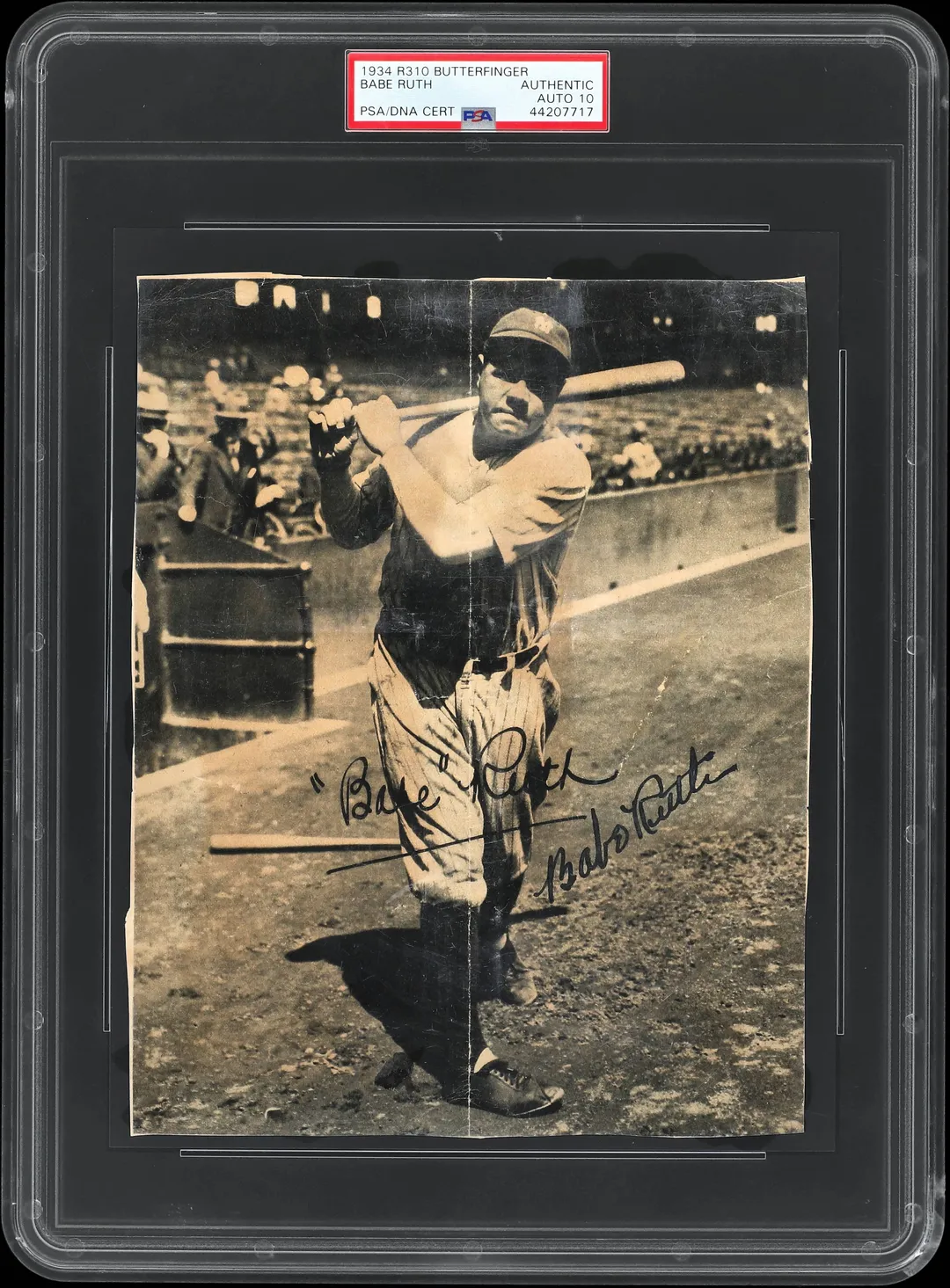
1934 R310 Butterfinger Babe Ruth Auto Sells for $17K
Goldin sold a 1934 R310 Butterfinger Babe Ruth PSA Authentic, PSA/DNA 10 auto for $17,080. See why this ultra-rare signed premium matters to collectors.
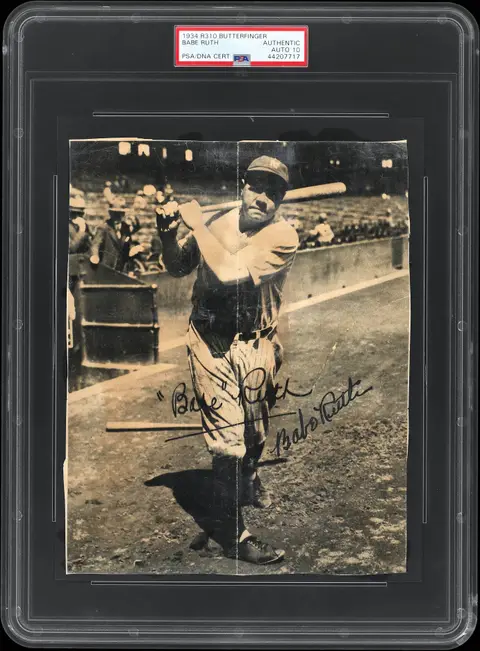
Sold Card
1934 R310 Butterfinger Signed Babe Ruth - Mile High Find Collection - PSA Authentic, PSA/DNA GEM MT 10 Autograph - One of 2 Known Signed Copies
Sale Price
Platform
GoldinWhen a vintage Babe Ruth rarity surfaces with a bold, high-grade signature, collectors across eras tend to take notice. That’s exactly what happened with the recent sale of a 1934 R310 Butterfinger Signed Babe Ruth from the Mile High Find Collection, authenticated by PSA with a PSA/DNA GEM MT 10 autograph grade. Sold by Goldin on 2/22/26 for $17,080, this piece offers a useful case study in how scarcity, condition, and provenance combine to shape the vintage autograph market.
The card: 1934 R310 Butterfinger Babe Ruth, signed
Let’s start by identifying the piece clearly:
- Player: Babe Ruth
- Team: New York Yankees (the card depicts him in his Yankees era, even though 1934 was his final year with the club)
- Year: 1934
- Set: R310 Butterfinger premium issue
- Type: Large-format paper premium, not a standard tobacco- or gum-sized card
- Autograph: On-card (signed directly on the piece)
- Authentication and grades:
- PSA: card authenticated (labeled “Authentic” rather than a numeric card grade)
- PSA/DNA: autograph graded GEM MT 10 (top of the scale for PSA’s auto grade)
- Special distinction: One of only two known signed copies of this specific R310 Butterfinger Babe Ruth, and the only one (as of this sale) with a GEM MT 10 autograph.
The R310 Butterfinger issue is an oversized, thin-paper premium distributed with Butterfinger candy in the mid-1930s. These were not preserved in the same way as standard cards, and the large format made them especially vulnerable to creasing, tears, and pinholes. Unautographed examples are already hobby-recognized rarities; an on-card Ruth signature on this format is a different level of scarcity.
Why the R310 Butterfinger Ruth matters
For newer collectors: this piece sits at the intersection of pre-war cardboard and early baseball iconography. A few key points:
- Era: 1930s pre-war vintage. This era is defined by low overall production, fragile paper stock, and survival issues. Clean survivors are scarce; signed survivors are scarcer still.
- Set significance: The R310 Butterfinger premiums are a well-known but relatively tough regional-style issue. They feature large, photographic images with facsimile signatures in the design. Genuine hand-signed examples, especially by the biggest stars, turn a tough premium into a true outlier.
- Player importance: Babe Ruth is the foundation for much of pre-war collecting. While his earlier tobacco and caramel issues tend to get the most headlines, any authentic, visually strong Ruth autograph on a contemporaneous piece is a cornerstone-type collectible.
- Autograph era: This is not a modern “insert auto” pulled from a pack. It’s a period piece that Ruth actually handled and signed, likely in the mid‑1930s. That combination of era + on-card signature is a major driver of demand.
Because of the oversized, fragile nature of the R310 premiums, signed copies that survive intact, present well, and carry top-tier third-party authentication are rare by default. When the total known population is as tiny as two, the card’s importance to advanced Ruth and pre-war autograph collectors becomes clear.
Grading details: PSA Authentic with a PSA/DNA GEM MT 10 autograph
This example is labeled PSA Authentic for the piece itself, which means PSA has confirmed it is a genuine 1934 R310 Butterfinger Ruth, but did not assign a numerical card grade. In many vintage autograph cases, collectors are more concerned with the presentation and the autograph quality than whether the paper grades a 2 or a 3.
The autograph is the headliner here:
- PSA/DNA GEM MT 10 is the highest auto grade PSA assigns.
- This requires a bold, well-placed signature with clean ink and no significant flaws.
In practical terms, a GEM MT 10 auto on a pre-war Ruth piece is extremely difficult to find. Ink from this era often fades, skips, or bleeds. Many surviving Ruth autographs are strong but not perfect. A 10-grade on a 1930s issue signals exceptional eye appeal and penmanship.
The sale: $17,080 at Goldin on 2/22/26
The Goldin auction closed on 2/22/26 with a realized price of $17,080. For context, we can look at the broader landscape of:
- Other Ruth autographs (on cuts, checks, balls, and photos)
- Other pre-war signed card-like pieces
- Unsigned R310 Butterfinger premiums
Unsigned R310 Butterfinger Ruth
Unsigned R310 Butterfinger Babe Ruth premiums occasionally surface. Recent hobby data shows that:
- Authentic, presentable unsigned examples can reach into the mid-to-high four figures, depending on condition and eye appeal.
- High-grade examples (when they appear) can push notably higher given the scarcity of clean, crease-free copies.
This creates a baseline: even without ink, a Ruth R310 Butterfinger is a serious vintage piece.
Ruth autographs on other mediums
Ruth’s autograph exists on a wide range of items with varied price levels:
- Checks, cuts, and album pages: These often trade in the low four figures for basic, authenticated examples. Eye appeal (layout, clarity, display potential) can move prices upward.
- Single-signed baseballs: Strong, clean Ruth singles can move into the five-figure range, especially with high-end authentication and presentation.
- Photos and premium pieces: Period-signed photos and premium prints often land somewhere between high four and low five figures, again strongly driven by image quality, size, and signature strength.
When we compare the Goldin result—$17,080—to broader Ruth autograph pricing, this sale slots into the upper mid-range of his autograph market, but on a highly distinctive format.
Signed cards and card-adjacent pieces
Modern collectors may be used to pack-issued, serial-numbered autographs, but true signed pre-war card issues and premiums are significantly more thinly traded:
- Many pre-war signed pieces are unique or nearly unique.
- The market often defaults to “what is a serious collector willing to pay this time?” rather than a stable comp history.
Because only two signed R310 Butterfinger Ruths are known, regular public sales are limited. That means there isn’t a long, detailed price history for this exact combination of card + signature + grade.
Within that constraint, $17,080 appears consistent with what the market has been doing with scarce, visually strong, authenticated Ruth signatures on desirable, era-appropriate media. It’s not an outlier on the level of record-setting Ruth bats or early tobacco cards, but it is a meaningful result in the intersection of vintage autographs and pre-war cardboard.
Scarcity, provenance, and the Mile High Find Collection
Two details deepen the collector appeal of this example:
Population and scarcity
- Only two signed copies of this R310 Butterfinger Ruth are currently known in the hobby.
- Oversized premiums already have low survival rates; add the autograph requirement, and the effective supply is tiny.
- With so few examples, a single sale can heavily influence how collectors think about the card’s market level.
The Mile High Find Collection
- The card is attributed to the Mile High Find Collection, a named group of items that have been entering the market over time.
- Named finds often carry a sense of narrative provenance: a coherent discovery or accumulation from a particular source rather than scattered single-owner pieces.
- While each item still stands on its own merits, a well-regarded find can add comfort around authenticity and condition history.
For serious pre-war collectors, those two ingredients—ultra-low population and clear provenance—can be as important as any numeric card grade.
What this sale suggests about the market
Because this is such a thinly traded, near-unique item, it’s better to treat $17,080 as data for context, not a firm “price guide” line.
Several takeaways for collectors:
Pre-war autograph demand remains steady
High-quality, authenticated Babe Ruth autographs on period pieces continue to find ready bidders. This sale fits into that ongoing pattern.Card-like mediums can carry a premium over cuts
While a basic Ruth cut signature can be more affordable, pieces like this—where the autograph lives on a recognizable baseball premium—often command stronger attention, especially with top grades.Autograph grade matters on key vintage pieces
A PSA/DNA GEM MT 10 auto does not just add a line to the label; it provides confidence that the ink will present well in a display or high-end collection for years. That’s a key differentiator on a 90‑year‑old piece.One sale does not define a guarantee
With only two known signed copies, each future sale could come in higher or lower, depending on presentation, timing, and bidder pool. Collectors should view this result as a single reference point in an extremely thin market, not a promise of what the next example will realize.
How collectors can think about pieces like this
If you’re newer to pre-war or vintage autographs, this R310 Butterfinger Ruth highlights a few practical concepts:
Comps (comparable sales):
In modern cards, comps are easy to find—there are many identical cards in similar grades. Here, true comps are limited. You may need to compare across mediums (premium vs photo vs ball) and eras (1930s vs later-signed items) to build a mental price map.Pop report (population report):
PSA and other grading companies track how many examples of a card or autograph they’ve graded. For rare vintage issues, pop reports are often tiny. When you’re dealing with “one of two known signed copies,” pop numbers and hobby knowledge both matter.Condition vs. presentation:
Especially with premiums, a numeric grade on the card often matters less than overall aesthetics: centering, creases, tears, and how the autograph visually sits on the image. Collectors often pay up for pieces that simply look right, even if the technical paper grade is modest.Provenance:
Knowing where a piece came from and how it was discovered can reassure buyers that they’re dealing with a long-hidden or carefully preserved example rather than a recently altered or mishandled one.
Where this fits in a Ruth or pre-war collection
For Ruth-focused collectors, this card offers:
- A 1930s-era autograph on a contemporary premium.
- A scarce, non-mainstream issue that sits alongside better-known Ruth cards rather than overlapping them.
- A signature quality (GEM MT 10) that’s unusually strong for the era.
For broader pre-war collectors, it represents:
- A case study in how regional and premium issues can be every bit as significant as flagship gum cards.
- A reminder that supply can be effectively fixed at 1–2 pieces for some items, which changes how pricing behaves.
Final thoughts
The 1934 R310 Butterfinger Signed Babe Ruth from the Mile High Find Collection—PSA Authentic with a PSA/DNA GEM MT 10 autograph—closing at $17,080 through Goldin on 2/22/26 is a meaningful data point for both Ruth autographs and pre-war signed premiums.
For collectors, the sale underscores a few enduring truths:
- Quality, period-correct Ruth autographs remain highly liquid and well-followed.
- Unique or near-unique signed premiums don’t trade often, so each sale carries outsized informational value.
- In the vintage space, presentation, provenance, and population can matter as much as any single line on a label.
As more items from the Mile High Find Collection and other advanced holdings reach public auction, collectors will have additional opportunities to observe how the market values truly scarce, historically rooted pieces like this one. For now, this R310 Butterfinger Ruth stands out as a rare, instructive intersection of pre-war cardboard and autograph history.