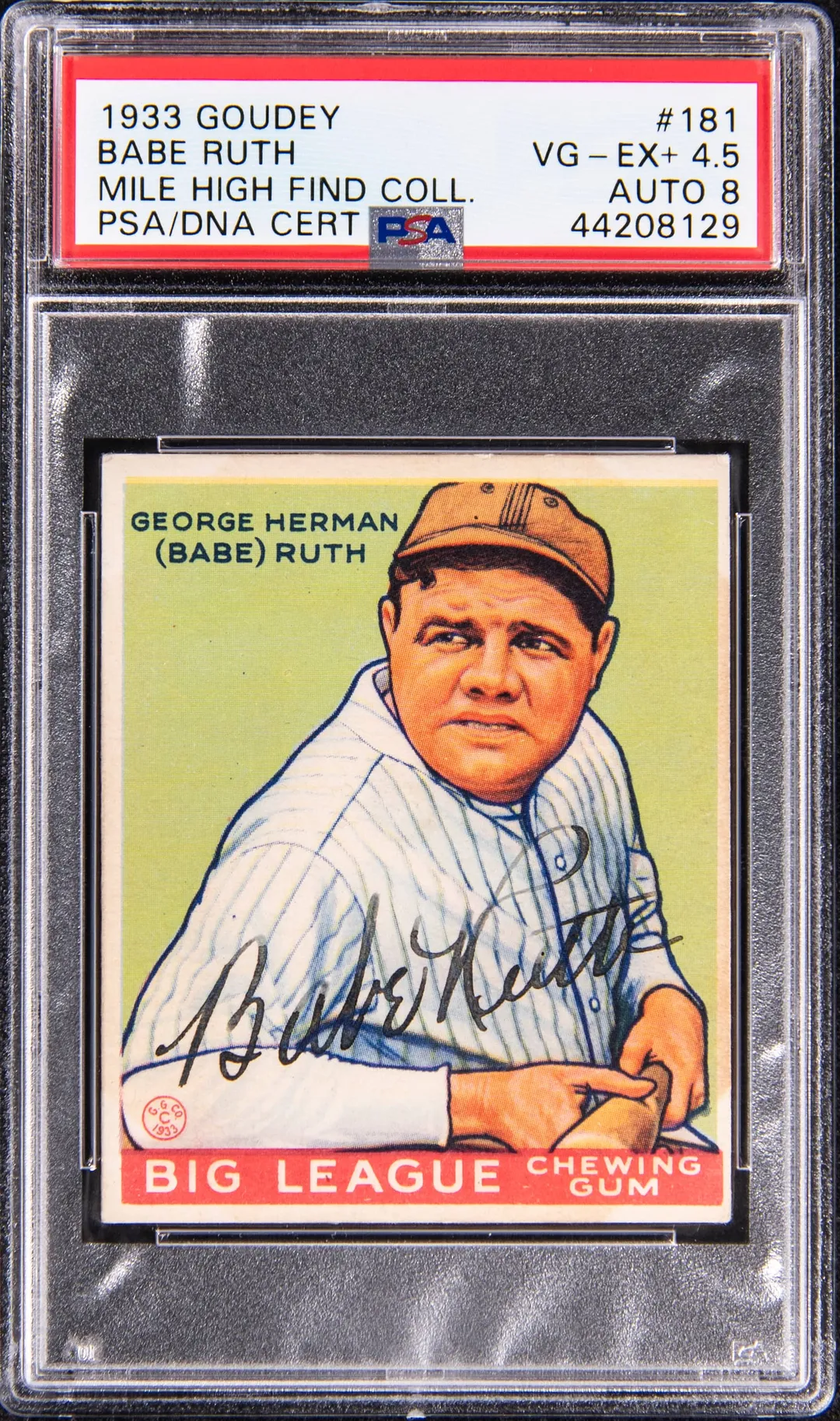
1933 Goudey Babe Ruth Signed PSA 4.5 Sells for $1.46M
Goldin sells a POP 1 1933 Goudey #181 Babe Ruth signed PSA 4.5, PSA/DNA 8 from the Mile High Find Collection for $1.46M. figoca breaks down the sale.
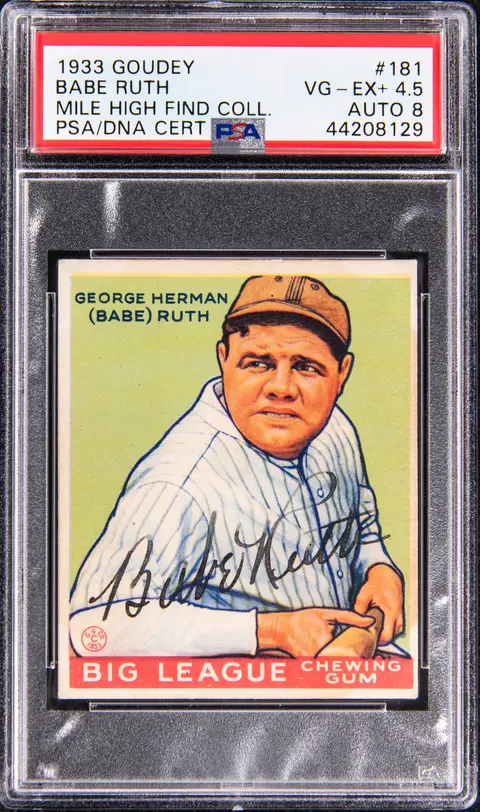
Sold Card
1933 Goudey #181 Babe Ruth Signed Card - Mile High Find Collection - PSA VG-EX 4.5, PSA/DNA NM-MT 8 - POP 1 Highest Graded Signed Goudey Ruth for All 4 Subjects - JSA LOA
Sale Price
Platform
Goldin1933 Goudey Babe Ruth cards sit near the center of vintage baseball collecting, and a recent result at Goldin underlined just how far the very best examples have come.
On February 22, 2026 (UTC), Goldin sold a 1933 Goudey #181 Babe Ruth from the “Mile High Find Collection” for $1,464,001. This example is autographed, graded PSA VG-EX 4.5 for the card itself, with the signature authenticated and graded PSA/DNA NM-MT 8. It is accompanied by a JSA Letter of Authenticity (LOA).
Most importantly for collectors: this is a population 1 ("POP 1") card and currently the highest graded signed 1933 Goudey Babe Ruth across all four Ruth subjects in the set.
Card overview: 1933 Goudey #181 Babe Ruth
- Player: Babe Ruth, New York Yankees
- Year / Set: 1933 Goudey
- Card number: #181
- Issue type: Not a rookie card, but a true key issue and one of the flagship Ruth cards in pre-war collecting
- Attributes: On-card autograph, vintage ink signed directly on the original card
- Grading:
- Card: PSA VG-EX 4.5 (Very Good–Excellent)
- Autograph: PSA/DNA NM-MT 8 (Near Mint–Mint)
- Additional authentication: JSA LOA
- Provenance: Mile High Find Collection
The 1933 Goudey set is considered one of the foundational gum card releases in the hobby. It features bright, colorful artwork and a checklist packed with stars. Babe Ruth appears on four different cards in this set (#53, #144, #149, and #181), and together they form one of the most pursued vintage runs for a single player.
While unsigned 1933 Goudey Ruths are already important, authenticated on-card signed copies sit in a different category of scarcity and desirability. Ruth passed away in 1948, decades before graded card and autograph encapsulation became standard, so his signatures on period cards are extremely limited.
Grading, pop report, and why this copy stands out
In grading, a “pop report” (population report) is the grading company’s count of how many copies of a card exist in each grade. A POP 1 card means that only one example has received that exact grade, and none have graded higher in the same category.
This card carries two critical components:
Card grade – PSA VG-EX 4.5
- For a 1933 card, VG-EX 4.5 represents a well-preserved example with honest wear: light corner rounding, minor surface or edge wear, and typically solid eye appeal.
- Many surviving Goudey Ruths show heavier creasing, staining, or back damage. Finding a mid-grade example that still presents strongly is not easy.
Autograph grade – PSA/DNA NM-MT 8
- The PSA/DNA 8 autograph grade signals a bold, well-placed, and relatively clean signature for its age.
- Ruth’s signature can vary widely in strength and clarity, especially on cards that saw years of handling before collectors recognized their long-term importance.
Combining a strong mid-grade card with a high-grade signature is rare for this issue. Many signed Ruth Goudeys either appear on lower-grade cards, carry weaker or less legible autographs, or have not been dual-graded to modern standards.
The designation that this is the highest graded signed Goudey Ruth for all four 1933 Goudey Ruth subjects makes it a genuine outlier in the pop report. Among all signed 1933 Goudey Ruth cards—#53, #144, #149, and #181—this example currently sits at the top.
Market context and recent sales
For a card like this, direct “comps” (recent comparable sales) are sparse. Signed, graded 1933 Goudey Ruth cards are rare enough that each major auction result tends to stand on its own, especially when the card is population 1 and the highest graded.
Key points for context:
Unsigned 1933 Goudey Ruths:
- High-grade unsigned copies of Ruth’s 1933 Goudey cards, especially in PSA 8 and above, have repeatedly sold in the mid six-figure range and beyond in recent years, depending on the specific pose and card condition.
- Even solid mid-grade unsigned examples can reach into five- and low six-figure prices, reflecting how central these cards are to vintage collections.
Signed vintage Ruth cards:
- Authenticated signed Ruth pieces (photos, cuts, checks, balls) appear more often than signed period trading cards.
- Signed playing-days cards, especially from iconic sets like 1933 Goudey, tend to command a premium because they combine two markets: high-end vintage cardboard and high-end vintage autographs.
Signed 1933 Goudey Ruth examples:
- Publicly recorded sales of signed 1933 Goudey Ruths are infrequent, and when they surface, they are often unique in their exact grade combination.
- Each result needs to be read as a data point rather than a stable price “range,” because the next available copy may be meaningfully different in card grade, signature quality, or eye appeal.
At $1,464,001 through Goldin on February 22, 2026 (UTC), this card lands firmly in the high end of the vintage market. Its price reflects:
- The historical importance of 1933 Goudey as a set.
- Babe Ruth’s status as one of the central figures in all of sports collecting.
- The extreme scarcity of signed, high-grade Goudey Ruths.
- The unique POP 1, highest-graded status across all four 1933 Goudey Ruth subjects.
Given the scarcity of direct comps, this sale functions more as a new benchmark than a typical transaction. Collectors and market watchers will likely use this result as a reference point for future signed Ruth Goudey offerings.
Why this matters to collectors
1. A convergence of key collecting lanes
This card sits at the intersection of several important lanes in the hobby:
- Pre-war vintage cards – Early gum issues with strong artwork and historical significance.
- Blue-chip legends – Ruth is often treated as a “blue-chip” player for vintage collections, meaning demand is broad and persistent across eras of collectors.
- On-card autographs – Hard-signed, era-appropriate autographs are generally preferred over modern cuts or reprint autos.
- High-end graded examples – Dual-graded card and signature, third-party authenticated by leading firms (PSA and JSA).
When all of these elements align, the result is a card that appeals to multiple collector segments at once: vintage set builders, Ruth specialists, autograph collectors, and investors who focus on historically important pieces.
2. Era, scarcity, and condition
The 1933 Goudey release belongs firmly to the pre-war vintage era. Surviving cards are limited by:
- How few cards were produced relative to modern print runs.
- The way they were originally used—handled by children, stored in less-than-ideal conditions, and rarely preserved with future value in mind.
Add an authentic Ruth autograph to the surface of a card like this, and the pool of surviving, high-quality examples shrinks even further. Many signed vintage cards have condition issues such as ink bleeding, surface damage around the signature, or fading. That makes a PSA/DNA 8 signature on a VG-EX 4.5 card all the more notable.
3. The role of provenance
The card is noted as coming from the Mile High Find Collection. Named finds and collections often matter to advanced collectors because they provide a narrative and provenance—essentially a paper trail for where the card came from and how it was stored.
Provenance does not replace condition, but when combined with high-grade results, it can strengthen a card’s overall story: not just what it is, but where it has been.
What this sale might signal for the market
Without making predictions or financial promises, a sale like this can still offer some takeaways for hobbyists:
- Top-end vintage demand remains deep. The price realized at Goldin suggests that serious collectors and buyers continue to compete aggressively for truly unique, historically significant pieces.
- Signed playing-days cards occupy a special tier. Even in a market where modern low-serial and patch autos get a lot of attention, on-card signatures from the playing days of all-time greats can command substantial premiums.
- Population and narrative matter. Being POP 1 and the highest graded across all four 1933 Goudey Ruth cards helped this copy stand apart from other high-profile Ruth items.
For collectors working at more modest levels, the key takeaway is less about chasing this exact card and more about understanding what drives long-term desirability: historically important sets, iconic players, authentic on-card autographs, and clear third-party grading and authentication.
How newcomers and returning collectors can use this info
Even if a million-dollar Ruth is out of reach, this sale offers some useful lessons:
- Learn sets and eras. Knowing where 1933 Goudey fits in the hobby timeline helps you evaluate other vintage issues—from T206 to Play Ball to post-war Bowman and Topps.
- Pay attention to pop reports. Understanding how many graded copies exist in each grade gives context when you look at prices. High population cards in the same grade tend to be less scarce, while POP 1 and low-pop examples often draw premium attention.
- Separate card and autograph quality. When you look at signed cards, consider both the condition of the cardboard and the strength of the signature. Dual grading (card + auto) helps clarify this.
- Track major auction houses. Sales at places like Goldin can act as reference points for long-term trends, especially for high-end vintage pieces.
Final thoughts
The February 22, 2026 Goldin sale of the 1933 Goudey #181 Babe Ruth Signed Card from the Mile High Find Collection for $1,464,001 is more than a headline number. It captures how much weight collectors place on:
- An iconic pre-war set.
- An all-time player.
- A rare on-card autograph.
- A POP 1, highest-graded status confirmed by leading grading and authentication firms.
For figoca readers, this result is a reminder that the trading card market’s most important pieces are still driven by history, scarcity, and condition. Whether you collect high-end vintage or you are just getting started, understanding why a card like this matters can help you make more informed decisions across your own collection.