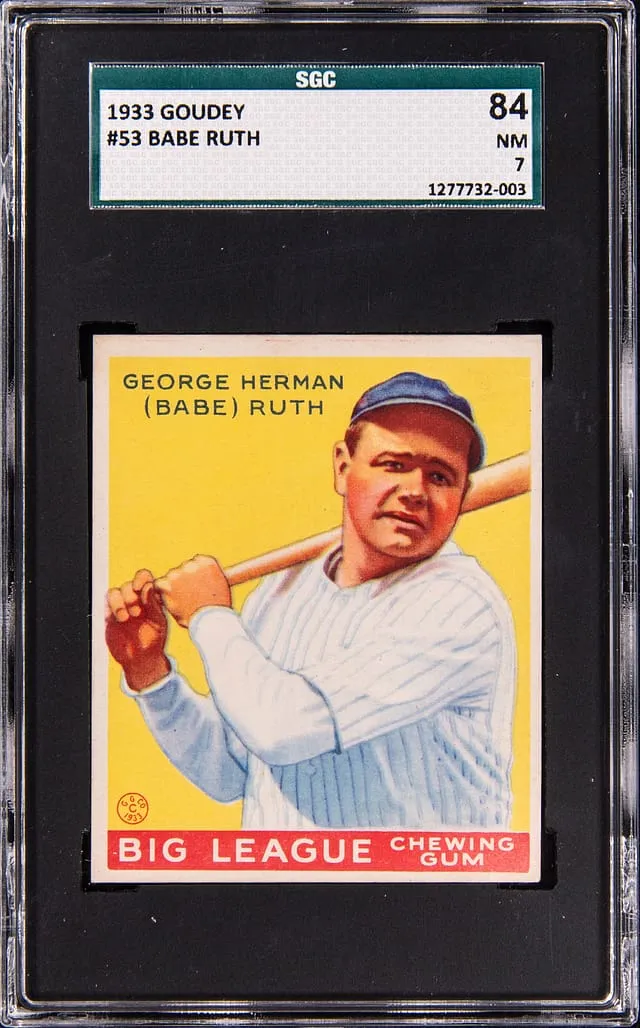
1933 Goudey Babe Ruth #53 SGC 7 sells for $124K
A 1933 Goudey #53 Babe Ruth graded SGC 7 sold for $124,440 at Goldin on Feb 22, 2026. See what this key vintage card means for today’s market.
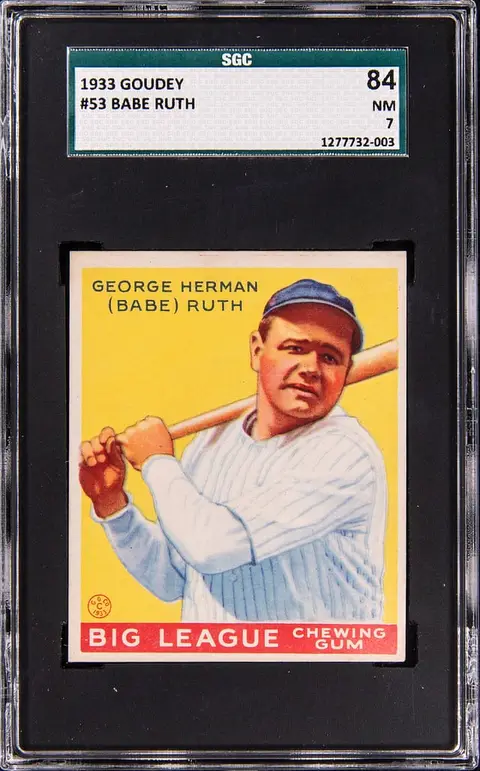
Sold Card
1933 Goudey #53 Babe Ruth - SGC NM 7
Sale Price
Platform
Goldin1933 Goudey Babe Ruth cards sit at the crossroads of hobby history, scarcity, and global name recognition. A recent sale underscored that reality: on February 22, 2026, Goldin sold a 1933 Goudey #53 Babe Ruth graded SGC NM 7 for $124,440.
In this post, we’ll break down what this card is, why collectors care, and how this sale fits into the broader market for Ruth’s 1933 Goudey cards.
The card at a glance
- Player: Babe Ruth (New York Yankees)
- Year / Set: 1933 Goudey
- Card number: #53
- Grading company: SGC (Sportscard Guaranty Corporation)
- Grade: NM 7 (Near Mint)
- Attributes: Standard base card, no autograph or memorabilia
- Era: Vintage pre-war
The 1933 Goudey issue is one of the foundational gum card sets in the hobby. Ruth appears on four different cards in the set (#53, #144, #149, #181). Card #53 is the yellow-background portrait, one of the most recognizable images of Ruth on cardboard.
This is not a rookie card—Ruth’s playing-era cards date back to the 1910s—but it is considered a key issue, meaning it is one of the most important and sought-after cards of a major Hall of Famer.
Why 1933 Goudey matters
For newer collectors, 1933 Goudey is often described as:
The set that bridges early tobacco cards and the modern gum card era.
A few reasons it’s so important:
- Gum-era cornerstone – Goudey’s 1933 release helped popularize the modern concept of buying a pack of cards with gum inside. The colorful artwork and star checklist made it a landmark set.
- Four Babe Ruth cards – Few sets feature a legend in four distinct poses. That alone keeps demand steady across grades and variations.
- Pre-war scarcity – Compared with post‑1950 sets, surviving examples—especially in higher grades—are significantly scarcer. Production quality, storage conditions, and the passage of almost a century all factor in.
The meaning of an SGC 7 for a 1933 Goudey Ruth
Grading companies like SGC evaluate condition on a scale from 1 to 10. An SGC 7 (Near Mint) for a 1933 issue signals a very strong example:
- Sharpness: Corners and edges are typically well above average for the era.
- Surface: Clean image, relatively free of heavy creasing or major print defects.
- Eye appeal: Centering and color are usually better than what you see in most raw (ungraded) or lower‑grade copies.
On pre-war cardboard, every step up the scale tends to narrow the population. While exact numbers can change as new cards are submitted, population reports ("pop reports"—the grading companies’ public counts of how many copies they’ve graded) generally show a steep drop once you cross into the Near Mint range for 1930s issues.
For a card like 1933 Goudey #53 Ruth, the difference in perceived quality between something in the Good/Very Good range and a true Near Mint example can be substantial to collectors, and that gap is reflected in price.
Recent sales and market context
When collectors talk about “comps” (short for comparables), they mean recent sales of the same or very similar cards, used as a reference point for price expectations.
For 1933 Goudey #53 Babe Ruth, comps over the last several years show a consistent pattern:
- Lower‑grade copies (for example, in the 1–3 range) have drawn steady interest from collectors who want a key Ruth at a more accessible entry point.
- Mid‑grade copies (around 4–6) often show clear separation from low‑grade examples, especially when eye appeal is strong.
- High‑grade copies (around 7 and above) tend to be far fewer and command a notable premium.
Against that backdrop, the Goldin sale on February 22, 2026 at $124,440 for an SGC NM 7 falls into the range you would expect for a strong, investment‑caliber example of this card in the current market climate for blue‑chip vintage.
Within the Ruth Goudey family, there have been several headline sales—particularly in very high grades (near‑mint‑mint and better)—that reached well into six figures and, in rare cases, beyond. The exact prices vary over time with overall market sentiment, but the trend has been clear: top‑end 1933 Ruth cards have established themselves as long‑term cornerstones of the vintage segment.
This SGC 7 result reinforces a few consistent themes:
- Grade still matters most on iconic vintage. The market continues to pay up for condition, especially in the Near Mint and better range.
- Cross‑holder strength. High‑end Ruths in SGC holders can achieve results in line with comparable examples in other major grading companies when the card and eye appeal are strong.
- Stable demand for key Ruth issues. Even with broader hobby cycles, the top Ruth Goudeys continue to see competitive bidding.
Why collectors care about this specific Ruth card
Several factors combine to keep demand for 1933 Goudey #53 high across experience levels:
- Iconic portrait: The yellow-background portrait is one of the classic images of Ruth that many collectors first recognize in books, documentaries, and hobby guides.
- Historical context: Issued near the end of Ruth’s playing career, it captures him as an already‑mythic figure in baseball history.
- Set synergy: Many set builders—collectors who try to complete entire checklists—treat the Ruth cards as the centerpiece of any 1933 Goudey run.
- Global appeal: Babe Ruth’s name recognition extends beyond baseball fans and beyond the U.S., which broadens the potential buyer pool for high‑end examples.
What this sale might signal for the market
A single auction result never tells the full story, but it can add another data point.
From a collector-focused perspective, the $124,440 sale of the SGC 7 at Goldin suggests:
- High‑grade vintage stability: Key pre‑war stars, especially Ruth, continue to perform as a relatively stable segment of the hobby compared with more volatile modern issues.
- Ongoing respect for 1933 Goudey: The set remains a bellwether for pre‑war demand. Strong results on its flagship cards are often read as a healthy sign for that part of the market.
- Condition premium remains wide: The gap between eye‑appealing high‑grade copies and lower‑grade examples shows no sign of closing quickly.
How different types of collectors might look at this sale
Newcomers and returning collectors
If you are just getting into vintage or coming back to the hobby, a six‑figure sale can feel distant. But it still has practical value:
- It underscores why even well-loved, lower‑grade Ruths carry strong demand.
- It explains why condition details—centering, color, creases—matter so much and why grading has become standard for key vintage cards.
Active hobbyists
For collectors already tracking numbers, this sale adds another modern comp for high‑grade Ruth Goudeys:
- It can be one reference point when evaluating mid‑grade or raw copies you see at shows or online.
- It offers a reminder to factor in both technical grade and eye appeal, as two cards with the same numerical grade can still be viewed differently by the market.
Small sellers and dealers
For sellers, a result like this may influence how you:
- Price lower‑grade Ruths or other pre‑war Hall of Famers.
- Decide whether to submit raw vintage to SGC or other major grading companies when building inventory.
- Communicate condition, history, and set significance to buyers who are just discovering 1930s issues.
Putting it all together
The 1933 Goudey #53 Babe Ruth – SGC NM 7 that sold at Goldin on February 22, 2026 for $124,440 is a clear example of how historical significance, visual appeal, and grade scarcity combine on a single card.
For collectors, it serves as:
- A benchmark for high‑grade pre‑war Ruth pricing.
- A reminder of the lasting importance of the 1933 Goudey set.
- An illustration of how condition, grading, and provenance (where and when a card is sold) can all affect realized prices.
As always, individual cards can sell above or below recent comps based on timing, presentation, and specific bidder interest. But results like this help map out the upper end of the market for one of the hobby’s most recognizable vintage icons.
If you’re exploring 1933 Goudey Ruths—whether in well-loved lower grades or aiming higher—studying sales like this one is a useful way to understand where your own collecting goals might fit into the broader landscape.