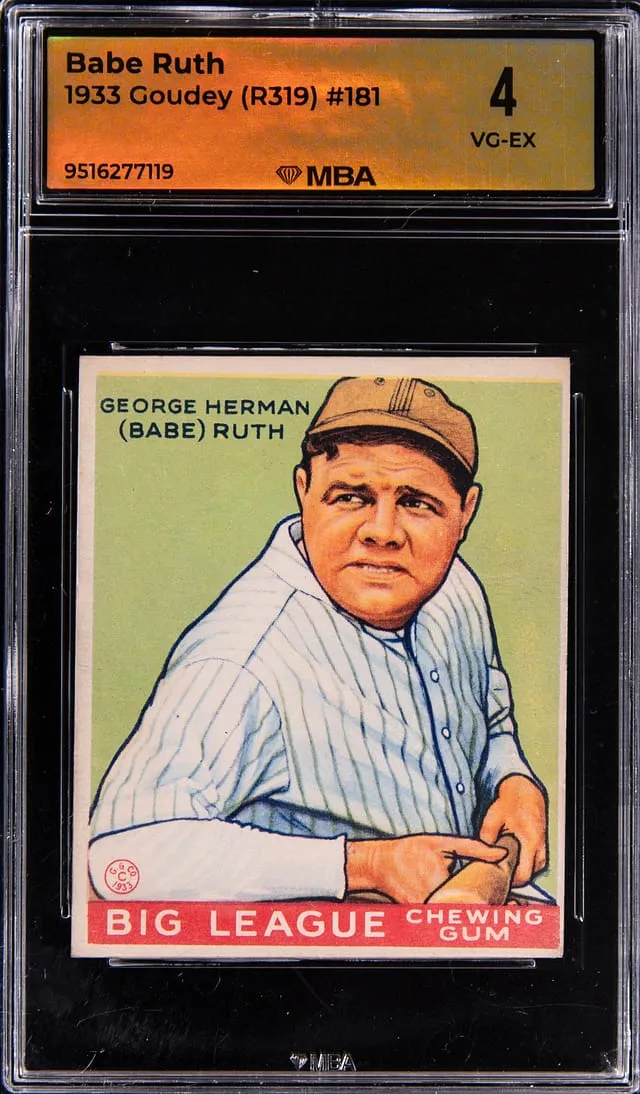
1933 Goudey Babe Ruth #181 VG-EX 4 sells for $26.9K
Goldin sold a 1933 R319 Goudey #181 Babe Ruth MBA VG-EX 4 for $26,907. See how this key vintage card fits today’s market and recent sales.
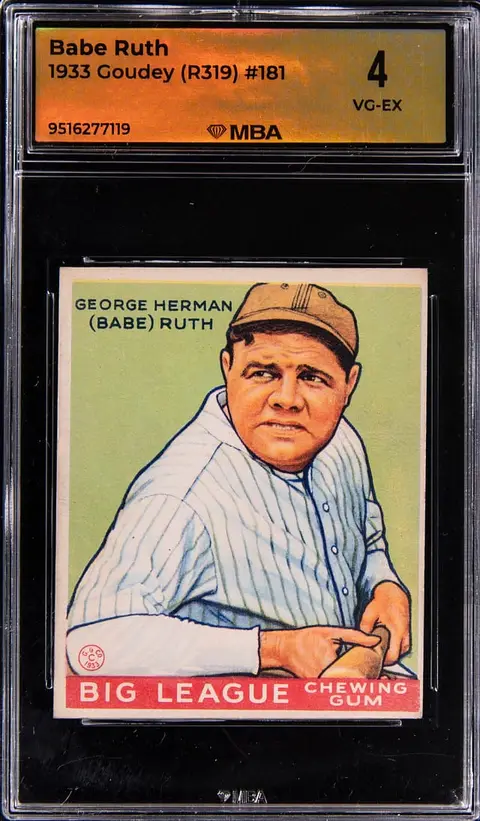
Sold Card
1933 R319 Goudey #181 Babe Ruth - MBA VG-EX 4
Sale Price
Platform
Goldin1933 Goudey Babe Ruth cards sit near the center of vintage baseball collecting, and the recent sale of a 1933 R319 Goudey #181 Babe Ruth graded MBA VG-EX 4 is a good reminder of why.
In a Goldin auction that closed on 2026-03-15, this example sold for $26,907. For a mid‑grade copy of one of Ruth’s key issues, the result fits neatly into the broader market story for this card: steady demand, clear historical significance, and ongoing interest from both advanced vintage collectors and newer hobbyists.
The card: 1933 R319 Goudey #181 Babe Ruth
Let’s pin down exactly what this card is:
- Player: Babe Ruth, New York Yankees
- Year: 1933
- Set: R319 Goudey (commonly just called “1933 Goudey”)
- Card number: #181
- Grading company: MBA (graded VG-EX 4)
- Attributes: Standard base issue, no autograph or memorabilia
- Rookie status: Not a rookie card, but an essential Ruth playing‑days issue
The 1933 Goudey set is one of the true cornerstone issues of pre‑war baseball. It was a colorful, widely distributed gum card set at the time, and today it’s one of the most recognizable vintage designs in the hobby.
Ruth appears on four different cards in 1933 Goudey: #53, #144, #149, and #181. All four are important, but #181 – with its green background portrait – is often treated as one of the more approachable entry points into owning a playing‑days Ruth from this set when compared side by side with high‑grade examples of #53 or the extremely tough #144.
What does VG-EX 4 mean for a 1933 Goudey Ruth?
The card in this sale was graded VG-EX 4 (Very Good to Excellent) by MBA. On the familiar 1–10 grading scale used in the hobby, a 4 typically reflects:
- Noticeable but honest corner and edge wear
- Moderate surface or print wear
- Small creases or wrinkles that don’t overwhelm the image
For a 92‑year‑old card printed on relatively delicate stock, a 4 is considered solid collector grade. It’s the type of grade where the card still presents well in a display or collection binder without the pricing jump that comes with higher‑grade examples.
Most population report data (the counts of how many copies exist in each grade) comes from major grading companies like PSA, SGC, and Beckett. MBA doesn’t publish the same scale of data, but using PSA/SGC as a proxy, the general picture is:
- Total graded population for 1933 Goudey Ruths is substantial for a pre‑war card, but
- The majority cluster in the 2 to 5 range
- High‑grade examples (7 and above) are significantly scarcer and see dramatically higher prices
A mid‑grade 4 fits squarely into that common "collector lane" where eye appeal and budget are often balanced.
Market context and recent sales
When collectors talk about “comps”, they mean recent comparable sales for the same or a very similar card. That usually means matching player, set, card number, and as close as possible on the grade and grading company.
Because this particular example is graded by MBA rather than PSA, SGC, or Beckett, its comps have to be read in context. Most public auction data and price histories focus on the big three grading companies, which tend to draw the deepest bidder pools.
Looking at public results for 1933 Goudey #181 Babe Ruth in roughly similar grades over the past 12–18 months:
- PSA 4 and SGC 4 copies of #181 have commonly landed in a band that roughly brackets this result, with some sales above and some below depending heavily on eye appeal (centering, color, registration) and the specific auction environment.
- We can also see that the price curve by grade is quite steep for this card. Even a bump from 4 to 5 can add a noticeable premium, and high‑end examples in 7+ territory sit in a completely different price tier.
At $26,907, this Goldin result aligns with expectations for a mid‑grade #181 in today’s market when we factor in:
- The strength of the auction house (Goldin is widely followed by high‑end and vintage bidders)
- The date (early 2026, in a generally stable period for blue‑chip vintage compared to the more volatile modern segments)
- The grading company (MBA, which typically won’t command the same premium as PSA or SGC but can still track close when the card itself looks strong)
In other words, this sale doesn’t represent a wild outlier or a record‑shattering spike; rather, it’s another data point confirming that 1933 Goudey Ruths continue to be treated as stable, long‑term staples in vintage collections.
Why collectors care about 1933 Goudey Babe Ruth cards
For anyone coming back into the hobby or exploring vintage for the first time, it can help to understand why the 1933 Goudey Ruths sit where they do:
Playing‑days cardboard
These cards were issued while Ruth was still an active player. Playing‑days cards, especially from a legend’s prime era, carry a different weight than post‑career or commemorative issues.Key pre‑war set
1933 Goudey is one of a small group of pre‑war baseball sets (alongside T206, 1934 Goudey, 1939 and 1941 Play Ball) that many collectors view as foundational. For set builders, player collectors, and historians, it’s a natural target.Multiple Ruths in one set
Having four different Babe Ruth cards in a single mainstream issue is unusual and adds to the mystique. Some collectors chase all four; others zero in on a favorite pose or background color.Recognizable design and artwork
The color artwork, bold backgrounds, and classic typography have held up remarkably well. Even newcomers who haven’t studied pre‑war cards often recognize a 1933 Goudey Ruth when they see one.Historical anchor in a changing market
Modern and ultra‑modern cards (roughly mid‑2000s forward) can move quickly with hype cycles, performance swings, and short‑printed parallels. Pre‑war icons like Ruth tend to trade more on historical significance and long‑term scarcity than week‑to‑week performance.
How this sale fits the current hobby environment
Vintage and pre‑war markets usually don’t whip around as dramatically as modern prospecting or ultra‑modern inserts. Instead, we tend to see:
- Periods of gradual appreciation, often when more collectors move upstream into vintage
- Occasional plateaus or softening, particularly after hot stretches in the broader hobby
- Strong underlying demand for historically significant, easily understood cards
This Goldin sale on 2026-03-15 fits with that pattern:
- It confirms that there is still deep, consistent bidder interest for 1933 Goudey Babe Ruth cards in mid‑grade.
- It reinforces that even non‑PSA/SGC slabs can attract healthy prices when the card itself is desirable and presented on a major platform.
- It provides another recent comp that collectors can point to when valuing their own examples, whether raw (ungraded) or graded by another company.
Importantly, a single auction never writes the whole story for a card. It’s one point in an ongoing data series. Tracking multiple results over time, across different auction houses and grades, gives a clearer picture.
Takeaways for different types of collectors
For newer or returning collectors
- A 1933 Goudey Ruth, even in lower grades, is widely recognized and easier to understand than many modern inserts and parallels.
- Grades like 1–3 can still offer strong historical appeal at more accessible price points, as long as you are comfortable with heavier wear.
- When you look at comps, try to match player + set + card number + grade + grading company as closely as possible.
For active hobbyists and small sellers
- This $26,907 result at Goldin is a useful reference point when you’re assessing trade or sale offers on similar Ruths.
- Eye appeal still matters within the same numerical grade. Two VG-EX 4 copies can perform differently at auction.
- Cross‑grading (submitting a card graded by one company to be evaluated by another) is common in vintage, but it carries risk. Conservative expectations are important.
For vintage‑focused collectors
- The sale reinforces the role of 1933 Goudey Ruths as a liquid, well‑understood segment of the vintage market.
- If you track auction results for Ruth across his major playing‑days issues (1910s–1930s tobacco, candy, and gum sets), this is another data point that helps you read relative demand between those lanes.
Final thoughts
The 1933 R319 Goudey #181 Babe Ruth is not a hidden gem or a niche parallel—it’s a straightforward, historically important card of the most famous baseball player of all time.
The $26,907 sale at Goldin on 2026-03-15 doesn’t rewrite the price record books, and that’s part of the story. It shows a mature market continuing to assign strong, steady value to a blue‑chip vintage icon in a collector‑friendly grade.
For collectors building toward their first major vintage purchase, tracking sales like this can help ground expectations. For long‑time hobbyists, it’s another confirmation that core pre‑war cards remain central to how the market understands baseball history in cardboard form.