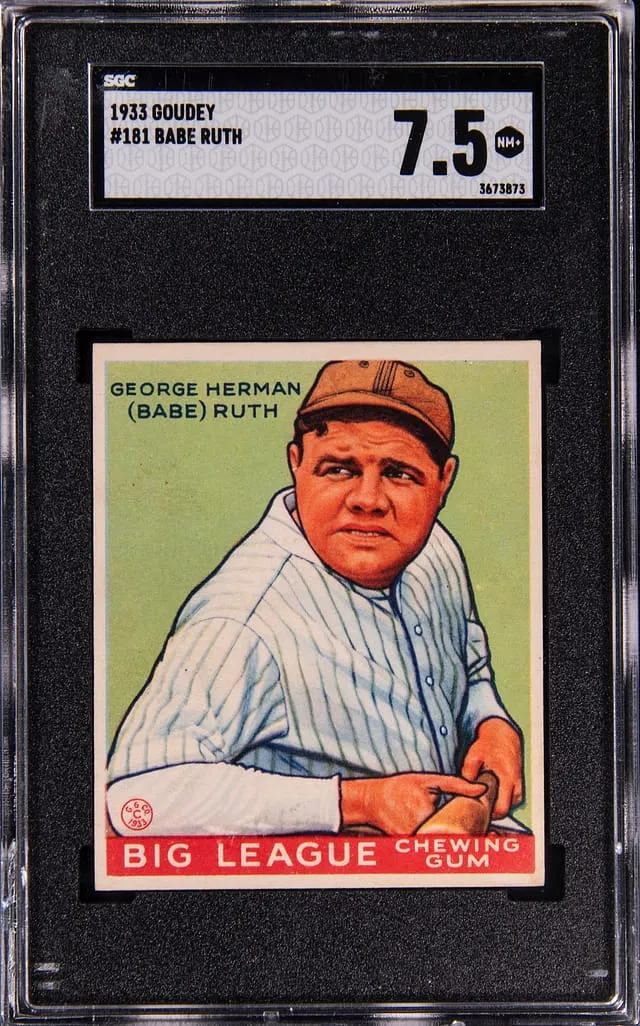
1933 Goudey Babe Ruth #181 SGC 7.5 Sells for $94K
Deep dive on the 1933 Goudey #181 Babe Ruth SGC 7.5 that sold for $94,556 at Goldin on March 8, 2026, with market context and collector insights.
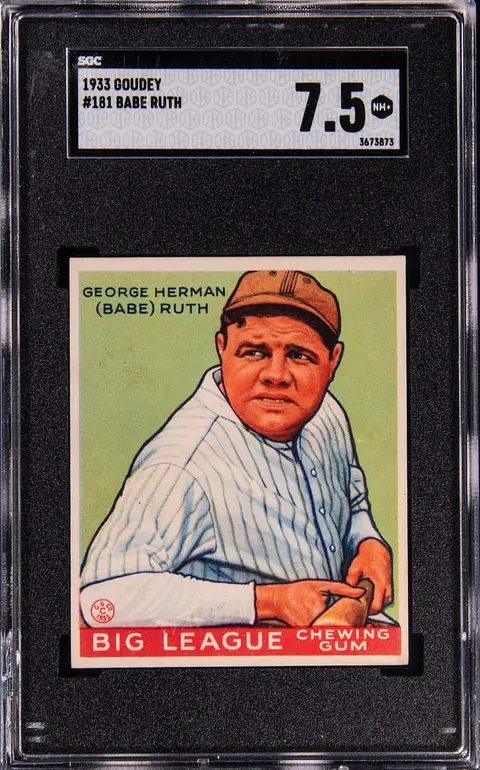
Sold Card
1933 Goudey #181 Babe Ruth - SGC NM+ 7.5
Sale Price
Platform
Goldin1933 Goudey #181 Babe Ruth in SGC 7.5 Sells for $94,556 at Goldin
When a vintage Babe Ruth card changes hands in a strong grade, collectors across the hobby tend to pay attention. That’s exactly what happened on March 8, 2026, when a 1933 Goudey #181 Babe Ruth graded SGC NM+ 7.5 sold at Goldin for $94,556.
Below, we break down what this card is, why it matters, and how this sale fits into the broader market for 1933 Goudey Ruth cards.
The card at a glance
- Player: Babe Ruth (New York Yankees)
- Year & set: 1933 Goudey
- Card number: #181
- Type: Base card (no parallel, no modern inserts)
- Era: Pre-war vintage
- Rookie?: Not a rookie card, but an elite key issue
- Grading company: SGC (Sportscard Guaranty Corporation)
- Grade: NM+ 7.5
- Attributes: Standard 1933 Goudey issue; no autograph or memorabilia, which is normal for this era
The 1933 Goudey set is one of the cornerstone baseball sets of the pre-war era. It was one of the first widely distributed gum card sets in full color, and it helped establish the template for modern baseball cards. Within that set, Babe Ruth is featured on four different cards (#53, #144, #149, and #181). Collectors often treat these four as a mini-run of essential Ruth issues.
Card #181 is the green-background portrait. It is widely viewed as one of the more visually striking of the four and is often grouped alongside #53 as a top-tier choice for collectors who want a single 1933 Goudey Ruth.
Why SGC 7.5 matters for this card
For pre-war vintage, condition is everything. Centering, registration, edge wear, and surface gloss all play a major role in value. A numerical grade gives a shorthand view of all those factors combined.
- SGC NM+ 7.5 sits in the upper tier of surviving examples.
- For a 1933 issue, anything in the 7–8 range is considered strong, with 8.5–9 and above becoming truly scarce and very expensive.
Population reports (often called “pop reports”) from major grading companies show how many copies exist in each grade. While exact current SGC pop numbers can move as cards are graded or re-graded, the broad picture has been consistent for years:
- Low-grade Ruths (1–3) are relatively common for this issue.
- Mid-grade (4–6) thins out.
- High-grade (7 and above) is where scarcity relative to demand becomes much more noticeable.
An SGC 7.5 is not the absolute top of the mountain, but it sits in a range that balances high-end eye appeal with more accessible pricing than the very top slabs.
Market context and recent sales
This sale closed at $94,556 at Goldin on March 8, 2026.
To understand that number, it helps to look at “comps.” In the hobby, comps are comparable recent sales of the same card (or very similar versions) that collectors use as rough market reference points.
For the 1933 Goudey #181 Babe Ruth:
- Lower grades (1–3) often trade in the low-to-mid five-figure range, depending on eye appeal, centering, and the grading company.
- Solid mid-grades (5–6) tend to stretch into the high five figures, again influenced by centering and overall presentation.
- High grades (7 and above) regularly push well into the five- and low six-figure territory.
For this specific lane—high-grade, third-party graded examples—recent public auction results in the past couple of years have generally shown:
- SGC/PSA 6–7 range: often somewhere in the $40,000–$80,000 band, with outliers both below and above when eye appeal is especially strong or weak.
- Top-end 8+ examples: can climb substantially higher, with some notable results well past the six-figure mark in strong market moments.
A realized price of $94,556 for an SGC 7.5 slots this copy into the upper end of the high-grade range, especially considering it is not a PSA holder, which sometimes commands a premium for certain vintage cards. The price suggests:
- Continued strong demand for iconic pre-war Ruth issues.
- Willingness among collectors and investors to pay a premium for eye-appealing, high-grade examples, even outside the very top couple of grades.
Because vintage markets evolve gradually rather than overnight, it is more useful to see this sale as part of a longer trend than as a single “record” headline. In the last several years, 1933 Goudey Ruths across all grades have generally held their status as blue-chip hobby staples, even as modern and ultra-modern cards have seen more volatility.
How this sale compares historically
Across auction houses, there have been notable sales of 1933 Goudey Ruths in high grade, especially in PSA 8–9 and SGC/BVG equivalents. While exact numbers move with broader economic conditions, a few consistent themes have shown up repeatedly:
Top grades set the ceiling.
- PSA 8 and above have historically set new benchmark prices when they appear, driven by low population and intense demand.
High-end mid grades set the floor.
- SGC and PSA 6–7 copies tend to stabilize broader expectations for what a “nice” 1933 Goudey Ruth should cost.
7–7.5 is a key pivot point.
- In many iconic vintage issues, the move from 4–5 to 6–7 is where prices stop behaving linearly. A card that looks significantly sharper than the typical mid-grade copy can command a noticeably bigger premium.
Within that framework, a $94,556 sale for an SGC 7.5 is consistent with the card’s status as one of the hobby’s premier pre-war Ruths. It does not change the overall hierarchy—top pop examples still sit above—but it reinforces the strength of demand in the high-grade band.
Why collectors care about 1933 Goudey Babe Ruth cards
Several factors make this card, and the 1933 Goudey Ruth run in general, a central target for both seasoned hobbyists and advanced Ruth collectors.
1. Historical significance
The 1933 Goudey set is considered a landmark in baseball card history:
- One of the first major, colorful gum issues with wide distribution.
- Widely regarded as a foundational set for modern card design.
- Contains multiple Hall of Famers and has become a benchmark for pre-war collecting.
Babe Ruth, by 1933, was already a larger-than-life figure. These cards don’t capture a rising rookie—they cement an established legend.
2. Four-card Ruth run in one set
Few sets feature a single player as prominently as Goudey does with Ruth:
- #53: Yellow background
- #144: Full-body batting pose
- #149: Red background portrait
- #181: Green background portrait (the card in this sale)
Some collectors try to assemble all four. Others pick a favorite based on artwork, color, or pose. In many collections, #53 and #181 are the leading choices for a single representative Ruth from the set.
3. Pre-war scarcity and survival
Pre-war cards were not produced or stored with long-term preservation in mind:
- Many were handled by kids, glued in scrapbooks, or thrown away.
- Surviving high-grade copies are rare simply because of how the cards were used.
By the time grading became standard hobby practice, most well-loved copies were already creased or rounded. That’s why high-grade pre-war cards, including this SGC 7.5, are so closely watched.
4. Stable demand over many cycles
Interest in Babe Ruth cards rarely tracks short-term sports cycles:
- There’s no modern-season performance to drive peaks and dips.
- Instead, demand tends to follow broader economic and collecting trends.
That doesn’t mean prices are fixed—they can and do move with the overall market—but Ruth’s status as a central figure in baseball history gives his key cards a long, well-documented track record of collector interest.
Reading the SGC 7.5 grade for this copy
Without seeing the individual card’s images, we can’t comment on its specific centering or print quality. But generally, an SGC NM+ 7.5 on a 1933 Goudey Ruth suggests:
- Clean front and back with only minor wear.
- No major creases or wrinkles.
- Respectable centering, though possibly not perfect.
- Strong overall eye appeal relative to the population.
For many collectors, this grade strikes a balance between condition and cost. As you move up to 8, 8.5, and beyond, the price curve usually gets much steeper while the visible differences become more subtle.
What this sale might mean for collectors
Instead of treating any single auction as a signal to chase or avoid a card, it’s often more helpful to think in terms of reference points.
For the 1933 Goudey #181 Babe Ruth:
- This Goldin sale at $94,556 becomes a fresh high-grade comp that collectors and small sellers can reference.
- It reinforces that well-presented copies in the 7–8 band remain in high demand.
- It underlines that SGC-graded examples, not just PSA, are competing at strong price levels in vintage.
If you’re a collector or small seller, this kind of result is useful for:
- Pricing conversations: When buying or selling a mid-to-high grade Goudey Ruth, recent public auctions can help anchor expectations.
- Grade targeting: Seeing the gap between mid- and high-grade prices can help you decide whether to prioritize grade, eye appeal, or budget.
As always, individual cards can trade above or below headline comps depending on timing, eye appeal, and bidder competition.
Final thoughts
The March 8, 2026 sale of a 1933 Goudey #181 Babe Ruth – SGC NM+ 7.5 for $94,556 at Goldin is another data point in the long story of one of the hobby’s most important vintage issues.
For newcomers, it’s a reminder that pre-war icons sit in a different lane than most modern cards: slower-moving, historically grounded, and heavily influenced by condition and grading.
For veteran collectors, this sale confirms what many already know: high-grade 1933 Goudey Ruths, especially the #181 green portrait, remain among the most closely watched and consistently collected Babe Ruth cards in the market today.