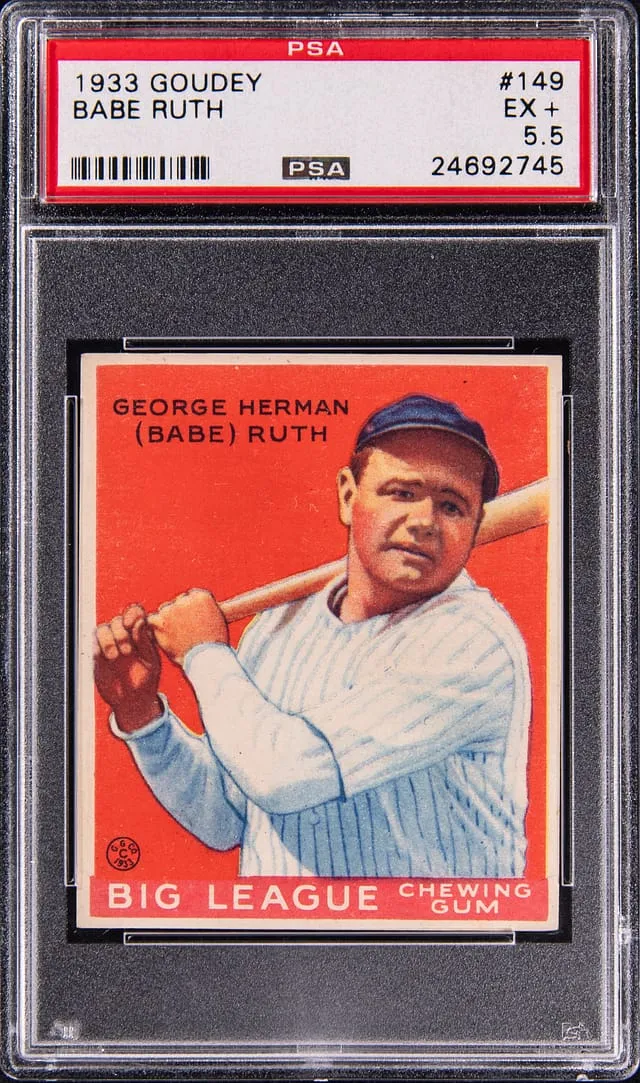
1933 Goudey Babe Ruth #149 PSA 5.5 sells for $73K
Goldin sold a 1933 Goudey #149 Babe Ruth PSA EX+ 5.5 for $73,200 on Feb 22, 2026. See why this pre-war Ruth remains a key vintage benchmark.
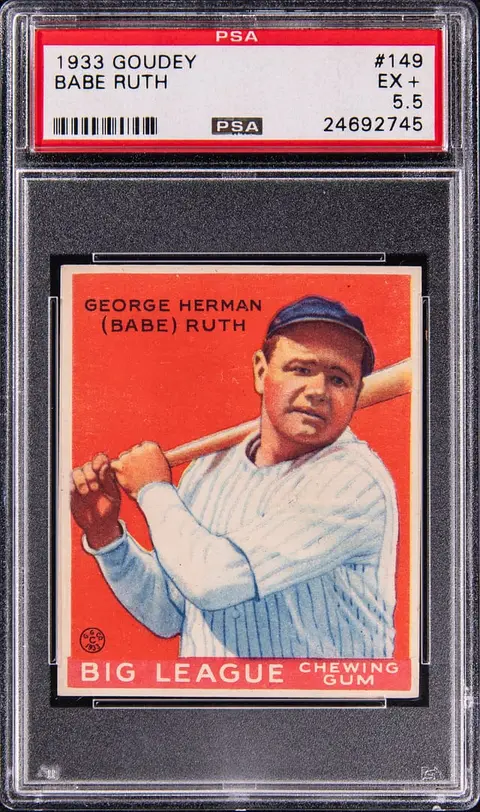
Sold Card
1933 Goudey #149 Babe Ruth - PSA EX+ 5.5
Sale Price
Platform
Goldin1933 Goudey #149 Babe Ruth in PSA EX+ 5.5 Sells for $73,200 at Goldin
The 1933 Goudey Babe Ruth cards sit at the center of pre-war baseball collecting, and card #149 is one of the hobby’s most recognizable vintage issues. On February 22, 2026, Goldin sold a copy of the 1933 Goudey #149 Babe Ruth graded PSA EX+ 5.5 for $73,200. For collectors who track vintage benchmarks, this is a useful data point for both the Ruth market and the broader pre-war space.
In this breakdown, we’ll walk through what this card is, why it matters, and how this particular sale fits into recent price action.
Card at a glance
- Player: Babe Ruth
- Team: New York Yankees
- Year: 1933
- Set: 1933 Goudey
- Card number: #149
- Parallel/variant: Base issue (no parallel)
- Rookie status: Not a rookie card, but a key vintage Babe Ruth issue
- Grading company: PSA (Professional Sports Authenticator)
- Grade: EX+ 5.5
The 1933 Goudey release is widely considered one of the landmark early gum card sets. It was one of the first major U.S. sets to pair full-color artwork with a national distribution, and it helped define what a modern baseball card could look like.
Babe Ruth appears on four different cards in the 1933 Goudey checklist: #53, #144, #149, and #181. All four are heavily collected, and different collectors have different preferences, but #149 is consistently treated as one of the key pieces in any serious Ruth run.
Why the 1933 Goudey Ruth matters to collectors
Vintage collectors generally divide the hobby into eras: pre-war (before World War II), post-war, “junk wax” (late 1980s–1990s mass production), and modern/ultra-modern. The 1933 Goudey Ruths are firmly in the pre-war category.
A few reasons these cards matter:
Era-defining set 1933 Goudey is one of the cornerstone pre-war sets along with T206, Play Ball, and a small handful of others. It captures the game just as the gum-card era really took off. For many collectors, owning a Goudey Ruth is the closest they’ll come to a true playing-days card of one of baseball’s most important figures.
Multiple iconic poses Because Ruth appears on four different cards in the set, collectors can choose among several different portraits and action images. Card #149 features one of the classic illustrations that has been reproduced in hobby media for decades, which keeps it at the front of collectors’ minds.
True scarcity in higher grades Pre-war cards were printed on relatively fragile stock, often handled heavily, and stored in less-than-ideal conditions. High-grade examples are much less common than modern issues. Even grades that sound “mid-tier” by modern standards (like PSA 5–6) can be significant for a 1930s card.
What PSA EX+ 5.5 means for a 1933 Goudey Ruth
PSA uses a 10-point scale, with 10 being gem mint. EX+ 5.5 falls in the “Excellent-plus” range. In practical terms for a pre-war card, that typically means:
- Honest corner wear, but no major chipping or paper loss
- Respectable surface eye appeal, with possible light creasing or minor wrinkles that don’t dominate the image
- Solid centering for the issue, though some tilt or off-center cuts are common
For 1933 Goudey Babe Ruth cards, the population report (the grading company’s public count of how many copies exist at each grade, often called the “pop report”) tends to show a pyramid: many lower-grade copies (1–3), fewer in the mid-grades (4–6), and very limited supply at the top.
While specific population counts change as new cards are submitted, PSA 5 to 6 copies usually sit in the perceived “sweet spot” for collectors who want a balance of vintage eye appeal and relative affordability versus the high-end 7–8+ examples.
Market context: how $73,200 fits in
Goldin’s February 22, 2026 sale of this PSA EX+ 5.5 at $73,200 gives us a new midpoint in the ongoing pricing story for this card. Looking at recent patterns across major auction houses and marketplaces:
- Lower grades (PSA 1–2 range) have typically sold at a substantial discount to this result, reflecting heavier wear and more condition issues.
- Higher grades (PSA 7 and above) have historically reached much stronger price levels, sometimes multiples of what mid-grade examples achieve, especially in strong market windows.
Viewed against the broader curve, $73,200 for a PSA 5.5 is consistent with the idea that collector demand remains steady for solid mid-grade copies. It lines up with the long-term pattern where well-centered, visually appealing mid-grade Ruth cards continue to command meaningful premiums over heavily worn examples, while still trailing the rare high-grade population by a wide margin.
Because individual results can vary based on centering, color, registration (print clarity), and eye appeal, any single sale should be read as one data point rather than a definitive “new level.” Still, this auction confirms that the mid-grade 1933 Goudey Ruth market is active and supported by willing bidders.
Comparing to related Ruth Goudey cards
Collectors often look across the four 1933 Goudey Ruths when evaluating value and relative demand:
- Card #53: Another widely recognized pose, often tracked closely in auction results.
- Card #144: Shares artwork with #53 but is part of a separate print run and has its own following.
- Card #181: Offers a different visual look and can sometimes move differently in price from #149 and #53.
Price levels can differ among these four cards depending on recent supply, specific grade populations, and shifts in collector preference, but all are considered major Ruth issues from a flagship pre-war set.
This particular #149 in PSA 5.5 slots into that ecosystem as one of the “reachable but still significant” Ruth Goudey options, especially for collectors who prioritize overall visual appeal over strict top-end grading.
Why this sale matters for collectors
For newcomers, returning collectors, and hobbyists trying to make sense of vintage prices, this Goldin result provides a few useful takeaways:
Vintage benchmarks help orient the rest of the market
Cards like the 1933 Goudey Ruth are often treated as reference points when people talk about the health of vintage. Stable to firm results in those benchmarks can support confidence across other pre-war issues.Mid-grade vintage remains a core collecting lane
While headlines often focus on record-setting high grades, many long-term collectors quietly target PSA 4–6 examples. This sale shows that the mid-grade tier for key Hall of Famers continues to attract meaningful bidding.Individual card quality still matters
Two cards with the same numerical grade can sell at different levels if one has better centering, color, or overall eye appeal. When you look at sales results, it’s helpful to compare the images, not just the numbers.
How small sellers and hobbyists can use this data
If you’re a smaller seller or an active hobbyist:
- Treat this sale as a reference point, not a guarantee. It’s one confirmed data point that sits within a broader range of recent comps (recent comparable sales).
- When reviewing your own cards, consider where they might fall relative to this result based on grade, eye appeal, and which specific Ruth card you’re holding.
- Use population reports and recent auction histories together. Pop data tells you how many graded copies exist at each level; realized auction prices tell you what the market has recently paid.
Final thoughts
The February 22, 2026 Goldin sale of a 1933 Goudey #149 Babe Ruth in PSA EX+ 5.5 for $73,200 reinforces this card’s status as a core piece of pre-war collecting. It’s not a rookie card, but it is one of the most recognizable playing-days issues of one of baseball’s defining players.
For collectors, the sale underscores a recurring theme: historically important vintage icons continue to anchor the market. Prices move, cycles change, but the 1933 Goudey Babe Ruth run remains central to how many people think about baseball cards as long-term collectibles.
As always, treat this result as one part of the picture. Compare across multiple recent sales, consider the specific card’s strengths and weaknesses, and focus on building a collection that matches your own goals and comfort level, rather than chasing any single headline number.