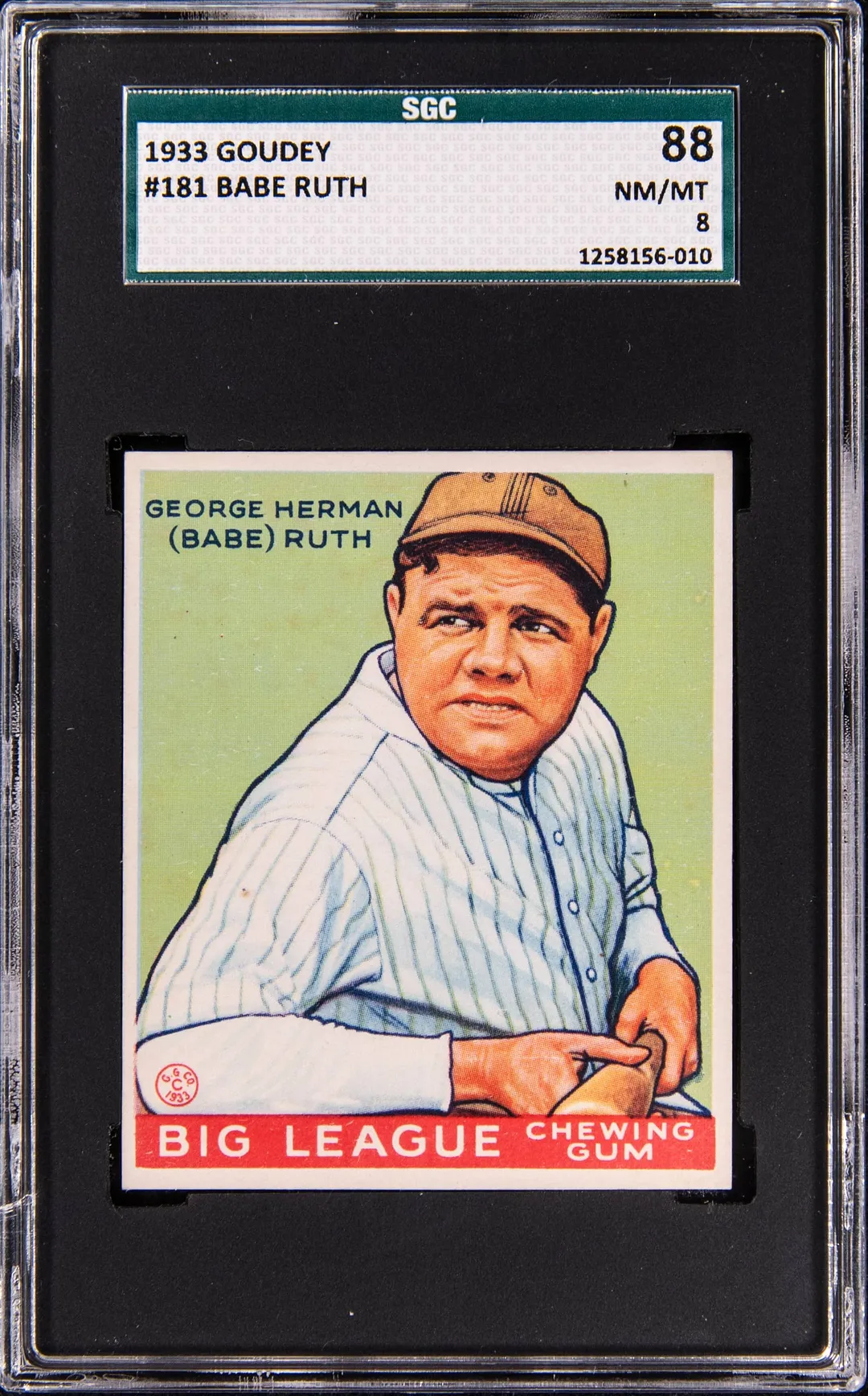
1933 Goudey #181 Babe Ruth SGC 8 Sells for $124K
Figoca looks at the 1933 Goudey #181 Babe Ruth in SGC 8 that sold for $124,928 at Goldin on Feb 22, 2026 and what it means for vintage collectors.
Sold Card
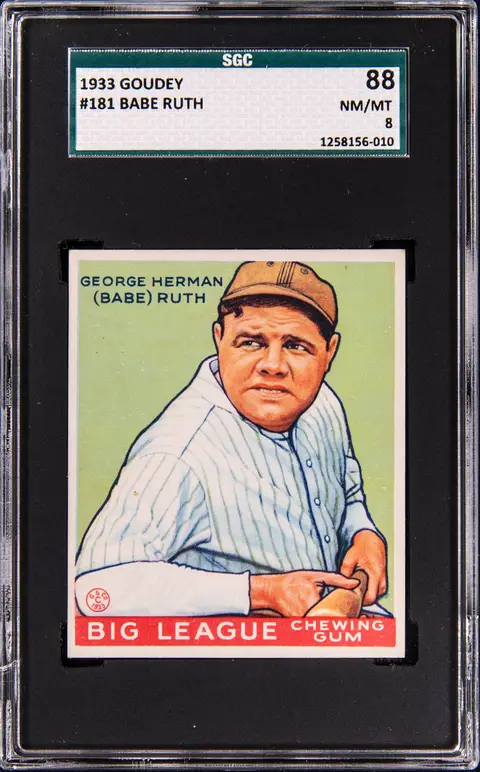
1933 Goudey #181 Babe Ruth - SGC NM-MT 8
Sale Price
Platform
GoldinA 1933 Goudey Babe Ruth in a high grade always turns heads, and the recent sale of a 1933 Goudey #181 Babe Ruth graded SGC NM-MT 8 is a good reminder of why this card sits near the center of the vintage baseball market.
On February 22, 2026, Goldin sold this copy for $124,928. In a hobby where condition, history, and scarcity all matter, this result adds another data point to the long story of one of Ruth’s most important cards.
The card: 1933 Goudey #181 Babe Ruth, SGC 8
Card details
- Player: Babe Ruth
- Team: New York Yankees
- Year: 1933
- Set: 1933 Goudey
- Card number: #181
- Issue type: Base card (not a parallel)
- Rookie status: Not a rookie, but a key career-era card
- Grading company: SGC (Sportscard Guaranty)
- Grade: NM-MT 8 (Near Mint–Mint)
The 1933 Goudey release is one of the foundational gum card sets in the hobby. For Babe Ruth, it’s especially notable because he appears on four different cards in the set: #53, #144, #149, and #181. All four are hobby staples, but #181 is often discussed as one of the core “must-have” Ruth Goudeys thanks to its classic portrait and broad collector recognition.
An SGC 8 on a 1933 card places this copy firmly in the high-grade tier. For prewar (pre–World War II) cards, anything in Near Mint or better is significantly tougher to find than mid-grade examples.
Why collectors care about 1933 Goudey Ruth cards
A cornerstone of prewar baseball
The 1933 Goudey set is widely viewed as one of the first truly modern-style baseball card issues: full-color lithography, card numbers, and national distribution in gum packs. For many collectors, it’s the set that bridges tobacco-era cards (like T206) and the postwar boom of Bowman and Topps.
Babe Ruth sits at the center of that story. These Goudey cards capture Ruth toward the back half of his New York Yankees career, after he had already reshaped how the game was played and marketed. While not his rookie, the 1933 Goudeys are among his most recognizable mainstream cards and are often the first prewar Ruth many collectors learn about.
Four Ruths in one set
Having four Ruths in the same set gives collectors multiple entry points, but it also spreads demand across four numbers. That means each individual card has to stand on its own.
Card #181, with its bold background and strong portrait, is one of the best-known designs in the group. High-grade copies have become reference points when people talk about how the market values prewar Hall of Famers in strong condition.
Market context: how does $124,928 fit in?
When collectors talk about “comps,” they mean comparable sales: recent auction or marketplace results that help frame what a card has been selling for lately.
For the 1933 Goudey #181 Ruth, price depends heavily on grade and grading company. While exact figures shift over time, the general pattern looks like this:
- Mid-grades (SGC/PSA 3–5): Commonly traded and often used as the baseline for Ruth Goudey demand. These can range from the mid–four figures up into the low–five figures depending on eye appeal and exact grade.
- Strong mid to lower high grades (SGC/PSA 6–7): A noticeable step up in scarcity. These often land in the five-figure range, with nice examples pushing higher.
- High grades (SGC/PSA 8 and above): This is where population drops sharply and competition increases. Sales here are less frequent and can vary more.
Within that top tier, a few important factors tend to shape pricing:
- Grading company: PSA, SGC, and Beckett each have their own market patterns. For prewar cards, SGC has long been respected, especially with vintage-focused collectors.
- Population (“pop”) report: The population report is the grading company’s public count of how many copies exist in each grade. For a prewar issue like 1933 Goudey, SGC 8-level cards are a small fraction of total submissions.
- Eye appeal: Centering, color, and surface quality can create a real spread even among the same numeric grade.
Against that backdrop, a $124,928 sale for an SGC 8 at Goldin in early 2026 sits in the expected high-end range for this card: it reflects both the scarcity of an NM-MT example and sustained demand for Ruth’s key gum issues.
Because sales in this grade level are relatively infrequent, each auction helps reset collectors’ expectations. This result doesn’t represent a sudden shift on its own, but it reinforces the idea that high-grade 1933 Goudey Ruths remain firmly established in the upper tier of vintage baseball pricing.
Scarcity and grading: why an SGC 8 matters
For a 1933 card, condition challenges include:
- Rough handling in gum packs
- Poor original centering
- Print imperfections
- Decades of storage in non-ideal environments
Reaching an SGC 8 means this copy has avoided or minimized most of those issues. While ultra-elite grades above 8 do exist, they are significantly rarer. That creates a simple ladder for collectors:
- Lower and mid grades: more accessible, but more supply.
- High grades like SGC 8: fewer copies, stronger competition.
- Top-pop (highest grade in the population report): extremely limited, sometimes only traded occasionally.
This sale sits on that middle-high rung: clearly premium, but not so rare that it never appears on the market.
What this sale tells us about the vintage market
A single price never tells the whole story, but this Goldin result offers a few useful signals for collectors and small sellers:
Blue-chip vintage remains anchored. Core prewar cards of the most important players—Ruth, Cobb, Wagner, Gehrig—continue to see steady interest in strong grades. The exact dollar figures can move with broader market conditions, but demand for historically significant pieces has remained resilient over time.
Condition premiums are alive and well. The spread between mid-grade and high-grade copies is large, and this sale reinforces that. When you’re looking at comps, it’s important to compare like to like: same card, similar grade, and similar overall eye appeal.
Auction venues matter. A major house like Goldin aggregates serious bidders and provides marketing and visibility. That can help set or confirm price ranges for important cards.
Takeaways for different types of collectors
Newer or returning collectors
If you’re just getting back into the hobby, a six-figure Goudey Ruth may feel out of reach, but it still provides a helpful reference point:
- It shows which players and eras have long-term collecting histories.
- It demonstrates how much condition and grading influence value.
- It gives context when you see lower-grade or alternative Ruth cards at shows and online.
You can use high-profile results like this as a benchmark while you explore more affordable options—later-career issues, lower grades, or different sets that still connect to the same player.
Active hobbyists and small sellers
For those already active in the market, this sale is a useful data point when:
- Pricing other 1933 Goudey Ruths in lower grades
- Considering crossover or resubmission strategies between grading companies
- Evaluating whether a raw prewar Ruth is worth sending in for grading
It’s also a reminder to look beyond the headline number and into the details: grade, centering, eye appeal, and the specific auction environment that produced the result.
Final thoughts
The February 22, 2026 sale of a 1933 Goudey #181 Babe Ruth graded SGC NM-MT 8 for $124,928 at Goldin doesn’t rewrite the story of this card—it adds another chapter.
For vintage collectors, it confirms what they already know: high-grade Ruth Goudeys are still among the most watched cards in the hobby. For newer participants, it’s a clear example of how history, scarcity, and condition come together to shape prices at the top of the market.
At figoca, we track these sales to help collectors put individual results in context. Whether you are browsing show cases, listing a card online, or planning a targeted collection around prewar legends, understanding how a card like this behaves at auction can help you make more informed, calm decisions in a fast-moving hobby.