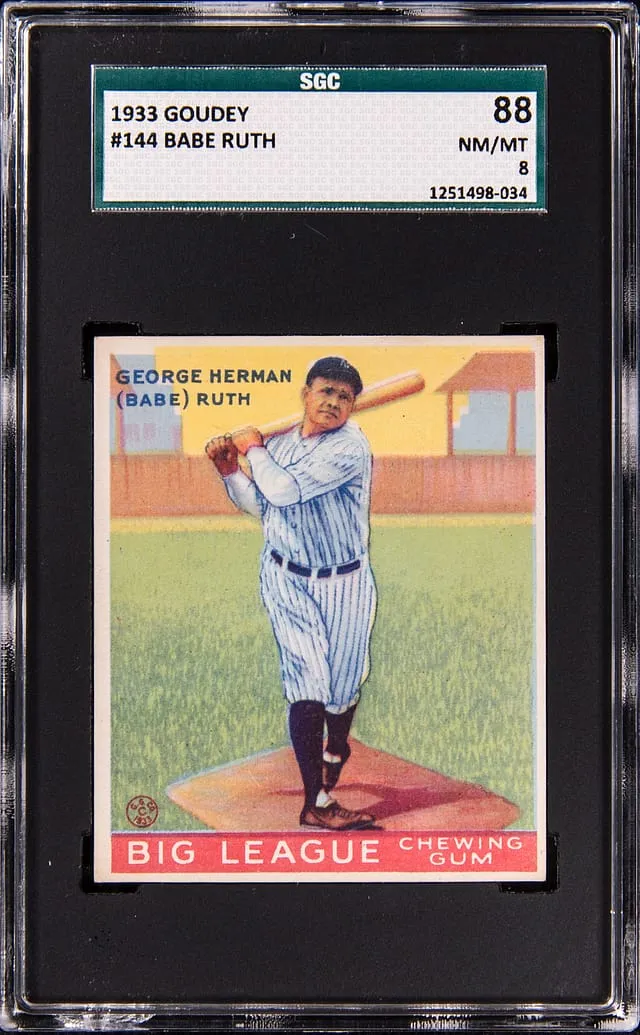
1933 Goudey #144 Babe Ruth SGC 8 sells for $158K
Goldin sold a 1933 Goudey #144 Babe Ruth SGC NM-MT 8 for $158,600. See why this scarce high-grade pre-war icon matters to collectors.
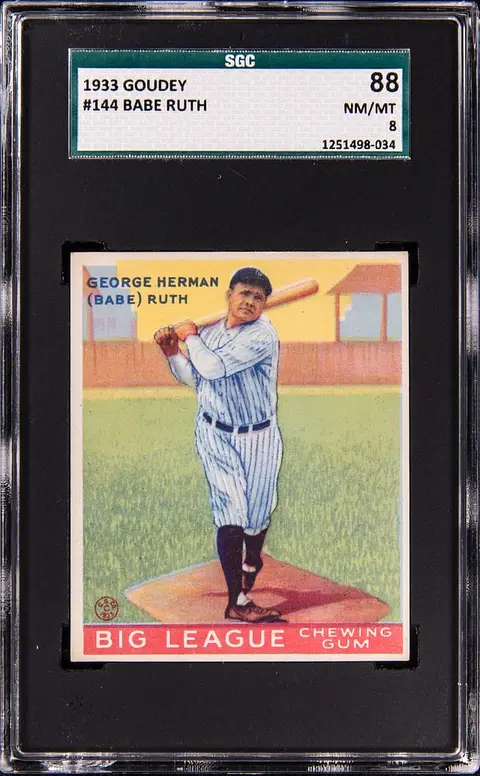
Sold Card
1933 Goudey #144 Babe Ruth - SGC NM-MT 8 - Only 4 Higher SGC Copies
Sale Price
Platform
Goldin1933 Goudey #144 Babe Ruth (Boston Red Sox / New York Yankees legend pictured as a member of the Yankees) is one of the cornerstone cards of pre-war baseball collecting. On February 22, 2026, Goldin sold an SGC NM-MT 8 copy for $158,600, with only four higher-graded examples in the SGC population. For vintage Ruth collectors and set builders, this is a notable data point for one of the most recognizable cards in the hobby.
Card overview
The card:
- Year: 1933
- Set: Goudey
- Card number: #144
- Player: Babe Ruth, New York Yankees
- Issue type: Standard base card from the iconic 1933 Goudey set (Ruth has multiple cards in this checklist)
- Rookie status: Not a rookie; Ruth’s playing-days cards span the 1910s–1930s
- Era: Pre-war vintage
Grading details:
- Grading company: SGC (Sportscard Guaranty Corporation)
- Grade: NM-MT 8 (Near Mint–Mint)
- Notes: No auto, patch, or serial numbering – as expected for a 1933 issue. The premium is derived from age, eye appeal, and grade scarcity.
Within SGC’s scale, an 8 is a very high grade for an 80‑plus-year-old card, typically implying sharp corners, strong color, and only minor print or surface touch. The auction note that only four copies grade higher underscores just how thin the top of the SGC census is for this card.
Why 1933 Goudey Babe Ruth matters
The 1933 Goudey set is widely viewed as one of the foundational gum card sets in baseball history. It was among the first major, colorful, widely distributed chewing gum sets in the United States, and it helped shift the hobby from tobacco and strip cards into the modern gum card era.
Babe Ruth has multiple cards in the 1933 Goudey checklist (#53, #144, #149, and #181). Collectors often treat these as essential pieces of any serious Ruth run and as key targets for pre-war type collectors. While opinions vary on which pose or background is most desirable, all four are considered blue-chip vintage issues.
Key reasons collectors care about this card:
- Babe Ruth is still the face of pre-war baseball collecting.
- 1933 Goudey is a flagship early gum set, heavily pursued by set builders and Ruth specialists.
- High-grade copies are meaningfully scarce due to age, handling, and original production quality.
- It is one of a small handful of widely recognized “must-have” Ruth playing-days cards, alongside his early tobacco and caramel issues.
Market context and recent sales
For vintage cards, “comps” (short for comparable sales) help frame where a new auction result sits relative to other recent transactions. For pre-war icons like Ruth, the most useful comps are usually:
- The same card in the same grade.
- The same card in adjacent grades (one step above and below).
- Other 1933 Goudey Ruth cards in similar grades, as a cross-check of demand.
Recent public sales data for 1933 Goudey Ruth in high grade show:
- NM-MT range (SGC/PSA 8 equivalents) commonly trading deep into six figures, with exact prices varying by pose, centering, color strength, and specific auction.
- Small populations at the top of the grading scale, so each appearance can move the perceived “going rate” more than for modern, plentiful issues.
Within that context, the $158,600 Goldin sale on February 22, 2026 is consistent with the card’s status as a premier pre-war Ruth, especially given the note that only four copies sit higher in SGC holders. For a card where total population in investment-grade condition is low and true 8s and better almost never flood the market, the realized price fits with the idea of steady, measured demand rather than a runaway outlier.
Scarcity and grading population
When collectors talk about a “pop report” (population report), they mean the grading company’s tally of how many copies exist at each grade. Pre-war cardboard is challenging:
- Many surviving examples were well-loved and heavily handled.
- Printing and cutting methods were less precise than modern production.
- Storage conditions over the decades lead to toning, creases, and edge wear.
Against that backdrop, SGC NM-MT 8 is a tough grade. Knowing there are only four higher SGC copies highlights two points:
- A small number of collectors can own an SGC 8 or better at any given time.
- Upward pressure on top-grade prices can appear when even a handful of new buyers or set builders enter the market.
It is also common for high-end Ruth collectors to cross cards between grading companies in pursuit of consistent registries or perceived upside from a regrade. That can further limit how often any single grading label and grade combination actually appears in public auctions.
How this sale fits into the broader Ruth and pre-war market
While individual auction prices can move up or down based on eye appeal and timing, a few themes help frame this result:
Ruth remains a cornerstone of vintage demand Babe Ruth’s market has historically been more stable than many modern stars because:
- His playing career and legacy are fully written.
- His cards have been collected for generations.
- There is sustained demand from both baseball historians and hobbyists.
Pre-war icons behave differently from modern serial-numbered cards Modern cards often rely on low serial numbering, autographs, or patches for scarcity. Pre-war issues, including 1933 Goudey, rely on:
- Natural survival rates and condition rarity.
- Set importance and historical appeal.
An SGC 8 from 1933 does not need serial numbering or an autograph to be scarce; the grade itself functions as the rarity filter.
Each top-grade sale helps calibrate expectations Because there are so few SGC 8+ copies, the market does not see a constant stream of comps. When a strong example surfaces at a major auction house like Goldin, the realized price becomes a fresh reference point for:
- Collectors tracking set registry builds.
- Owners of lower-grade copies thinking about relative spreads between grades.
- Auction consignors deciding how and when to bring similar cards to market.
Context for different types of collectors
If you are new to pre-war or returning after a long break, here is how this card fits into the landscape:
Newer collectors: The 1933 Goudey Ruth cards are often introduced as the “classic” Ruth gum cards. They are not entry-level items in high grade, but they help define what serious vintage looks like. Lower-grade examples and reprint issues can still offer an accessible way to enjoy the artwork and history.
Active hobbyists: For those already tracking vintage prices, $158,600 for an SGC 8 #144 at Goldin on February 22, 2026 aligns with the idea that well-centered, high-eye-appeal Ruths continue to command strong attention. It also illustrates how thin supply remains at the top of the grading scale.
Small sellers and part-time dealers: This sale does not necessarily change day-to-day pricing for mid-grade or lower-grade 1933 Goudey commons. However, it reinforces a few practical takeaways:
- Eye appeal and third-party grading matter a lot for key vintage stars.
- Documented auction results from established houses can be useful references when evaluating consignments or large purchases.
- When a card has a small top-end population, even one or two high-profile results can influence buyer expectations.
Key takeaways for figoca users
From a data and research perspective, this Goldin sale helps sharpen the picture for one of the hobby’s key vintage cards:
- Card: 1933 Goudey #144 Babe Ruth
- Grade: SGC NM-MT 8
- Auction house: Goldin
- Sale date: February 22, 2026 (UTC)
- Price: $158,600
- Grade scarcity: Only four higher SGC-graded copies reported
For collectors, it’s another reminder that pre-war icons continue to be defined by condition, set importance, and long-term demand more than short-term buzz. For anyone tracking the market with figoca, this sale is a clear, recent comp that helps anchor expectations around the very top of the 1933 Goudey Ruth market while leaving room for normal variation based on eye appeal and specific auction dynamics.
As always, auction prices are information, not guarantees. They add another data point to a long history of sales for one of baseball’s most important cards, and they can help collectors make better-informed, research-based decisions about how 1933 Goudey Babe Ruth fits into their own collecting goals.