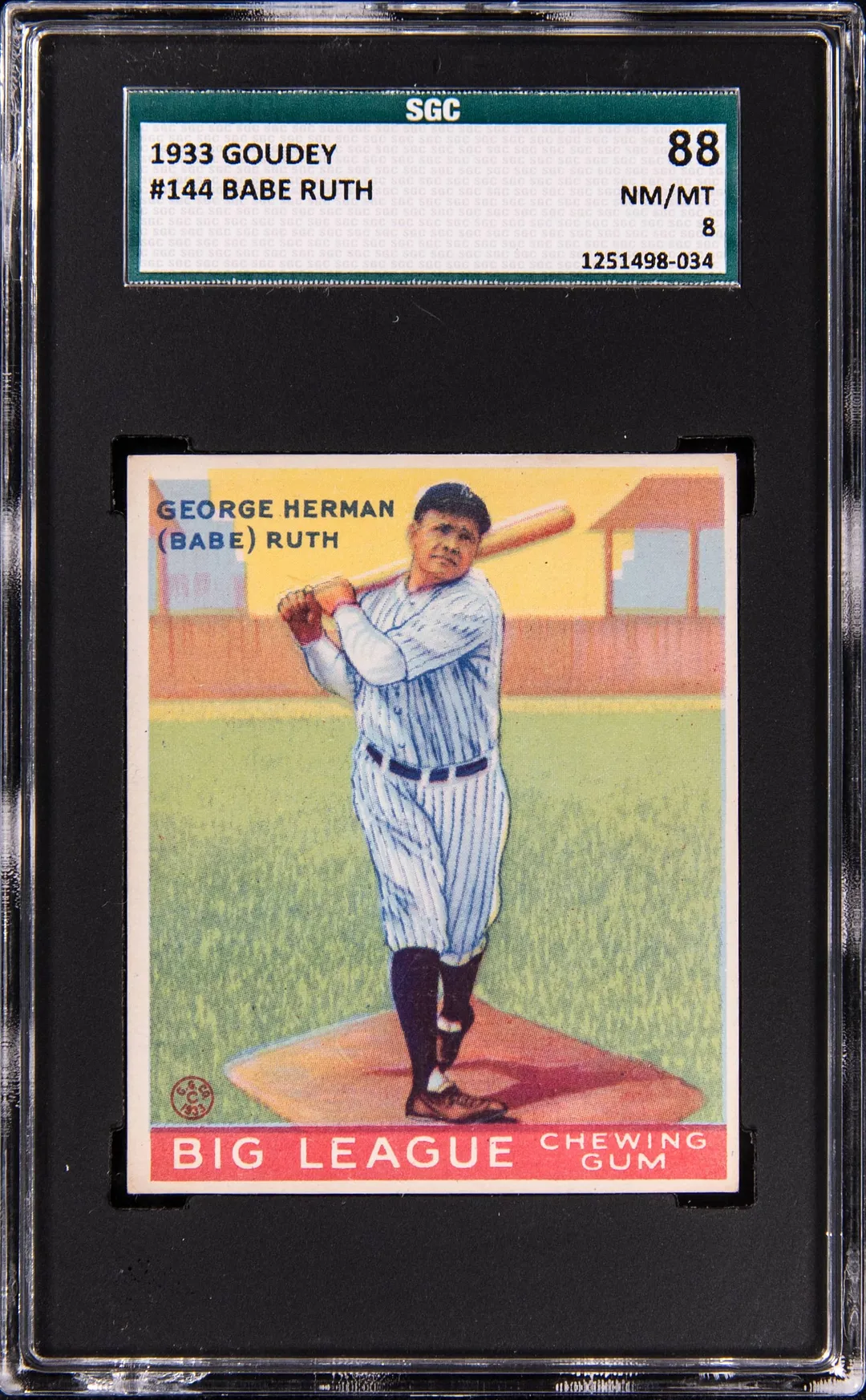
1933 Goudey #144 Babe Ruth SGC 8 sells for $158,600
Goldin sold a 1933 Goudey #144 Babe Ruth SGC NM-MT 8 for $158,600. Learn why this low-pop vintage icon matters to collectors.
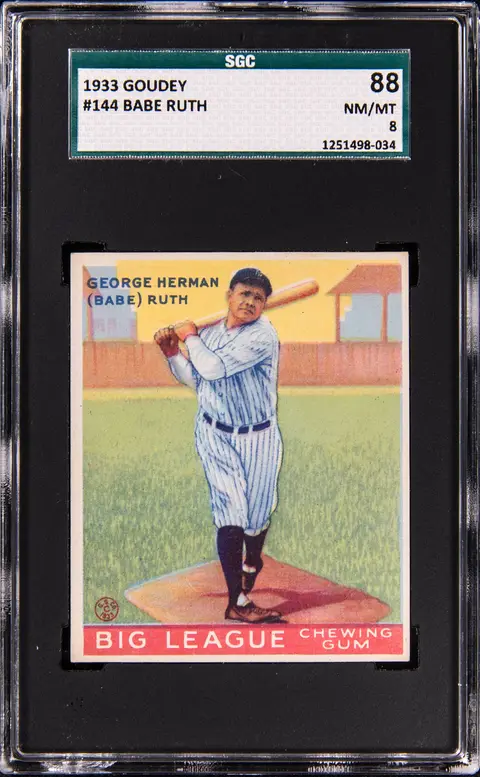
Sold Card
1933 Goudey #144 Babe Ruth - SGC NM-MT 8 - Only 4 Higher SGC Copies
Sale Price
Platform
Goldin1933 Goudey Babe Ruth cards sit at the intersection of baseball history and hobby history, and the market keeps reminding us why.
On February 22, 2026, Goldin sold a 1933 Goudey #144 Babe Ruth graded SGC NM-MT 8 for $158,600. With only four SGC copies graded higher, this is a true condition rarity in one of the most important pre-war sets.
In this breakdown, we’ll walk through what this card is, why it matters to collectors, and how this sale fits into recent market context.
The card: 1933 Goudey #144 Babe Ruth, SGC NM-MT 8
Let’s start with the basics:
- Player: Babe Ruth (New York Yankees)
- Year: 1933
- Set: 1933 Goudey (R319)
- Card number: #144
- Rookie?: Not a rookie card, but a key issue and one of Ruth’s most iconic mainstream cards
- Era: Pre-war vintage
- Grading company: SGC (Sportscard Guaranty Corporation)
- Grade: NM-MT 8 (Near Mint–Mint)
- Special attributes: None in terms of modern features (no autograph, patch, or serial numbering). Its importance comes from age, player, set, and condition.
The 1933 Goudey set is widely regarded as one of the cornerstone releases of vintage baseball. It introduced full-color lithographed cards with a gum product, helping shape what a “modern” trading card looked like.
Babe Ruth appears on four different cards in this set (#53, #144, #149, and #181), and each is heavily collected. The #144 issue is one of the classic portrait poses, with rich color that really exposes any printing or surface flaws—one reason high grades are so tough.
Why collectors care about the 1933 Goudey Ruth
For many collectors, a 1933 Goudey Ruth is:
- A hobby landmark: Alongside the T206 Honus Wagner and 1952 Topps Mickey Mantle, the 1933 Goudey Ruths are often mentioned in conversations about the “pillars” of the baseball card hobby.
- A key pre-war Ruth: Not a rookie, but a headlining card from near the end of Ruth’s playing career, produced at a time when his legend was already cemented.
- A display piece: The artwork, color, and vintage design make it one of the most visually recognizable Ruth issues.
- A condition challenge: Being a 1930s card, it has survived nearly a century of handling, storage, and environmental wear. Clean surfaces, strong color, and sharp corners are very hard to find.
Vintage cards like this are collected less for “print runs” (which are mostly unknown) and more for how many high-grade examples actually exist today. That’s where population reports come into play.
Population and grade scarcity
A population report (or “pop report”) is the grading company’s count of how many copies of a card exist in each grade. While exact SGC population numbers can change over time as new cards are graded or re-submitted, the key point here is:
- This example is an SGC NM-MT 8.
- Only four SGC copies are graded higher, making this essentially near the top of the SGC census for the card.
For high-end vintage collectors, that combination—iconic card, historically important player, and a grade that sits near the top of the population—is often what drives stronger auction results.
The sale: $158,600 at Goldin on February 22, 2026
- Auction house: Goldin
- Sale date (UTC): February 22, 2026
- Final price: $158,600 (converted from 15,860,000 cents)
- Card: 1933 Goudey #144 Babe Ruth, SGC 8
This result places a clear marker in the current market for high-grade SGC examples of this card. While pop counts between SGC, PSA, and other grading companies differ, collectors often look at cross-company data to get a sense of where a card sits overall.
Market context and recent sales
When we talk about “comps”—short for comparables—we’re referring to recent confirmed sales of the same card or very similar cards. For a card like the 1933 Goudey #144 Ruth, collectors usually look at:
- The same card/grade across different auction houses
- The same card in one grade higher or lower (e.g., SGC 7.5, SGC 8.5, PSA 8)
- Other Ruth Goudey numbers (#53, #149, #181) as secondary context
Recent auction history for this exact card and grade has shown a general pattern: high-grade pre-war Ruths tend to be thinly traded—they don’t come up for sale often, and when they do, each result can move the perceived range.
In that kind of thin market, a single sale like this one at $158,600 becomes an important data point. It doesn’t guarantee where the next copy will land, but it does:
- Provide a fresh reference price for serious buyers and sellers
- Show ongoing demand for top-end Goudey Ruths in strong holders like SGC 8
- Anchor negotiations around older sales, especially when some of those may be a year or more apart
Exact past prices can vary with card eye appeal (centering, color, print quality), auction timing, and which bidders happen to be active at a given moment. For that reason, many collectors think in ranges rather than single numbers when talking about high-end comps.
In this case, the realized price at Goldin fits with how the market has generally treated:
- High-grade Ruth Goudey issues as blue-chip vintage
- SGC 8-level vintage Hall of Fame cards with very limited populations
Why being “only four higher” matters
“Only 4 higher SGC copies” is not just a trivia note. For condition-focused collectors, it has practical meaning:
- It signals that this SGC 8 is already very close to the ceiling for this card in that grading company’s scale.
- Collectors who prioritize owning one of the best-known examples have very few opportunities left above this grade.
- When a known "ceiling" exists, strong 8s often attract buyers who might otherwise be chasing 8.5s or 9s that rarely appear.
For registry or set-build collectors—people assembling high-grade runs of key vintage sets—cards like this can be bottlenecks. When a set’s top Ruth is scarce in higher grades, the few available 8s can take on extra importance.
The 1933 Goudey set in the bigger picture
The 1933 Goudey release is a foundational vintage baseball set. Some reasons it continues to draw interest across all experience levels:
- Star power: Babe Ruth and Lou Gehrig headline a deep checklist of Hall of Famers.
- Visual appeal: The colored backgrounds and portrait artwork make it instantly recognizable, even to newer collectors.
- Historical role: It helped shape the template for modern gum cards, making it a natural goal for set builders and pre-war specialists.
- Condition sensitivity: Off-centering, print defects, and decades of wear mean truly high-grade examples are disproportionately rare.
That combination of design, history, and scarcity is why even advanced collectors often refer to 1933 Goudey as a “must know” set.
What this means for collectors and small sellers
A six-figure sale like this sits far above the entry point for most collectors, but it still has practical implications for the broader hobby:
- Signals on vintage demand: Strong results for high-end Ruths suggest that serious collectors remain committed to pre-war icons.
- Reference point for lower grades: While an SGC 8 is in a different universe from a PSA/SGC 1–3, many collectors use premium sales to help frame realistic expectations for their own lower-grade copies (recognizing the big gap between grade tiers).
- Reinforces the role of condition: With only four SGC copies graded higher, condition and eye appeal clearly matter. This often trickles down into how collectors treat storage, handling, and grading decisions on their own vintage cards.
For small sellers, this kind of auction can also be a reminder to:
- Check whether raw (ungraded) vintage cards might be worth submitting to a grading company.
- Review current pop reports to understand where a card fits in the broader landscape.
- Use recent auction prices as guides for conversation, not promises—especially as markets can move over time.
Final thoughts
The February 22, 2026 sale of a 1933 Goudey #144 Babe Ruth in SGC NM-MT 8 for $158,600 at Goldin is another clear data point in the story of pre-war vintage.
It highlights how:
- Key Ruth cards from historically important sets continue to attract serious attention.
- Top-end condition, backed by a respected grading company, can create meaningful separation in price.
- Thinly traded, high-grade vintage remains a space where each new sale helps shape the next round of expectations.
For anyone building knowledge in the hobby—whether you are new, returning, or already active—following landmark sales like this provides a grounded way to understand how history, scarcity, and condition come together in the trading card market.