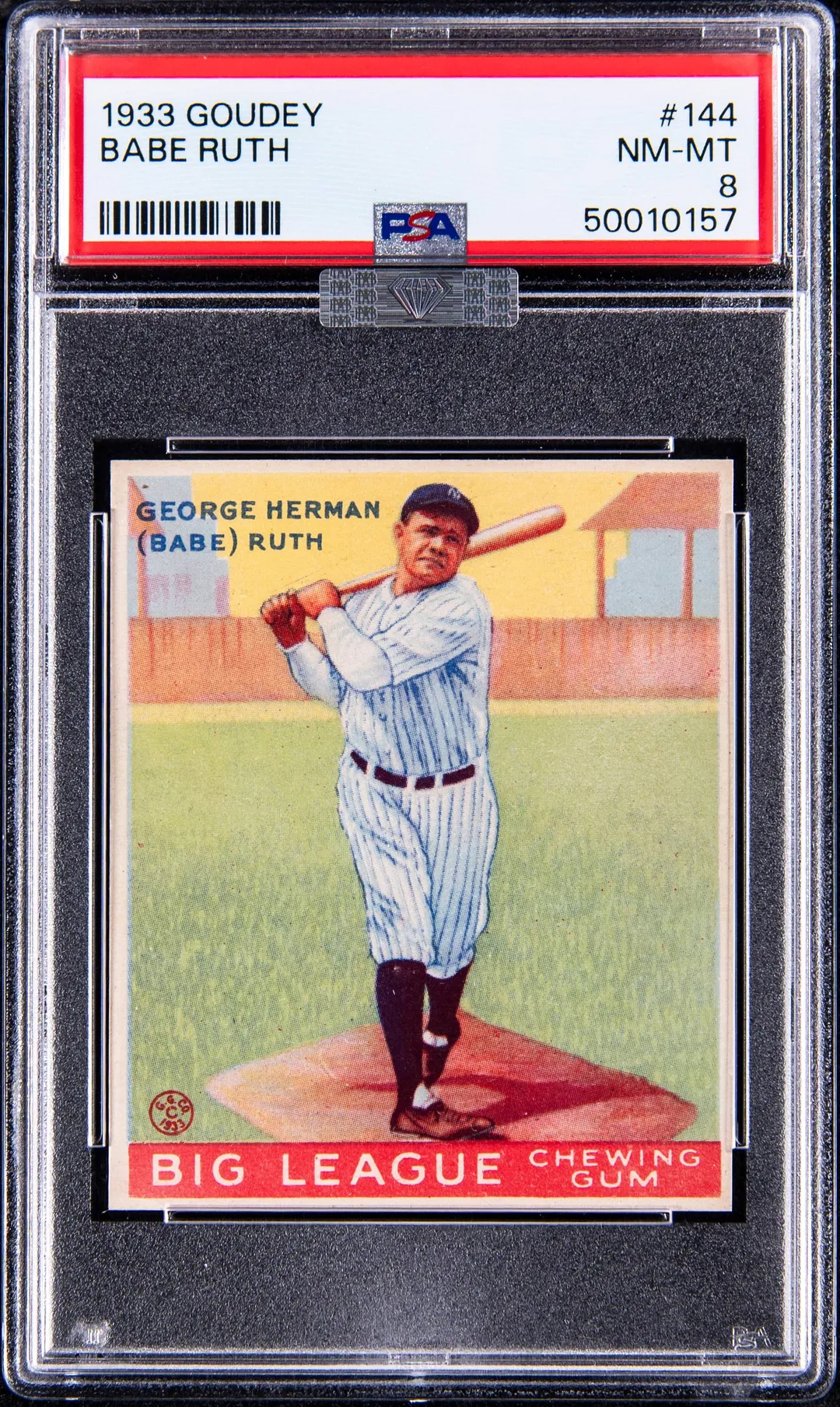
1933 Goudey #144 Babe Ruth PSA 8 Sells for $366K
Figoca breaks down Goldin’s $366,000 sale of a 1933 Goudey #144 Babe Ruth PSA 8 and what it means for high-end vintage baseball collectors.
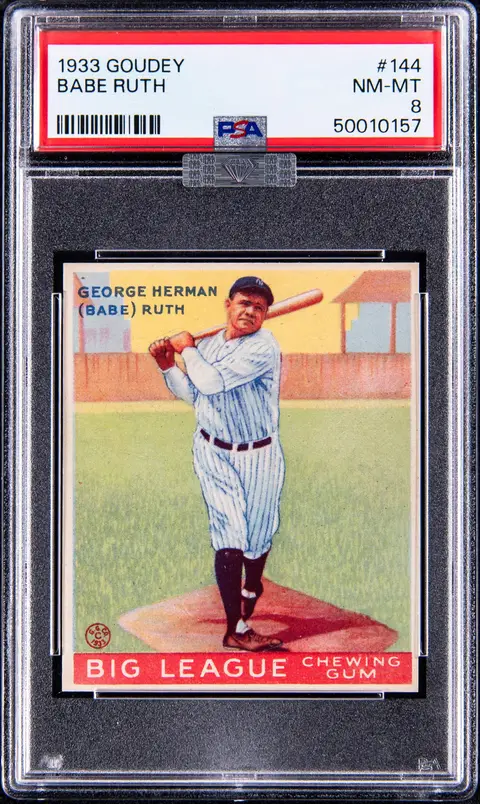
Sold Card
1933 Goudey #144 Babe Ruth - PSA NM-MT 8 - MBA Silver Diamond Certified
Sale Price
Platform
Goldin1933 Goudey #144 Babe Ruth is one of those cards that quietly sits near the center of the vintage baseball universe. When a strong copy surfaces in a major auction, collectors across eras tend to pay attention.
On February 22, 2026, Goldin sold a 1933 Goudey #144 Babe Ruth graded PSA NM-MT 8 for $366,000. The card also carried MBA Silver Diamond Certification, an additional third‑party eye‑appeal verification that has become more visible on high‑end vintage.
In this post, we’ll walk through what this card is, why it matters, and how this particular sale fits into the broader market context for Goudey Ruth cards.
The card at a glance
Card details
- Player: Babe Ruth (Boston Red Sox / New York Yankees legend, shown as a member of the New York Yankees era)
- Year: 1933
- Set: 1933 Goudey
- Card number: #144
- Manufacturer: Goudey Gum Company
- Card type: Base card (not a parallel, insert, or short print)
- Era: Vintage (pre‑war)
Grading and certification
- Grading company: PSA (Professional Sports Authenticator)
- Grade: NM-MT 8 (Near Mint–Mint)
- Additional review: MBA Silver Diamond Certified (above‑average eye appeal for the grade)
- Attributes: Standard issue, no autograph or memorabilia; significance is entirely historical, aesthetic, and condition-based.
While this is not a Babe Ruth rookie card—his playing‑days issues from the 1910s and early 1920s fill that role—the 1933 Goudey run of Ruth cards is widely treated as a core pillar of any advanced Ruth or pre‑war baseball collection.
Why the 1933 Goudey Ruth cards matter
A cornerstone pre‑war set
The 1933 Goudey set is one of the most studied and collected pre‑war baseball releases. It’s often described to newer collectors as one of the earliest "flagship" style gum card sets: a large, colorful checklist widely distributed to kids and tied directly to chewing gum.
Within that set, Babe Ruth appears on four different cards:
- #53 (yellow background)
- #144 (full‑body swinging pose)
- #149 (red background portrait)
- #181 (green background portrait)
All four are considered key cards for the set and the era. For many collectors, owning even one 1933 Goudey Ruth represents a major collecting milestone.
Why #144 is important
Card #144 is best known for its attractive full‑body swinging pose and large, bold “Ruth” text. Visually, it stands apart from the more common portrait‑style Ruth cards.
Factors that drive collector demand for #144:
- Era and timing: Issued late in Ruth’s career, near the end of his time with the Yankees, while he was still an active legend rather than a purely historical figure.
- Artwork: The swinging pose and colorful background have strong display appeal, especially in higher grades.
- Set synergy: Many collectors target all four Ruths from 1933 Goudey. As part of that mini‑set, #144 is a required piece.
The card is not particularly rare in low grade compared to other pre‑war issues, but true high‑grade examples are meaningfully scarce.
Understanding the PSA 8 grade and MBA eye‑appeal tag
PSA NM-MT 8 in a pre‑war context
In modern cards, a PSA 8 can sometimes feel like a mid‑tier grade. In pre‑war vintage, especially from the early 1930s and earlier, a PSA 8 is firmly in “high‑end” territory.
Why:
- Original handling: These cards were pulled from gum packs, often carried in pockets and stacked with rubber bands.
- Paper and print quality: Card stock and print registration from the era were inconsistent.
- Survival bias: Many surviving examples show heavy wear, stains, creases, or trimming.
A PSA 8 for a 1933 Goudey Ruth typically means:
- Strong corners for the issue.
- Clean front and back with strong color.
- No creases.
- Only minor centering or print issues that hold it back from a 9.
Population reports (which are counts of how many copies receive each grade) consistently show a steep drop‑off as you climb above PSA 6–7 into 8, 8.5, and 9. While exact numbers shift as more cards are graded or re‑submitted, PSA 8 remains a relatively small slice of the total graded population.
MBA Silver Diamond Certified
MBA (Market Builders Authenticated) provides eye‑appeal verification on already‑graded cards. Their Silver Diamond designation signals that, in their view, the card has above‑average visual appeal within its PSA grade.
For vintage collectors, eye appeal—centering, color saturation, registration, and overall presentation—can matter as much as the numeric grade. A PSA 8 with strong centering and color often sells at a premium compared with an average‑looking PSA 8 of the same card.
In this case, the MBA Silver Diamond tag serves as an additional signal to buyers that the card stands out visually among PSA 8 examples.
The sale: $366,000 at Goldin on February 22, 2026
- Auction house: Goldin
- Realized price: $366,000
- Sale date (UTC): February 22, 2026
The card achieving a $366,000 result places it clearly in the upper tier of Ruth Goudey prices, but to understand the number, it helps to set it next to related sales.
Market context and recent sales
When collectors talk about "comps" (short for comparables), they mean recent sale prices for the same card in similar condition, usually across major auction houses and marketplaces. For a card like the 1933 Goudey #144 Ruth, relevant comps include:
- The same card and grade (PSA 8)
- Nearby grades (PSA 7, 7.5, 8.5, 9)
- Other 1933 Goudey Ruth numbers (#53, #149, #181) in similar grades
How this price fits in
Across the vintage market, high‑grade Ruth Goudey sales have tended to:
- Command a notable premium for top‑end eye appeal (centering and color in particular)
- Show relatively wide ranges within the same grade, depending on presentation and timing
Within that context, a $366,000 realization for a PSA 8 #144 with recognized strong eye appeal sits on the stronger side of recent PSA 8 outcomes but not at the level reserved for:
- PSA 8.5 or PSA 9 copies
- The very top‑tier Ruth Goudey poses when they surface in true investment‑grade condition
This price also continues a broader pattern: while prices for many modern and ultra‑modern cards have seen sharper swings, iconic vintage blue chips—especially pre‑war Hall of Famers like Ruth—have tended to trade in a more measured range, with adjustments rather than extreme spikes.
Because individual auction results can differ based on the exact card, bidder mix, auction timing, and marketing, it’s more useful to view this $366,000 sale as one strong data point along a line of high‑grade Ruth Goudey transactions rather than a singular outlier.
Why collectors care: beyond the dollar amount
For newcomers and returning collectors, it’s helpful to separate three layers of significance:
Historical significance
- Babe Ruth remains the defining name of early baseball history.
- The 1933 Goudey issue captures him near the twilight of his playing days yet still active, not just a commemorative.
- The set itself is a cornerstone of pre‑war gum cards.
Set and visual significance
- #144’s swinging pose offers dynamic artwork that pairs well with the other three Ruths in the set.
- High‑grade examples display color and detail that many collectors only see in photos.
Market and collecting significance
- PSA 8 pre‑war cards of Ruth are difficult to replace, especially with confirmed strong eye appeal.
- For set builders chasing 1933 Goudey in high grade or Ruth specialists building a focused run, PSA 8 fits in a narrow window: substantially more attainable than 8.5 or 9, but still meaningfully rare.
Takeaways for different types of collectors
If you’re new or returning to the hobby
- Use this sale as a reference point for how the hobby treats true vintage icons.
- Notice how condition, third‑party grading, and eye appeal verification stack together to influence price.
- Even if this price point is far above your target range, the same principles apply to more accessible vintage stars.
If you’re an active hobbyist
- This result reinforces how the market continues to separate high‑end, well‑presented vintage from more average examples in the same grade.
- When looking at comps, focus on card‑by‑card details—centering, color, registration, and any eye‑appeal designations—rather than just the number on the label.
If you’re a small seller or trader
- The sale underlines how third‑party verification services like MBA can matter more on iconic vintage than on low‑end modern.
- Strong, well‑lit scans that show centering and surface clearly can help your own cards present closer to how top auction houses display theirs, even at lower price levels.
What this means for the broader vintage market
This Goldin sale doesn’t rewrite the story of vintage baseball, but it adds a clear chapter:
- Consistency: It supports the view that key pre‑war Hall of Fame issues—especially Ruth, Cobb, and similar names—continue to attract deep bidder pools when high‑quality copies appear.
- Selectivity: Buyers are increasingly selective about eye appeal, even within the same numeric grade. Tags like MBA Silver Diamond Certified are part of that conversation.
- Reference point: For anyone tracking the 1933 Goudey Ruth market, $366,000 for this PSA 8 is a useful benchmark, particularly when evaluating future PSA 8 offerings with comparable visual strength.
As always, it’s best to treat any single sale as one data point rather than a guarantee. But as data points go, this one reinforces a familiar message: well‑preserved, visually strong examples of historically important vintage cards continue to be closely followed and actively contested when they reach the auction block.
For collectors who appreciate both history and cardboard, the 1933 Goudey #144 Babe Ruth in PSA 8 remains a card that tells the story of the hobby as much as it reflects the story of the player.