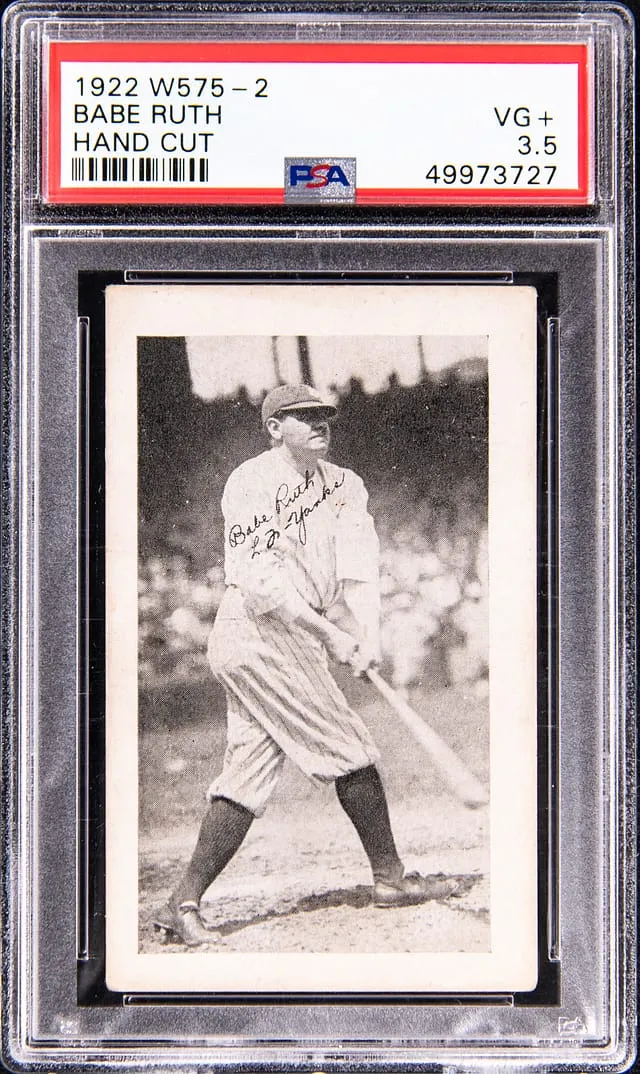
1922 W575-2 Babe Ruth Strip Card Sells for $19,520
Goldin sold a 1922 W575-2 “Autograph on Shoulder” Babe Ruth PSA 3.5 for $19,520 on Feb 22, 2026. See why this POP 1 vintage card matters.
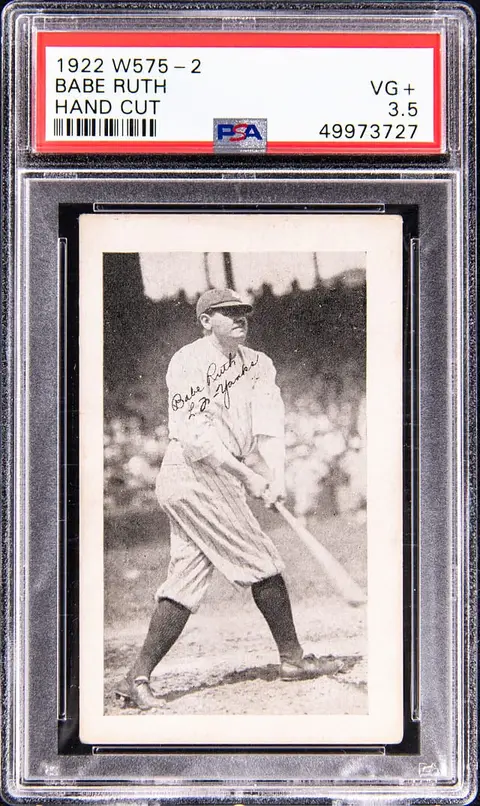
Sold Card
1922 W575-2 “Autograph on Shoulder” Babe Ruth; Hand-Cut - PSA VG+ 3.5 – POP 1; Only 6 PSA Examples Graded Higher
Sale Price
Platform
Goldin1922 W575-2 “Autograph on Shoulder” Babe Ruth; Hand-Cut - PSA VG+ 3.5 – POP 1; Only 6 PSA Examples Graded Higher
When a 1920s Babe Ruth strip card surfaces in a strong grade, collectors tend to pay attention. When that card is a population 1 (POP 1) example in PSA VG+ 3.5 with only six copies graded higher, and it sells at a major auction house, it becomes a meaningful data point for the vintage market.
In February 2026, Goldin sold a 1922 W575-2 “Autograph on Shoulder” Babe Ruth, hand-cut, graded PSA VG+ 3.5, for $19,520. For a hand-cut strip card from the early 1920s, that result helps clarify how the hobby is currently valuing scarcity, eye appeal, and set importance in the Ruth market.
The card: 1922 W575-2 “Autograph on Shoulder” Babe Ruth
Player: Babe Ruth
Team: New York Yankees
Year: 1922
Set: W575-2 strip card issue
Variant: “Autograph on Shoulder” pose (facsimile signature on shoulder)
Card type: Hand-cut strip card (vintage, pre-war era)
Grading company: PSA
Grade: VG+ 3.5 (Very Good Plus)
Population: POP 1 in PSA 3.5; only 6 PSA examples graded higher (per the auction description)
The W575-2 issue belongs to the family of 1920s strip cards—cards that were originally issued in strips and intended to be cut apart by hand. As a result, centering, borders, and general condition are usually rougher than what collectors expect from traditional pack-issued cards. Clean, well-centered examples with presentable fronts and backs are noticeably scarce.
The “Autograph on Shoulder” designation refers to the specific Babe Ruth pose in this set, where a facsimile signature appears across his shoulder. It functions as a key Ruth card from the early Yankees years, well before modern definitions of “flagship rookies.” While not a rookie card, it is very much a key pre-war issue for Ruth collectors.
Sale details
- Auction house: Goldin
- Sale date (UTC): 2026-02-22
- Realized price: $19,520 (hammer plus buyer’s premium, per auction result)
- Grade sold: PSA VG+ 3.5, population 1 with 6 higher
Goldin is one of the major auction houses for high-end sports cards and memorabilia, which means realized prices from their events are often used as reference points across the hobby.
Population and grading context
For hand-cut strip cards, grading is about more than technical corners and edges. PSA and other grading companies also consider how the card was cut—whether the borders are reasonably even, whether any parts of the image or text are missing, and whether there is evidence of trimming.
Key context points from this sale:
- POP 1 in PSA 3.5: According to the auction description, this specific PSA VG+ 3.5 is the only example at that grade.
- Only 6 higher: There are just six PSA-graded copies above 3.5. That implies a very shallow population in the mid- to high-grade range, typical for a 1920s hand-cut Ruth.
In pre-war cards, especially strip issues, a mid-grade can function similarly to a high grade in later eras because the starting pool of well-preserved, properly cut cards is so small.
Market context and recent sales
When talking about “comps” (short for comparable sales), collectors usually look at the same card in the same grade first, and then branch out to nearby grades when data is limited. For this specific 1922 W575-2 “Autograph on Shoulder” Ruth in PSA 3.5, public sales data is thin—population is low and transactions are infrequent.
Based on publicly available auction records and typical patterns for this type of card:
- Exact-grade comps (PSA 3.5): Sales of this exact card and grade are extremely rare. The population 1 status means this card may not have appeared in a PSA 3.5 slab at public auction before this Goldin sale.
- Nearby grades: Lower graded copies of comparable 1920s Ruth strip issues tend to sell at noticeable discounts to mid-grade examples, reflecting how sharply the market rewards eye appeal and technical grade once you cross from “low grade survivor” into “solid mid-grade.”
- Premium examples: When these W575-2 Ruth cards appear in higher grades (for example, PSA 4–5+), they typically attract disproportionately strong bidding relative to the grade jump, because the census thins out rapidly at the top.
Within that framework, a $19,520 result for a POP 1 mid-grade Ruth strip card from 1922 aligns with the broader trend we see: truly scarce early Ruth issues, especially in respected holders and presentable condition, are being treated as long-horizon collectibles with steady demand.
Rather than viewing this as an outlier, the sale is more easily understood as the market confirming a premium for:
- Early Yankees-era Ruth cards
- Tough hand-cut issues with limited high-grade population
- Eye-appeal-driven mid-grades (VG to VG-EX range) in PSA holders
Why this card matters to collectors
1. Early Babe Ruth Yankees cardboard
Babe Ruth’s playing career (and especially his early years with the New York Yankees) sits at the core of vintage baseball collecting. 1920s Ruth cards, even beyond his most famous 1910s issues, are foundational pieces in many advanced collections.
The W575-2 set falls into the early part of Ruth’s Yankees tenure. For collectors who prioritize chronological coverage of Ruth’s career, this card helps fill the space between his earliest Boston issues and his later, more frequently seen 1930s cards.
2. Strip card scarcity and survival
Strip cards were never meant to be long-lived collectibles. They were:
- Sold cheaply, often in strips
- Cut apart by hand, frequently by children
- Stored or handled casually
Because of that origin, surviving examples in decent condition are inherently scarce, and those that grade mid-range or better are even scarcer. The PSA VG+ 3.5 grade on a hand-cut 1922 strip card reflects a level of preservation that is not common.
3. Hand-cut nuance and eye appeal
With hand-cut issues, collectors pay close attention to:
- Border uniformity
- Whether the image or text is fully intact
- General centering and surface quality
Two cards with the same numeric grade can look meaningfully different in hand. That makes eye appeal—a card’s overall visual impression—critical. Auction descriptions and high-resolution images allow buyers to decide whether a particular example “overachieves” for its grade.
This VG+ 3.5 example, as a POP 1 with only six higher, likely stood out for its combination of technical grade and visual presence.
4. Pre-war vintage as a segment
The 1922 W575-2 Ruth sits in the pre-war vintage category (cards produced before World War II). This segment behaves differently from modern or ultra-modern cards:
- Supply is fixed and very limited. No new copies are being found in any meaningful numbers.
- Condition scarcity is real. Time, storage, and handling have already done decades of work thinning the high-end supply.
- Collector base tends to be long-term. Many buyers of early Ruth material are building collections with multi-year or multi-decade horizons.
Because of those factors, notable sales of pre-war icons tend to be studied more as historical markers than as short-term speculative events.
What this sale suggests about the market
A single auction result should never be taken as a guarantee of future performance. However, it can provide useful context for how collectors are currently valuing:
- Early 1920s Babe Ruth issues
- Tough hand-cut strip cards
- Scarce mid- to high-grade populations
The $19,520 sale price in Goldin’s February 22, 2026 auction suggests:
- Strong, targeted demand for early Ruth: Even secondary or non-flagship Ruth issues from the 1920s are receiving serious attention when they are scarce and presentable.
- Population data matters: The “POP 1; only 6 higher” note in the description is not just a detail—it is a core part of the value story for this card. Many advanced collectors track population reports closely when deciding where to focus their budgets.
- Vintage strip cards have matured as a niche: Years ago, strip cards were sometimes viewed as a side category beside mainstream tobacco and gum cards. Recent results, including this one, reflect a more structured appreciation of their historical role and difficulty.
What collectors and small sellers can take away
For collectors and small sellers looking at this sale as a reference point:
- Use it as a data point, not a rule. This Goldin result provides a high-confidence comp for a specific grade and specific example in early 2026, but different copies (even in the same grade) can perform differently depending on eye appeal, timing, and venue.
- Check population reports. When dealing with pre-war cards, a quick look at PSA’s population data can clarify whether a card is one of many or one of a precious few at its grade level.
- Photograph and present carefully. For hand-cut cards, detailed images of borders, corners, and surfaces help potential buyers evaluate the cut and overall eye appeal, which can materially affect realized prices.
- Consider the broader Ruth ladder. When evaluating any single Ruth card, it helps to place it among his other issues by year, team, and set. This 1922 W575-2 “Autograph on Shoulder” sits in an important era of his Yankees career and provides a more accessible (though still expensive) target than some of his earliest cards, while remaining significantly rarer in finer condition than many 1930s issues.
Final thoughts
The February 22, 2026 Goldin sale of the 1922 W575-2 “Autograph on Shoulder” Babe Ruth, hand-cut and graded PSA VG+ 3.5, at $19,520 is a useful marker for the current state of the pre-war Ruth market. It reinforces how the hobby is rewarding a mix of:
- Historical significance (early Ruth, Yankees era)
- Condition within context (mid-grade for a hand-cut strip card)
- True scarcity (POP 1 with only six higher)
For collectors tracking iconic vintage pieces, this result sits alongside other notable Ruth sales as one more reference point in a market that continues to value early, scarce, and well-preserved examples of the game’s most important players.