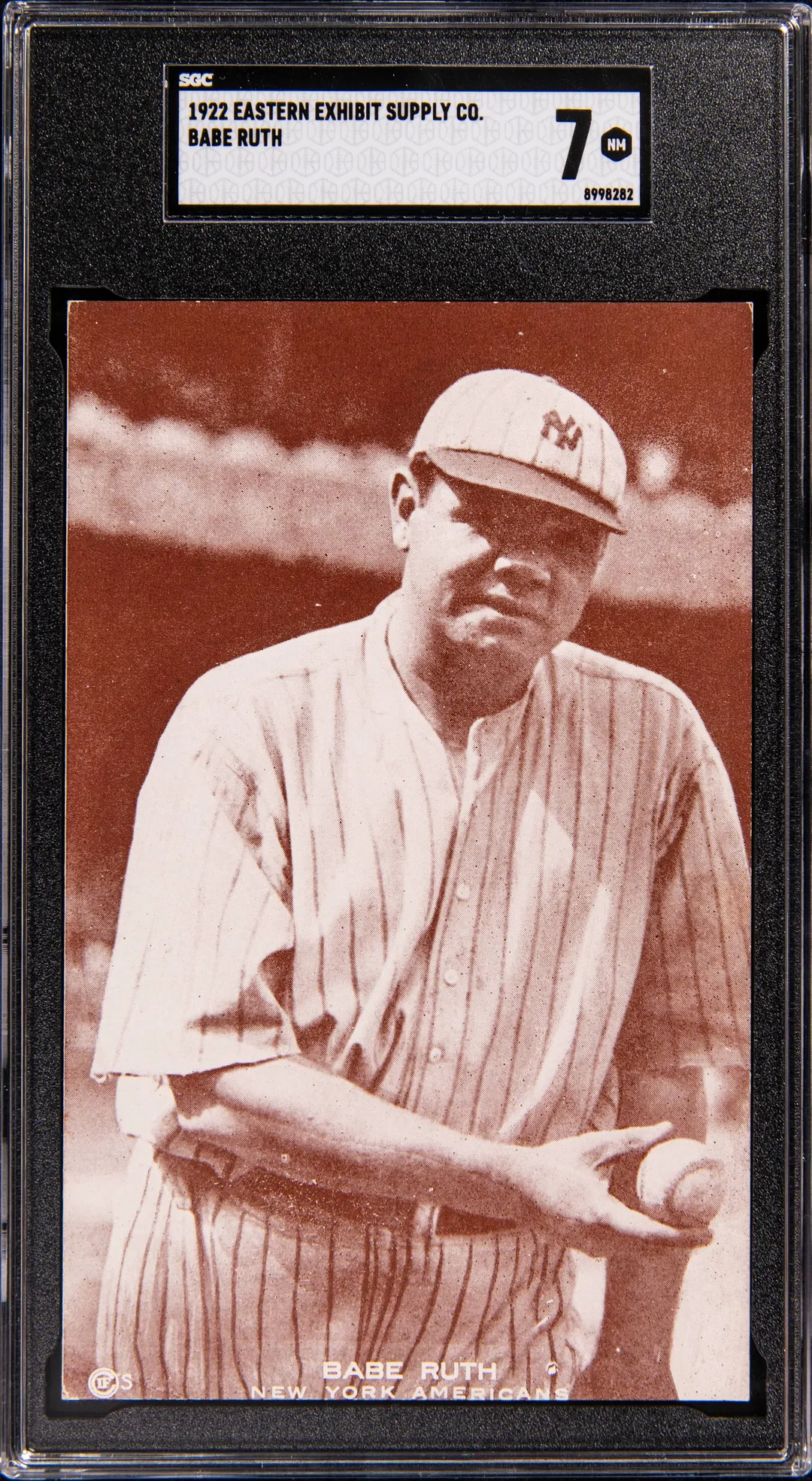
1922 Babe Ruth Exhibit Postcard SGC 7 Sells for $22K
Breakdown of the $22,052 Goldin sale of the POP 1 1922 Eastern Exhibit Babe Ruth postcard in SGC NM 7, the highest graded copy on SGC & PSA pop reports.
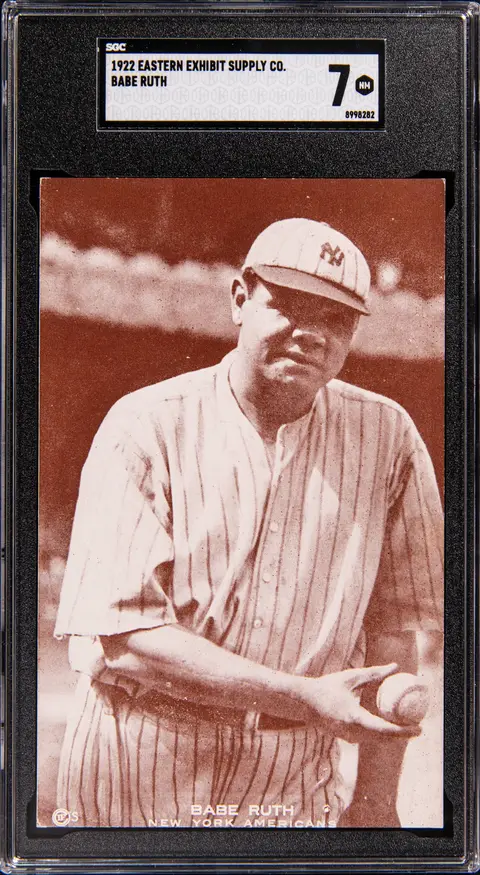
Sold Card
1922 Eastern Exhibit Supply Co. Babe Ruth Postcard - SGC NM 7 – POP 1; Highest Copy on the Combined SGC & PSA “Pop” Charts
Sale Price
Platform
GoldinA 1922 Eastern Exhibit Supply Co. Babe Ruth postcard just quietly set a new benchmark for one of the more elusive corners of the Ruth market.
On February 22, 2026, Goldin sold a 1922 Eastern Exhibit Supply Co. Babe Ruth Postcard graded SGC NM 7 for $22,052. This example is a population 1 (“POP 1”) at SGC and, when you combine both SGC and PSA population reports, it stands as the highest graded copy currently known.
Below, we’ll walk through what this card is, why collectors care about it, and how this sale fits into recent market context.
The card at a glance
- Player: Babe Ruth
- Team: New York Yankees
- Year: 1922
- Issue: Eastern Exhibit Supply Co. postcard
- Type: Exhibit-style postcard (not a modern standard-size card)
- Grading company: SGC
- Grade: NM 7 (Near Mint)
- Population: POP 1 at SGC; highest known example on combined SGC & PSA pop reports
- Key attributes: Early-career Ruth, oversized postcard format, pre-war/vintage era, condition scarcity
This is not a traditional base “card” in the modern sense. Eastern Exhibit Supply Co. produced postcard-sized, arcade and vending machine issues in the early 1920s, covering prominent baseball stars of the era. Ruth’s appearances in these Exhibit/postcard formats are broadly viewed as important early-career pieces, sitting not far behind his mainstream 1910s issues in terms of historical interest.
For many collectors, this 1922 postcard sits in a sweet spot: an early Yankees-era Ruth issue that is significantly more obtainable than his true rookie cards, but still genuinely rare—especially in high grade.
Why this postcard matters to Ruth collectors
1. Early Yankees-era Ruth
By 1922, Babe Ruth had already transformed from dominant pitcher to slugging outfielder and cultural phenomenon. Cards and postcards from this narrow window of his career capture him as the face of the newly emerging Yankees dynasty.
While the hobby often centers on Ruth’s true rookie issues and his 1933 Goudey cards, early 1920s pieces have become a key focus for collectors who:
- Want pre-war Ruth items but find rookies financially out of reach.
- Prefer photographic or real-photo style images rather than art-based lithographs.
- Appreciate oddball and regional-type issues with lower print runs and survival rates.
The Eastern Exhibit Supply Co. postcard checks all three boxes.
2. Exhibit/postcard format and scarcity in grade
Exhibit and postcard issues from the 1920s were often:
- Distributed in less controlled settings (arcades, vending machines, public venues).
- Handled casually, written on, or even mailed.
- Stored without protective sleeves or top loaders for decades.
All of that makes high-grade survivors difficult to find. Paper stock, corners, and surfaces tend to show wear, creases, and writing. A Near Mint 7 from this era is, in practical terms, an extreme outlier.
That’s what makes the population 1 note so important:
- POP report (population report): A grading company’s count of how many copies of a card they’ve graded at each grade level.
- Combined highest: When you check both SGC and PSA reports, nothing is graded higher than this SGC 7. It’s not just a strong copy—it is currently the top of the census.
For collectors who like owning the single best graded example of a specific issue, this is exactly the type of card that stands out.
3. Pre-war vintage and long-term collector interest
This postcard is firmly in the pre-war vintage category (pre–World War II). That era typically offers:
- Natural scarcity, due to age and lower original production.
- Fewer high-grade survivors, especially in oversized formats.
- Strong crossover appeal to both baseball historians and hobby collectors.
Ruth remains the central figure of pre-war collecting. Even as modern and ultra-modern cards cycle through hype phases, early Ruth pieces tend to be collected with a longer view: historical significance first, speculative gain second.
Market context: how does $22,052 fit in?
The Goldin sale closed at $22,052 on February 22, 2026.
When looking at price context, collectors usually check “comps”—recent comparable sales of the same card or very close versions (same issue, nearby grade) across auction houses and marketplaces.
For this exact card in this exact grade, there is no direct comp history because:
- It is a population 1 SGC 7.
- No higher-graded example exists on either SGC or PSA’s pops.
- Public auction records for higher-grade Eastern Exhibit Ruth postcards are very sparse.
Instead, collectors generally triangulate value by looking at:
- Lower-grade examples of the same issue – where available, sales in the VG–EX range (Very Good to Excellent) typically come in at a fraction of this sale, reflecting both condition gaps and the uniqueness of the pop 1 NM.
- Other early-1920s Ruth Exhibits and postcards – which often sell at strong vintage-pre-war premiums even in mid-grade, especially when the photo is appealing and the card is unaltered.
- Comparable pre-war Ruth issues – such as certain Exhibit and regional releases that are not rookies but are still early, photo-driven items.
Within that broader context, a five-figure result for a lone top-pop, pre-war Ruth postcard is consistent with how the market has treated similar scarce Ruth items over the last few years:
- Pre-war Ruth continues to command attention even when modern segments of the market cool.
- Condition scarcity (especially pop 1 or top-pop) can create large multiples over mid- or low-grade examples.
- Oversized and oddball issues have gradually gained more recognition as collectors move beyond the well-known mainstream sets.
This sale doesn’t signal a sudden explosion for the entire category, but it does reinforce a pattern: early Ruth, in truly exceptional grade, still finds willing buyers at notable premiums.
Grading and condition: why NM 7 matters here
For modern cards, a 7 can feel like a mid-tier grade. For a 1922 pre-war postcard, it’s a very different story.
Key condition factors in a card like this:
- Corners and edges: Postcards were often stacked or rubber-banded. Clean corners and edges at NM level are uncommon.
- Surface and image: Large photographic surfaces pick up scuffs, scratches, and handling wear.
- Backs: Writing, postal markings, or album removal damage are common; a clean back is a major plus.
SGC’s Near Mint 7 on a 1922 postcard signals that the piece has survived more than 100 years with a level of preservation rarely seen for this format. That’s precisely why the pop report is so thin at the top end.
What this sale could mean for collectors and small sellers
For newcomers, returning collectors, and small sellers, this Goldin result offers a few practical takeaways:
Oddball and postcard issues deserve a second look.
Early Exhibit and postcard releases, especially for iconic players like Ruth, may not be as widely discussed as mainstream sets, but they often have real scarcity and deep collector demand.Population reports matter—but context matters more.
A pop 1 label is interesting, but it’s most meaningful when paired with:- A historically important player.
- A respected grading company.
- A genuinely tough issue where high grades are rare by nature.
Condition premiums are magnified in pre-war.
The difference between a mid-grade and a top-pop pre-war Ruth can be dramatic. For sellers, that underlines why careful preservation and grading decisions are so important.Use multiple data points for price expectations.
Because top-pop examples like this are unique, there’s no simple “price chart.” Collectors typically look at:- Recent sales of lower-grade copies of the same issue.
- Sales of similar-era Ruth Exhibits and postcards.
- The general trend in pre-war Ruth demand.
None of this should be taken as a guarantee of future prices. But as a single data point, this $22,052 sale supports the broader view that:
- Early 1920s Ruth remains a priority segment for serious vintage collectors.
- High-grade pre-war postcards continue to secure strong results when they do surface.
- The market still recognizes and rewards true condition scarcity.
Final thoughts
The 1922 Eastern Exhibit Supply Co. Babe Ruth Postcard in SGC NM 7 is more than just another vintage sale. It’s currently the finest known graded example of a scarce, early-career Ruth issue, and its $22,052 hammer at Goldin on February 22, 2026, fits comfortably within how the hobby has been valuing rare, high-grade pre-war Ruth pieces.
For collectors, this sale serves as a reminder: there is still meaningful depth in vintage Ruth beyond the headline rookie cards and 1933 Goudey. Exhibit and postcard issues like this one continue to play an important role in how the hobby documents and values the career of baseball’s most enduring icon.
As always, this write-up is for hobby context only and not financial advice. Recent sales provide insight into how the market has behaved—not a prediction of where it will go next.