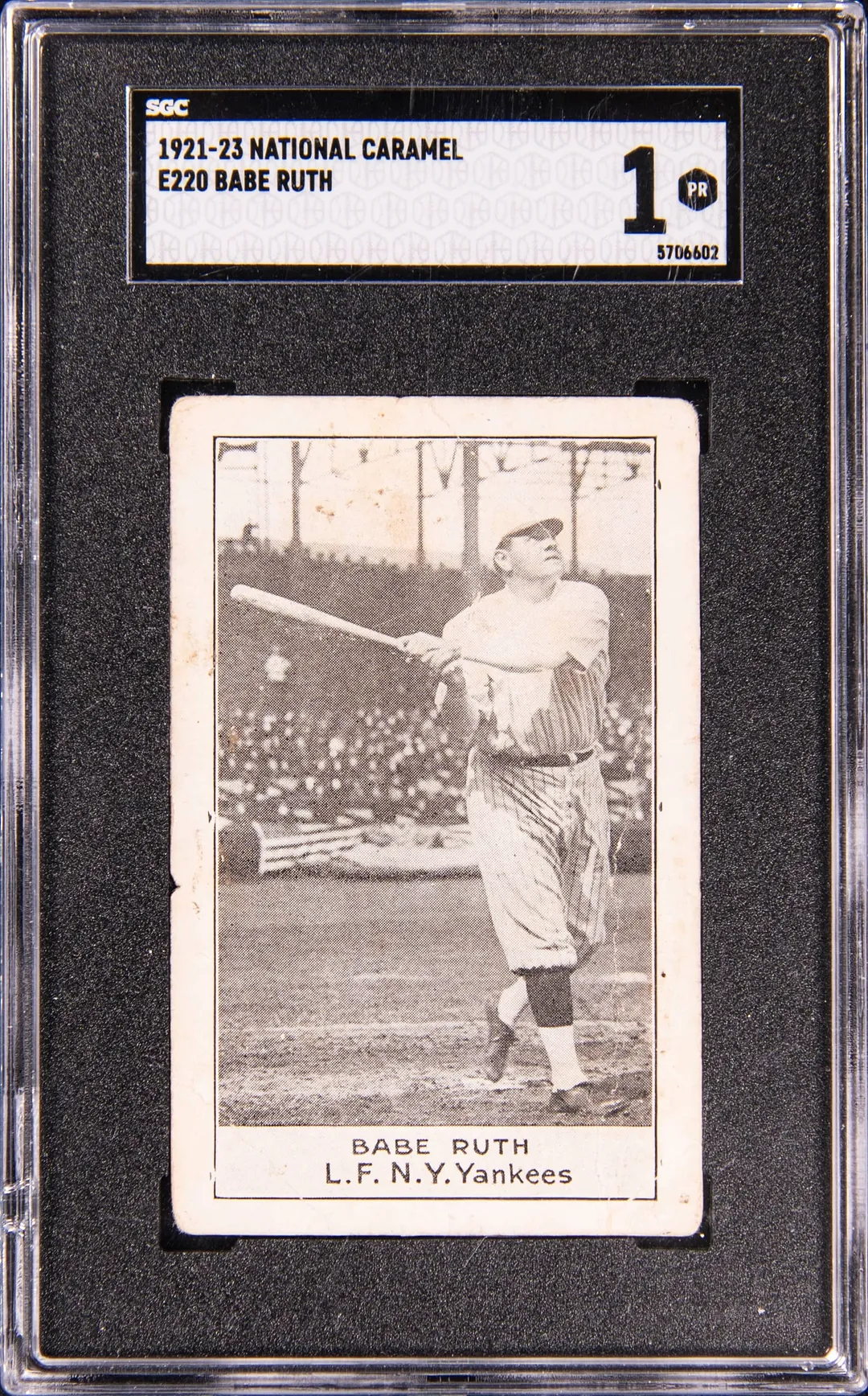
1921-23 E220 Babe Ruth SGC 1 sells for $23,180
Goldin sold a 1921-23 E220 National Caramel Babe Ruth SGC PR 1 for $23,180. See why this low-grade prewar icon still commands strong attention.
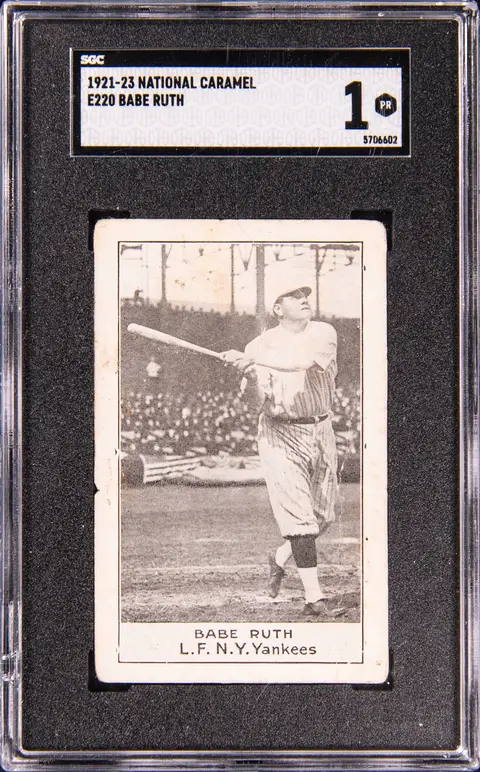
Sold Card
1921-23 E220 National Caramel Babe Ruth - SGC PR 1
Sale Price
Platform
Goldin1921-23 E220 National Caramel Babe Ruth SGC 1 Sells for $23,180
On February 22, 2026, Goldin sold a 1921-23 E220 National Caramel Babe Ruth graded SGC PR 1 (Poor) for $23,180. For a low-grade, prewar Babe Ruth, this is a meaningful data point for anyone tracking vintage baseball and early candy issues.
Below, we’ll walk through what this card is, why it matters, and how this sale fits into the broader market.
What exactly is the 1921-23 E220 National Caramel Babe Ruth?
- Player: Babe Ruth
- Team: New York Yankees
- Years: 1921–1923 production window
- Set: E220 National Caramel
- Card type: Early caramel (candy) issue
- Grading company: SGC (Sportscard Guaranty Corporation)
- Grade: PR 1 (Poor)
- Attributes: No autograph, no patch – this is a classic, prewar candy card
The E220 National Caramel set is a small, early-1920s candy issue. It’s not as widely known outside vintage circles as Ruth’s 1916 M101-4/5 or 1933 Goudey cards, but among dedicated prewar collectors, E220 is a respected and genuinely tough set.
This Babe Ruth is not his rookie card. Ruth’s true rookie-era issues date to the mid-1910s, when he was still with the Boston Red Sox. However, it is an important early Yankees-era card, printed just as Ruth was transforming both the Yankees franchise and the sport itself.
Why collectors care about this card
Several factors combine to make the E220 Ruth an important card in the hobby:
1. Early 1920s window
The 1921–1923 range puts this card right at the dawn of the Yankees dynasty. Ruth had joined New York in 1920. By 1923, the Yankees opened Yankee Stadium and won their first World Series. Any Ruth card from this period captures the transition from the dead-ball era to the home-run era he helped define.
2. Caramel ("E-card") heritage
The hobby often refers to early candy issues as “E-cards.” They were distributed with caramel or candy, usually in small, regionally focused runs. These cards:
- Tend to be much tougher than mass-produced gum issues from the 1930s and later.
- Often show heavy wear – creases, staining, rounded corners – simply because they were cheaply made and handled by kids.
The E220 set fits that profile: low surviving numbers, lots of condition problems, and strong demand from prewar specialists.
3. Scarcity in any grade
Because so few E220 Ruths survive, collectors pay attention to almost every copy that comes to market.
- Third-party grading company population reports (often shortened to “pop report”) summarize how many copies of a card they’ve graded at each grade level.
- For E220, pops are generally low versus more widely distributed Ruth issues.
Even at SGC PR 1 – the lowest standard grade on the scale – an E220 Ruth is far from a common find.
Understanding the SGC PR 1 grade
An SGC PR 1 label means the card is Poor. It may have:
- Heavy creasing or wrinkles
- Paper loss or surface damage
- Stains or discoloration (common on caramel issues)
- Rounded corners and edge wear
For many modern cards, a PR 1 grade would destroy most of the value. But for scarce prewar issues, collectors often focus more on survival and authenticity than on condition alone, especially when the subject is Babe Ruth.
In other words, this sale is a reminder that with true scarcity and a historically important player, even heavily worn copies can command strong prices.
Market context: where does $23,180 fit?
The Goldin result of $23,180 on February 22, 2026, is best understood by comparing it to other:
- E220 Ruth sales in different grades
- Prewar Ruth issues of comparable scarcity
Comps and price ranges
In the hobby, “comps” simply means comparable recent sales used for price context. With E220, there are not many comps because the card surfaces infrequently.
Recent public sales data (where available) suggests:
- Higher-grade E220 Ruth examples (where they exist at all) typically bring a multiple of low-grade copies, sometimes many multiples, simply due to scarcity at the top of the grading scale.
- Other early Ruth candy issues in Poor to Good condition can also land in the five-figure range, depending on the exact set and eye appeal.
Against that backdrop, a $23,180 sale for a PR 1 E220 Ruth sits in what appears to be a healthy, but not extreme range for a low-grade copy of a tough prewar Ruth candy card. The limited sales history means each auction helps reset the reference point for future pricing.
Because the card doesn’t trade often and condition varies widely from copy to copy, it’s more accurate to see this sale as one important data point rather than a firm, universal “value” for all PR 1 examples.
How this sale fits into the broader Ruth and prewar market
1. Ruth remains a cornerstone of vintage collecting
Across prewar and early postwar sets, Babe Ruth consistently commands strong demand. Key patterns continue to hold:
- Iconic mainstream issues (like 1933 Goudey) tend to have more frequent trades and a wider range of grades.
- Scarcer regional or candy issues, like E220, see fewer transactions but often punch above their visibility because advanced collectors chase them.
This Goldin sale reinforces the idea that there is stable interest in lesser-known but genuinely scarce Ruth cards, not just the headline-grabbing rookies and Goudey issues.
2. Vintage vs. modern dynamics
Compared to modern and ultra-modern cards (roughly 2000s–present), vintage and prewar cards:
- Are not produced with serial numbers, autos, or patches.
- Rely on historical importance and scarcity rather than artificial rarity.
- Show more tolerance for wear, particularly in cards approaching or surpassing a century in age.
This E220 sale is consistent with that pattern. Even in a PR 1, the card cleared $20,000, demonstrating how market participants continue to prioritize era, player, and set scarcity over condition alone in this segment.
What this might mean for collectors and small sellers
This result doesn’t set any all-time record for Babe Ruth or for prewar cards in general, but it does offer a few useful takeaways:
- Prewar “off-the-radar” sets still matter. Not every significant card comes from a major flagship set. Serious collectors increasingly look for tough regional and candy issues.
- Low grade can still be valuable. With genuinely scarce, historically important cards, even PR 1 copies can trade for meaningful sums.
- Comps are thin, so condition and eye appeal matter. Small differences in centering, image clarity, and surface issues can move prices when there are few direct comparisons.
For collectors considering similar cards, it’s helpful to:
- Review auction archives (including past Goldin, Heritage, REA, and others) for as many historical sales as you can find.
- Look carefully at front-and-back scans, not just the numerical grade.
- Factor in how often the card actually comes to market.
Final thoughts
The February 22, 2026 Goldin sale of a 1921-23 E220 National Caramel Babe Ruth – SGC PR 1 at $23,180 is another reminder of how deep the vintage and prewar Ruth market runs. Even in low grade, a century-old candy card of the sport’s most famous figure still commands serious attention – and serious prices.
For collectors, it’s a compelling case study in how scarcity, history, and player legacy can outweigh condition in shaping the market for truly early baseball cards.