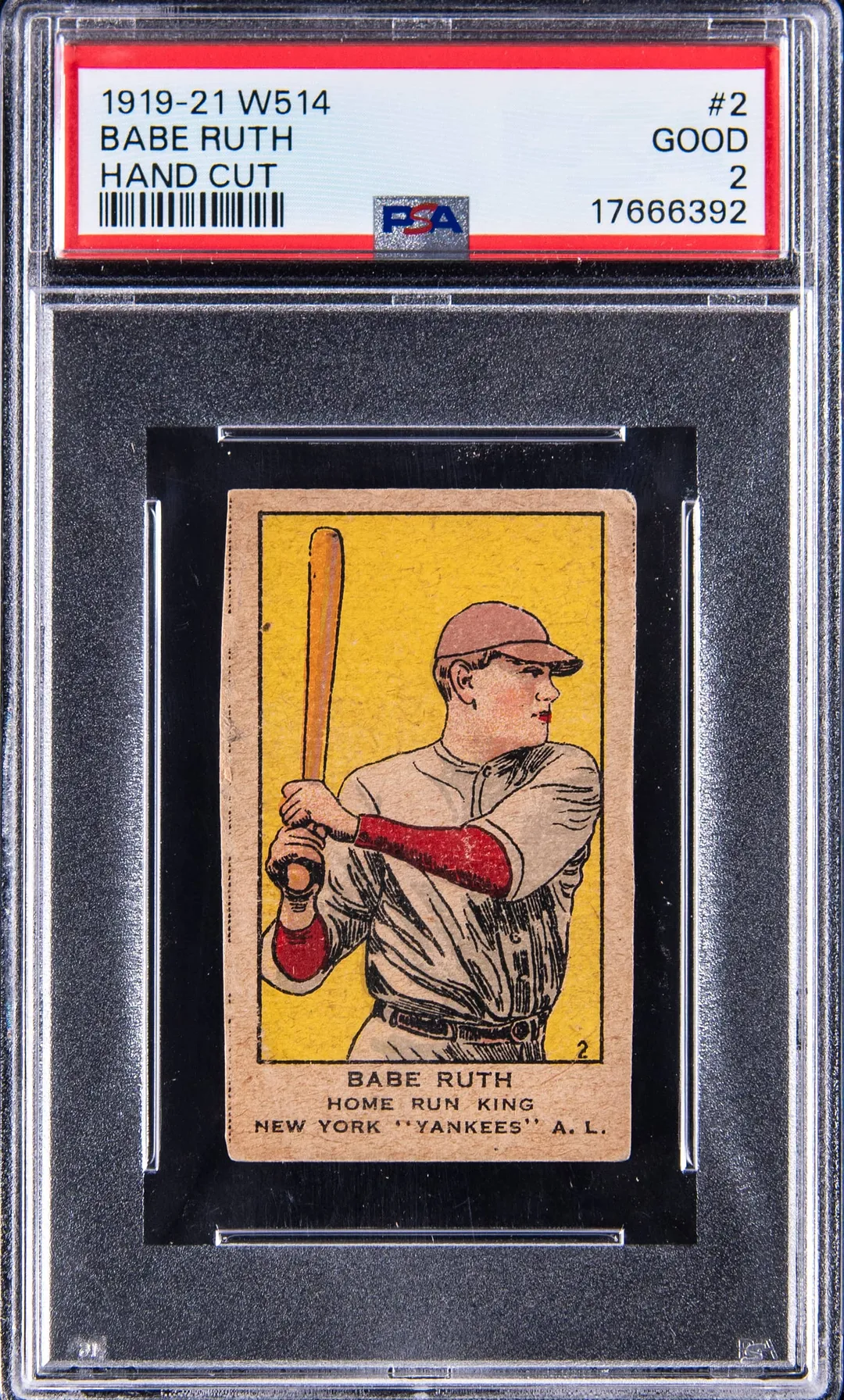
1919-21 W514 Babe Ruth PSA 2 Sells for $12,322
Goldin sold a 1919-21 W514 #2 Babe Ruth PSA 2 for $12,322 on Feb 22, 2026, marking a notable result for one of his earliest Yankees-era cards.
Sold Card
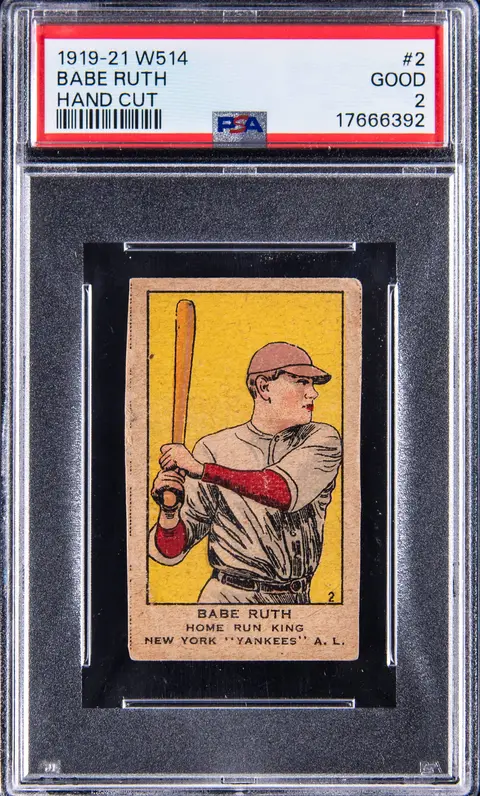
1919-21 W514 #2 Babe Ruth, Hand Cut - PSA GD 2 - One of Babe Ruth's Earliest Yankee Cards
Sale Price
Platform
Goldin1919-21 W514 #2 Babe Ruth, Hand Cut - PSA GD 2: One of Babe Ruth’s Earliest Yankee Issues Hits $12,322
On February 22, 2026, Goldin sold a 1919-21 W514 #2 Babe Ruth, hand-cut strip card graded PSA Good 2, for $12,322. For collectors tracking early Ruth material and prewar strip cards, this is a useful new data point in a niche but historically important segment of the hobby.
Card overview: what exactly sold?
- Player: Babe Ruth
- Team: New York Yankees (depicted as a Yankee; issued during his transition era)
- Years: 1919–1921
- Set: W514 strip card issue
- Card number: #2
- Format: Hand-cut strip card
- Grading company: PSA (Professional Sports Authenticator)
- Grade: GD 2 (Good)
The W514 set is a classic prewar baseball strip card release. These were printed in vertical strips and meant to be cut apart by hand, which is why centering, edges, and overall eye appeal can vary so much from copy to copy. While this is not typically labeled a “rookie card” in the same sense as Ruth’s key 1914–1916 issues, it is widely recognized as one of his earliest nationally distributed cards in a Yankees uniform.
Why the W514 Babe Ruth matters to collectors
Early Ruth timeframe
Babe Ruth’s move from the Boston Red Sox to the New York Yankees before the 1920 season is one of the defining shifts in baseball history. Cards that capture Ruth around this transition attract strong long-term interest because they sit at the crossroads between his pitching dominance in Boston and his emergence as the game’s defining slugger in New York.
The W514 Ruth is often discussed among:
- Prewar specialists, who chase strip cards, caramel issues, and early tobacco cards.
- Ruth collectors, who are trying to build a run of his key appearances across teams and eras.
- Vintage investors and historians, who view early Yankees-era Ruth cards as important cultural artifacts of the sport’s growth.
Strip card scarcity and condition
Strip cards are fundamentally different from the more familiar tobacco (T206), caramel, or gum cards:
- They were sold in strips and cut by hand, not at the factory.
- As a result, they often show uneven borders, poor centering, and handling wear.
- High-grade examples are genuinely scarce; low- to mid-grade examples make the card more accessible but still condition-sensitive.
Because of that, collectors tend to evaluate a W514 Ruth not just by the numerical grade, but also by subjective eye appeal: centering, how the image presents, and how intrusive creases or stains are.
PSA GD 2 market context
A “PSA Good 2” grade indicates a structurally intact card with obvious wear: noticeable creasing, rounding or fraying at the corners, possibly small stains or surface issues, but no major pieces missing. For a hand-cut W514, this sits in the lower middle of the typical grade distribution you’ll see at auction.
Recent sales and pricing context
Market information for this specific card and grade is relatively thin compared to mass-produced modern issues, but enough public auction data exists to give a sense of the range.
Based on recent and past public results for 1919–21 W514 Babe Ruth #2 in various grades:
- Lower-grade copies (PSA 1 / 1.5, SGC equivalents) have tended to sell at meaningfully lower price points than PSA 2, reflecting heavy wear and eye appeal challenges.
- Mid-grade copies (PSA 3–4 range) can command a significant premium over Good 2, with collector demand driven by the combination of early Ruth timing and tougher-than-average condition for strip cards.
- High-grade copies (above PSA 5) are rare enough that each auction result can feel like its own event, and sale prices can vary widely depending on eye appeal and timing in the market.
Within that framework, Goldin’s February 22, 2026 result of $12,322 for a PSA 2:
- Sits toward the stronger side of what has typically been seen for low- to mid-grade W514 Ruth examples.
- Aligns with the steady premium that early Ruth material has generally maintained relative to broader vintage baseball over the last several years.
- Reinforces how established Ruth’s early cards are as reference points for the prewar market.
Because prewar cards trade less frequently than modern parallels, “comps” (short for comparable recent sales used as reference points) are best viewed as a range rather than a precise number. Eye appeal, auction timing, and who’s actually bidding all matter.
Set significance: the W514 issue
The W514 set, produced around 1919–1921, is one of the most recognizable strip card issues:
- It includes a wide cross-section of stars and commons from the era.
- Hand-cut format means every card is a bit unique in dimensions and borders.
- It’s a common entry point for collectors who want prewar stars but find earlier tobacco or regional issues out of reach.
From a historical standpoint, the W514 Ruth sits alongside his other early 1910s–1920s cards as part of the foundation of prewar baseball card collecting. For some collectors, it serves as a more attainable alternative to ultra-premium Ruth cards, while still retaining the early-career, New York-era connection.
How this sale fits into the broader Ruth and prewar market
A few themes that help frame this result:
Established blue-chip status Babe Ruth’s earliest cards have long been considered core holdings for vintage-focused collectors. They tend to weather short-term market swings better than more speculative modern players, though prices can and do move over time.
Prewar supply is thin by nature Unlike modern serial-numbered cards where production numbers are known, prewar strip card populations are inferred through grading submissions and long-term hobby experience. The total number of surviving W514 Ruths is limited, and many reside in long-term collections.
Condition sensitivity The jump from PSA 2 to PSA 3 and above can be sizable for this card, reflecting how much collectors value even modest improvements in eye appeal for early Ruth issues.
Hobby awareness and education As more newer collectors move backward from 1950s Topps into the prewar era, cards like the W514 Ruth often become “bridge” pieces: still recognizable, but with a distinct prewar look and feel.
What this means for different types of collectors
- Newer collectors: The W514 Ruth is a clear illustration of how prewar strip cards work—hand-cut, condition sensitive, and driven by historical significance more than flashy design.
- Returning collectors: If you left the hobby when 1950s–1960s cards were the standard of “vintage,” sales like this show how far back serious collectors now look, and how established prewar Ruth has become as a reference point.
- Active hobbyists and small sellers: The $12,322 Goldin result is a useful benchmark when evaluating raw or lower-graded W514 Ruths. It underscores the importance of both third-party grading and honest assessment of eye appeal.
Key takeaways
- Card: 1919–21 W514 #2 Babe Ruth, hand-cut strip card.
- Grade: PSA GD 2 (Good).
- Sale: $12,322 via Goldin on February 22, 2026 (UTC).
- Significance: One of Babe Ruth’s earliest widely recognized Yankees-era issues, from a classic prewar strip set.
- Market context: A solid result in line with the long-standing premium that early Ruth cards command, and a helpful new comp in a relatively thin but closely watched corner of the vintage market.
As always with prewar and early Ruth material, each example is a little different. For collectors building a Ruth run or a focused prewar collection, tracking results like this across grades and auction houses can give a clearer view of how the market values history, scarcity, and condition over time.