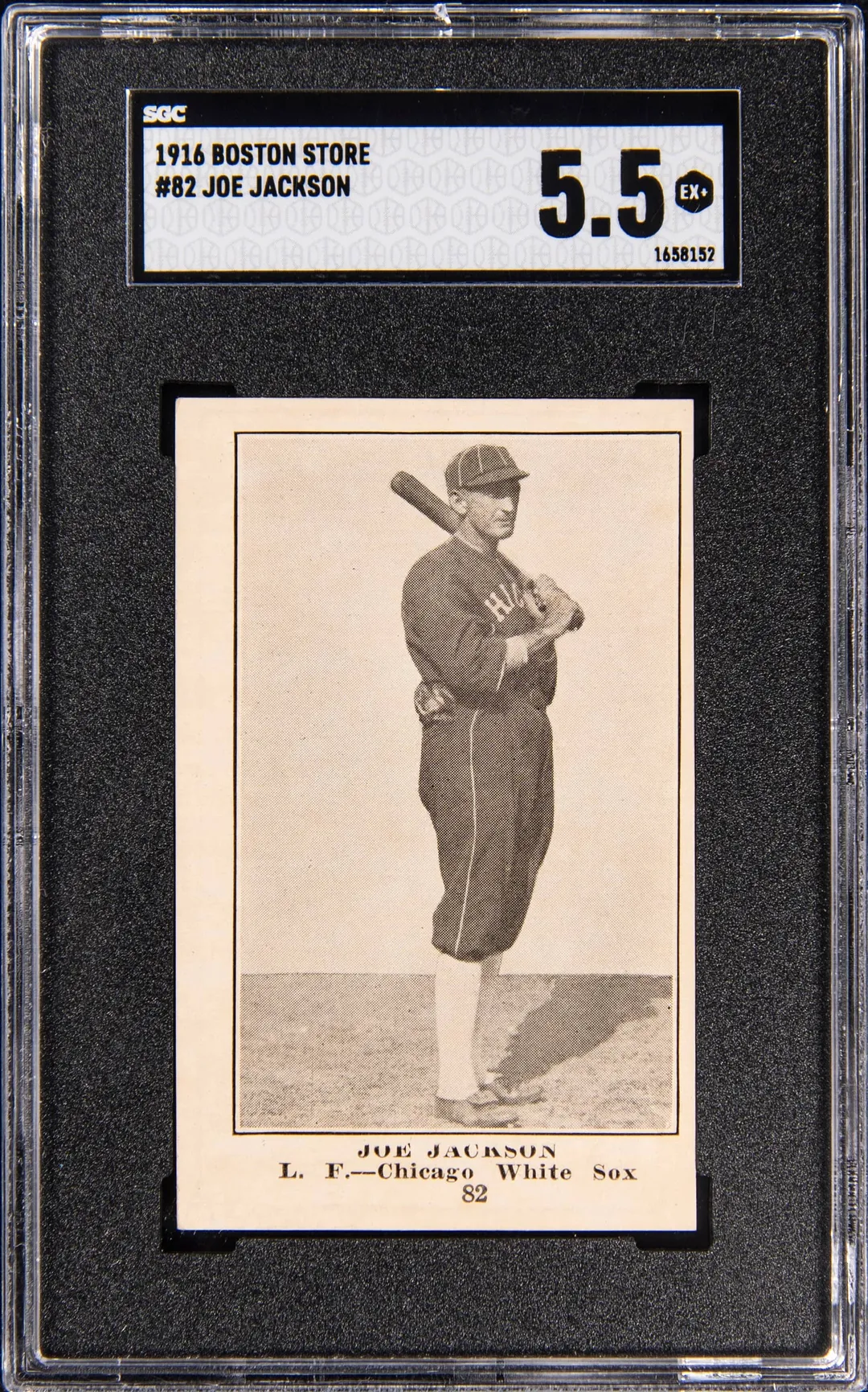
1917 Boston Store Joe Jackson SGC 5.5 sells for $136k
Goldin sold a 1917 Boston Store #82 Joe Jackson SGC EX+ 5.5, pop 1 and highest SGC copy, for $136,640 on Feb 22, 2026. Here’s the market context.
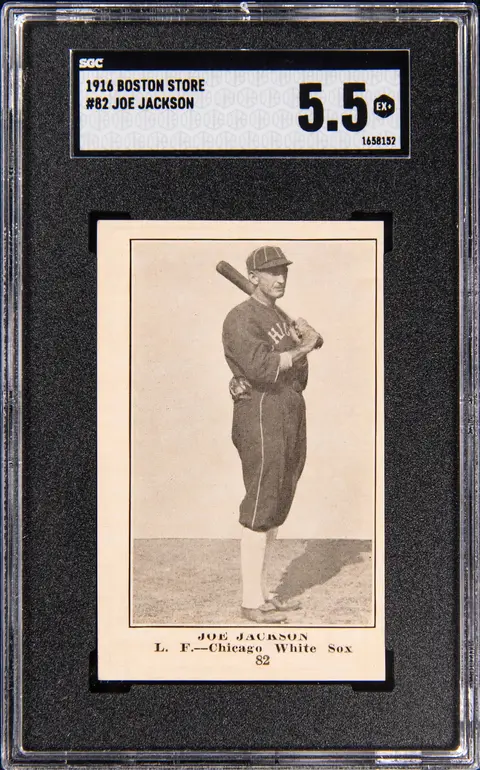
Sold Card
1917 Boston Store #82 Joe Jackson SGC EX+ 5.5 – POP 1; Highest SGC Copy
Sale Price
Platform
Goldin1917 Boston Store #82 Joe Jackson SGC EX+ 5.5 – POP 1; Highest SGC Copy
On February 22, 2026, Goldin sold a 1917 Boston Store #82 Joe Jackson graded SGC EX+ 5.5 for $136,640. For a pre-war issue, that combination of player, set, and grade puts this card squarely in the conversation with some of the most significant early 20th-century baseball pieces.
In this breakdown, we’ll walk through what this card is, why it matters to collectors, and how this $136,640 result fits into the broader vintage market.
Card overview
- Player: Joe Jackson ("Shoeless" Joe Jackson)
- Team: Chicago White Sox (depicted with Chicago in the Boston Store issue)
- Year: 1917
- Set: Boston Store (E135-type regional/department store issue)
- Card number: #82
- Grading company: SGC (Sportscard Guaranty Corporation)
- Grade: EX+ 5.5
- Population (pop) note: POP 1 at this grade level; highest-graded copy in the SGC population report at the time of the sale
- Attributes: Early-career playing-days card from Jackson’s active years; no autograph or patch, as this era predates those concepts.
This is not a rookie card in the strict sense—Jackson’s earliest issues predate 1917—but it is a key playing-days card of a Hall-of-Fame-caliber (though banned) figure from a highly respected pre-war regional issue.
Why the 1917 Boston Store set matters
The 1917 Boston Store cards are part of the broader family of early 1910s–1917 retail and regional issues that include Collins-McCarthy, Weil Baking, and related types. They were distributed through a department store rather than in packs with gum.
For collectors, that means:
- Scarcity by design: These were not mass-produced national issues. Survivorship is low compared with many tobacco (T206) or later gum-era sets.
- Condition challenges: Thin stock, handling by kids, and non-collector storage over a century all contribute to heavy wear. High-grade examples are genuinely rare.
- Era significance: 1917 sits near the tail end of the pre-war period and right before the live-ball era. Many key stars’ cards from this pocket of time are considerably tougher than their T206 counterparts.
Joe Jackson’s presence in the set elevates its status even more. For many collectors, early Jackson cards are among the most historically important pieces outside of the biggest names in the hobby like Honus Wagner and Babe Ruth.
Joe Jackson’s collector profile
Shoeless Joe Jackson is one of the most storied figures in baseball and hobby history:
- Career .356 batting average, one of the highest in MLB history.
- Central figure in the 1919 Black Sox scandal and banned from baseball in 1921.
- Because of the ban and the era he played in, Jackson has far fewer distinct cards than later legends. His key cards are heavily concentrated in the 1910–1919 window.
For collectors, that combination of all-time talent, controversy, and limited cardboard representation creates sustained demand for almost any confirmed authentic playing-days card. Within that small catalog, regionally issued sets like Boston Store stand out for their scarcity.
Understanding SGC EX+ 5.5 and population scarcity
SGC’s EX+ 5.5 grade sits at the top end of the “Excellent” tier. For a 1917 issue, an EX+ card typically shows:
- Noticeable but moderate corner rounding
- Some edge wear and possibly light surface soiling
- Clean front with strong image focus
- Back free of major paper loss or heavy staining
The key detail here is population, often called the “pop report”—a grading company’s count of how many copies they’ve graded at each grade level.
This 1917 Boston Store #82 Joe Jackson is:
- POP 1 at SGC 5.5
- Highest-graded SGC example at the time of this sale
Even if PSA or other companies have graded a handful of copies, the SGC note tells us that collectors looking specifically for a higher-end SGC example have exactly one option at this level.
In the pre-war space, top-of-pop cards often command a notable premium, especially when they combine a star player with a tougher regional set.
Market context and price positioning
Goldin’s February 22, 2026 sale closed at $136,640. To understand that number, it helps to think about three layers of context:
- Exact-card comps – recent sales of the same 1917 Boston Store #82 Joe Jackson in different grades.
- Cross-set Joe Jackson comps – sales of Jackson’s other key pre-war issues.
- Era and segment trends – how early-1900s playing-days stars have been performing more broadly.
1. Exact-card comps
Publicly available sales of the 1917 Boston Store Joe Jackson are sparse, especially in the mid- to high-grade range. That’s typical for regional pre-war issues:
- Lower-graded examples tend to surface only occasionally on major auction platforms.
- When they do, they can vary widely based on eye appeal, centering, and whether they appear in a clustered “pre-war showcase” auction.
In that context:
- A top-of-pop, highest-graded SGC copy naturally sits at the top of the pricing spectrum for this card.
- The $136,640 result reflects both the grade scarcity and the reality that a long-time Jackson or type collector may not see another comparable example come up for years.
Because direct, same-card comps are limited, collectors often anchor value using sales from other Jackson issues and from similar pre-war star cards.
2. Cross-set Joe Jackson comps
While exact recent comp numbers change over time, historically:
- High-grade T210, E90-1, and other early Jackson issues have brought six-figure prices when the card, grade, and eye appeal line up.
- Eye-catching examples from scarcer regional sets can rival or exceed more common Jackson issues even when the latter are better-known by name.
This $136,640 sale slots into that pattern:
- It is consistent with upper-tier Joe Jackson playing-days pricing.
- The price reflects a premium for the card’s combination of set scarcity, star power, and SGC top-of-pop status, rather than just the grade number alone.
3. Era and segment trends
Within the broader vintage space:
- Pre-war Hall of Fame and near-HOF stars have generally shown more stable long-run demand compared with modern speculative plays.
- Cards from the 1900–1919 window, especially scarce regional issues, have seen collectors prioritize proven rarity and historical relevance over short-term hype.
This Goldin sale fits that pattern of collectors focusing on:
- Documented scarcity (few graded examples, POP 1 at the top)
- A player with deep historical importance
- A design and issue firmly anchored in the pre-war era
Why this specific card matters to collectors
For a wide range of hobbyists—newer vintage collectors, seasoned pre-war specialists, and small sellers looking upmarket—this card checks several important boxes:
1. True scarcity, not just low pop
Population reports only tell part of the story. Pre-war regional issues are:
- Less likely to be found in large, undiscovered quantities
- More likely to have a significant portion of surviving examples in very low grade or damaged condition
That means a POP 1, highest-graded designation often aligns with reality: there simply may not be many nicer raw copies left to grade.
2. Crossover appeal
The card appeals to multiple collecting lanes:
- Player collectors who focus on Joe Jackson
- Set and type collectors building 1910s regional issue runs
- Pre-war investors and curators prioritizing historically important names in rare issues
When a card sits at the intersection of several of these groups, competitive bidding becomes more likely—especially at a well-marketed auction house like Goldin.
3. Eye appeal at a playable grade
EX+ 5.5 is often a “sweet spot” in vintage:
- Still presents very well in-hand and in scans
- Avoids the steep premium jumps that can occur in ultra-rare 7–8 territory (where it exists at all)
- Keeps the focus on the aesthetic and historical significance, not just a top-end registry chase
For many collectors, a strong 5–6 in a truly tough pre-war issue can be more desirable than a technical 7 in a more common set.
What this means for newer and returning collectors
If you are newer to pre-war or returning to the hobby and trying to read this result, a few takeaways can help frame it:
Pre-war is its own ecosystem. You cannot directly compare a 1917 regional card’s price to a modern ultra-modern parallel. Scarcity, age, and historical importance play a much larger role.
Top-of-pop is meaningful in older sets. In modern products, low population can be a temporary artifact of what’s been submitted so far. In pre-war, especially regional issues, it often reflects genuine scarcity.
Auction context matters. A card like this selling at Goldin on February 22, 2026 benefits from broad visibility among advanced vintage buyers. Results from smaller venues or private deals might differ.
Think in ranges, not guarantees. This $136,640 sale provides a clear reference point, but future results will still depend on timing, eye appeal, and which collectors are active when the card surfaces again.
How small sellers can use this data
Most small sellers won’t handle a six-figure Shoeless Joe, but the principles scale down:
- Check population reports when you list older cards. A modest-grade pre-war or early post-war card that is top-of-pop can often justify extra attention in your description.
- Highlight set context. Instead of just “vintage card,” note if it’s a regional issue, food release, or otherwise tougher than flagship gum sets from the same period.
- Use major auction results as anchors, not promises. Sales like this one are helpful for understanding how advanced collectors value scarcity and history, even if you’re working with more accessible pieces.
Final thoughts
The 1917 Boston Store #82 Joe Jackson SGC EX+ 5.5 that sold at Goldin on February 22, 2026 for $136,640 represents a clear benchmark for this card: a top-of-pop, highest-graded copy of a scarce pre-war regional issue featuring one of baseball’s most important and debated figures.
For collectors and market watchers, it reinforces a theme that has held through multiple hobby cycles: genuinely scarce, historically grounded vintage pieces can maintain deep interest, even as attention shifts across eras and products. Whether you chase high-end pre-war or not, understanding why cards like this command such respect is key to reading the broader trading card market with a clear, informed lens.