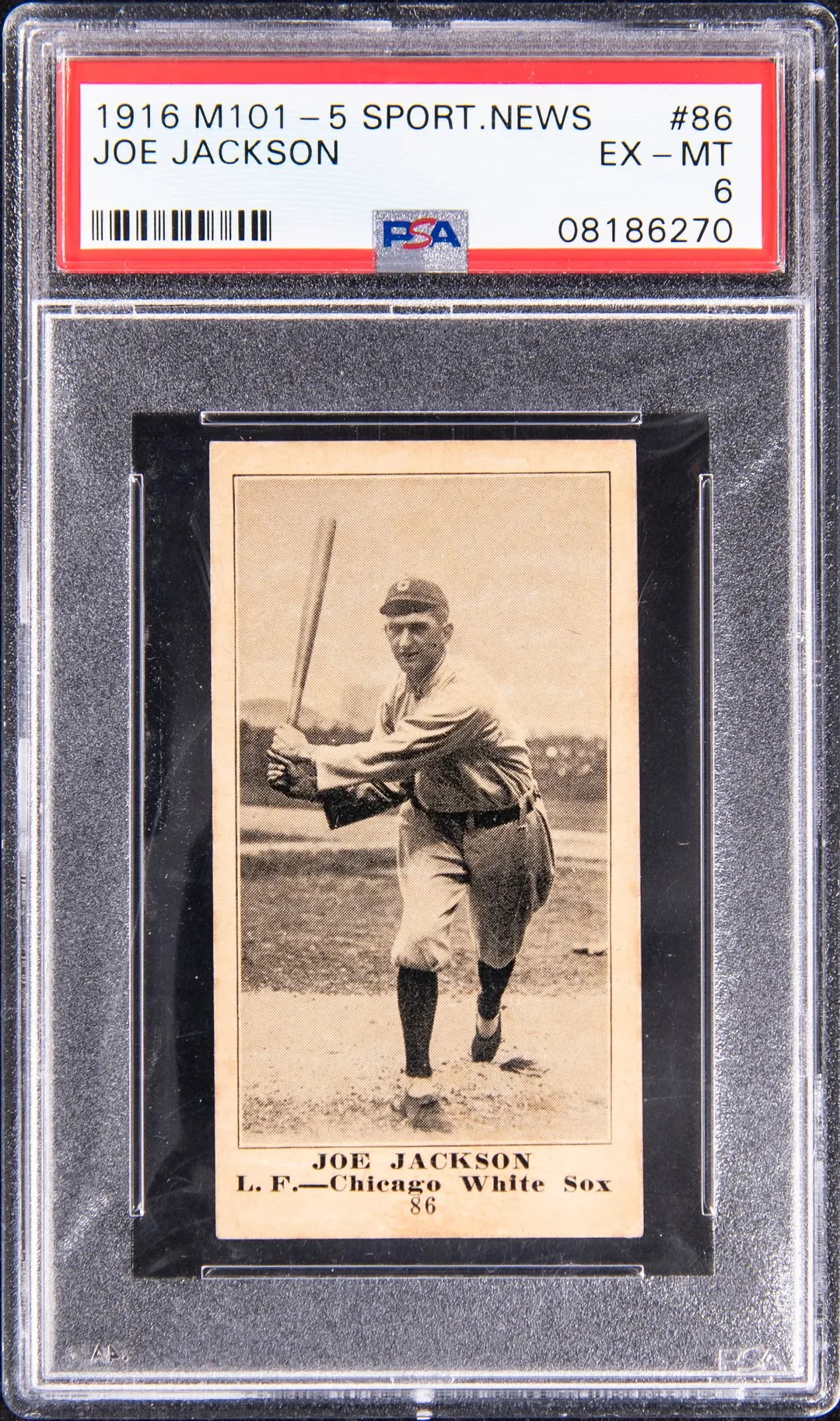
1916 M101-5 Joe Jackson PSA 6 Blank Back Sells Big
Goldin sells a 1916 M101-5 Sporting News Joe Jackson Blank Back PSA 6 for $81,740. A low-pop pre-war icon and key data point for vintage collectors.
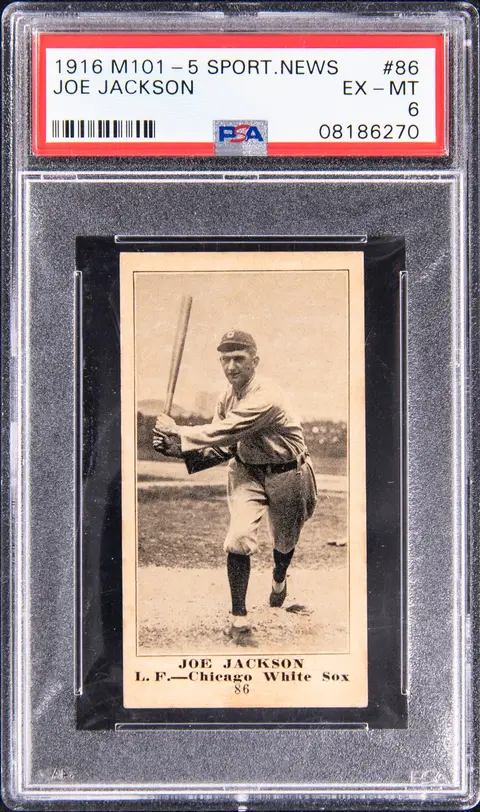
Sold Card
1916 M101-5 Sporting News #86 Joe Jackson Blank Back - PSA EX-MT 6 – POP 2; Only 3 M101-5 Blank Backs Graded Higher
Sale Price
Platform
GoldinA $81,740 sale for a pre-war baseball icon always deserves a closer look.
On February 22, 2026, Goldin sold a 1916 M101-5 Sporting News #86 Joe Jackson Blank Back, graded PSA EX-MT 6, for $81,740. For collectors who focus on early baseball issues, this is a meaningful data point for one of Shoeless Joe Jackson’s most important cards.
In this breakdown, we’ll walk through what this card is, why the blank back matters, how rare a PSA 6 really is, and how this sale fits into recent market activity.
Card at a glance
- Player: Joe Jackson (Shoeless Joe)
- Team: Chicago White Sox
- Year: 1916
- Set: M101-5 Sporting News
- Card number: #86
- Back type: Blank back (no advertising)
- Grading company: PSA (Professional Sports Authenticator)
- Grade: EX-MT 6 (Excellent-Mint)
- Population in this grade: POP 2 (only 2 copies in PSA 6)
- Higher blank backs graded: Only 3 M101-5 blank backs of this card are graded higher
The 1916 M101-5 issue is a key pre-war set that was originally distributed by The Sporting News and various regional advertisers. The same front image can be found with different advertising backs, and a smaller share of copies are completely blank on the reverse. This sale focuses on that scarcer blank back variety.
Is this a rookie card?
Collectors often debate Jackson’s earliest and most important cards. Joe Jackson has issues that predate 1916, so this 1916 M101-5 is not his rookie. Instead, it is treated as a major early-career card from his prime years with the White Sox.
Among Shoeless Joe’s market, the 1916 M101-5 (and its closely-related M101-4 counterpart) are widely recognized as cornerstone type cards: widely cataloged, desirable across the hobby, and central to many pre-war collections.
Why the 1916 M101-5 set matters
For newer collectors, it helps to understand the status of the M101-5 set itself.
- Pre-war era: Produced during the 1910s, this is firmly in the pre-war vintage era. Surviving examples, especially in higher grades, are much tougher than most post-war cards.
- Checklist strength: The set includes a deep roster of Hall of Famers and stars, which keeps long-term interest strong.
- Multiple backs: Cards were issued with backs for retailers, newspapers, and other brands. Blank backs account for a smaller share of surviving copies, adding another layer of scarcity.
Collectors who build type sets (one representative card from many classic sets) or focus on pre-war stars often rank M101-5 among the foundational issues to know.
What does EX-MT 6 mean for a 1916 card?
PSA’s EX-MT 6 grade indicates a card that is sharp for its age, with moderate but clearly acceptable wear:
- Corners: Noticeable but not heavy wear
- Surface: Clean overall, with minor flaws
- Centering: Typically solid, though not perfect
For a 1916 issue, EX-MT 6 is significantly above the average survivor. Many M101-5 cards fall in the PSA 2–4 range due to creases, paper loss, and heavy handling over the past century.
The population note on this card is important:
- POP 2 in PSA 6 for this specific blank back
- Only 3 blank backs graded higher
In other words, among PSA-graded M101-5 Joe Jackson blank backs, this card sits near the top of the grading pyramid. Population (“pop”) reports are counts from the grading company that show how many copies exist in each grade, which helps collectors understand relative scarcity.
Market context: how does $81,740 fit in?
This particular copy sold at Goldin on February 22, 2026 for $81,740. To put that in context, it’s useful to look at the broader pattern of sales around this card and related versions.
Because the M101-5 Joe Jackson blank back is a narrow slice of an already small population, exact recent comps (short for “comparables,” meaning very similar items that have sold recently) are limited. That said, a few patterns generally show up when you study public auction results for:
- Same card, different backs (advertising backs instead of blank)
- Same card, different grades (lower and occasionally higher than PSA 6)
- Closely related sets (notably the M101-4 Joe Jackson card, which shares a similar image and era)
What tends to emerge:
- Grade drives big price steps. Moving from low to mid-to-high grade on pre-war stars like Jackson often creates sharp jumps in price, because high-grade survivors are disproportionately rare.
- Back variety matters. Certain advertising backs have their own following. Blank backs, while not as heavily branded, are understood to be a smaller fraction of the total and are tracked separately by focused pre-war collectors.
- PSA 6 sits in a premium band. For pre-war Hall of Famers, collectors often view PSA 5–7 as a “sweet spot” that balances condition and price. Within that band, each bump up the grading scale can have a noticeable impact on realized prices.
Within that framework, a result of $81,740 for a POP 2 PSA 6 blank back aligns with the idea that:
- Scarcer back types can command a premium over more common backs in the same grade.
- High-grade pre-war Shoeless Joe cards continue to attract serious bidding, especially at major auction houses like Goldin.
Because public sales of this exact back and grade are limited, it’s more accurate to view this as a strong, data-rich comp rather than a routine transaction. Future sellers and buyers of high-grade M101-5 Joe Jacksons—blank back or otherwise—are likely to reference this sale when discussing value ranges.
Why collectors chase Shoeless Joe Jackson
Joe Jackson holds a unique place in baseball history, which spills over directly into his card market:
- Elite talent: Jackson’s career batting average and offensive production place him among the greats of the dead-ball and pre-live-ball eras.
- Cultural impact: His connection to the 1919 Black Sox scandal and subsequent lifetime ban from Major League Baseball have made him a focal point of baseball lore.
- Limited card run: Because his career and public profile were cut short, Jackson’s card checklist is far smaller than that of many Hall of Famers from later decades.
For many collectors, owning a strong early Jackson card is about more than stats—it’s about holding a tangible piece of one of baseball’s most discussed careers.
How the blank back angle affects demand
Within the M101-5 world, back variations are a key area of specialization. Here’s how the blank back fits in:
- Smaller surviving share: While exact print counts aren’t known, blank backs tend to show up in lower numbers than some common advertiser backs.
- Cataloged separately: Many collectors and registries treat blank backs as their own line item, which keeps demand organized and visible.
- Grade scarcity compounds back scarcity: When a tough back variety also appears in a high grade like PSA 6, it creates a very narrow supply for collectors willing to pay a premium.
The fact that only three blank back copies are graded higher than this PSA 6 underlines why bidders were willing to reach the $81,740 mark.
What this sale suggests about the current market
Rather than treating a single auction as a prediction, it’s more helpful to see it as one more data point in a trend line. For this card, a few fair takeaways are:
- High-grade pre-war stars remain targeted. Even as modern and ultra-modern issues draw attention, serious collectors still allocate meaningful budgets to iconic pre-war cards.
- Population data matters in bidding. The POP 2 status and note that only three higher-graded blank backs exist likely supported competitive bidding at Goldin.
- Set and player history still carry weight. The combination of a respected 1910s set, a legendary player, and a top-tier grade continues to resonate with both seasoned vintage collectors and newer entrants looking for historically important pieces.
This sale does not guarantee future prices, up or down, but it does offer a clear, recent benchmark for anyone tracking early Joe Jackson cards.
Takeaways for different types of collectors
New or returning collectors:
- Use this card as a case study in how era, player, set, back variety, and grade all stack together to influence value.
- When you see references to “M101-5” or “pre-war,” know that you’re looking at a niche where condition scarcity is real and pop reports are essential reading.
Active hobbyists:
- If you chase Jackson, M101-5 and its related M101-4 counterpart remain core targets; tracking both along with back varieties can give you deeper insight into the Jackson market.
- When evaluating a card like this, compare not only grade but also back type and population. A PSA 6 with a more common back may behave differently than a PSA 6 blank back with POP 2.
Small sellers and market watchers:
- This Goldin result from February 22, 2026 at $81,740 is a meaningful comp to reference when talking about high-grade pre-war stars.
- When you see interest in specific pre-war names cooling or heating up, check whether the cards involved are run-of-the-mill mid-grade copies or population outliers like this one.
Final thoughts
The 1916 M101-5 Sporting News #86 Joe Jackson Blank Back in PSA EX-MT 6 is more than just a nicely preserved century-old baseball card. It’s a low-pop, high-grade example of a key pre-war star from a historically important set, with a back variation that adds another layer of scarcity.
The February 22, 2026 Goldin sale at $81,740 doesn’t rewrite the entire pre-war market, but it does provide a clear, recent reference point. For anyone mapping the landscape of Shoeless Joe Jackson’s earliest and most important issues, this sale now sits firmly on the timeline.