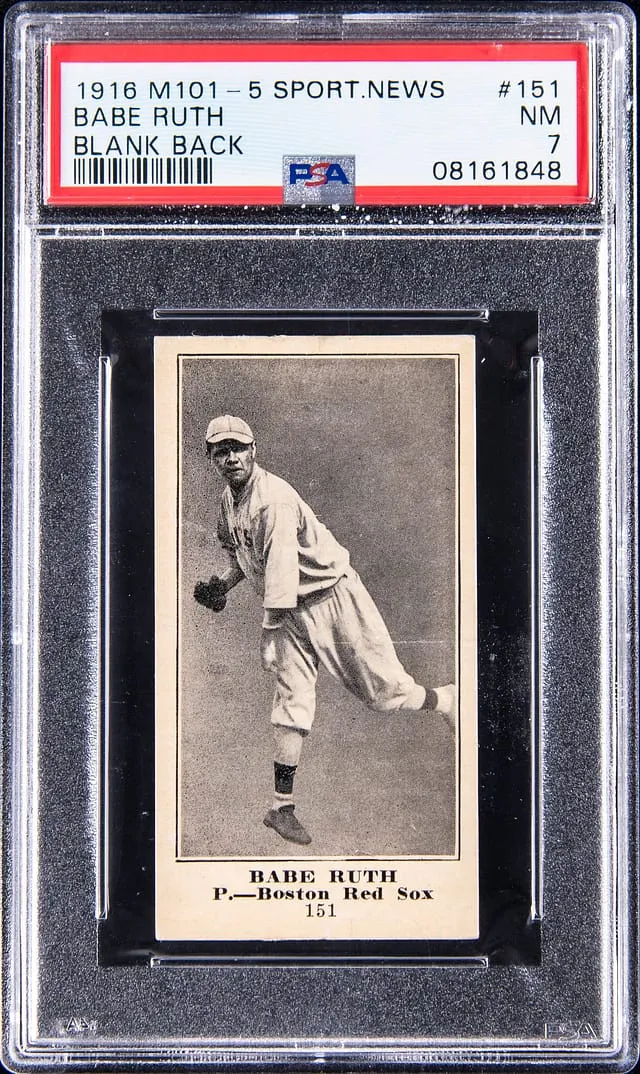
1916 M101-5 Babe Ruth PSA 7 Rookie Sells for $1.4M
Goldin sells a 1916 M101-5 Sporting News #151 Babe Ruth rookie, PSA 7 (pop 3), for $1,415,200. A key data point for high-end pre-war vintage cards.
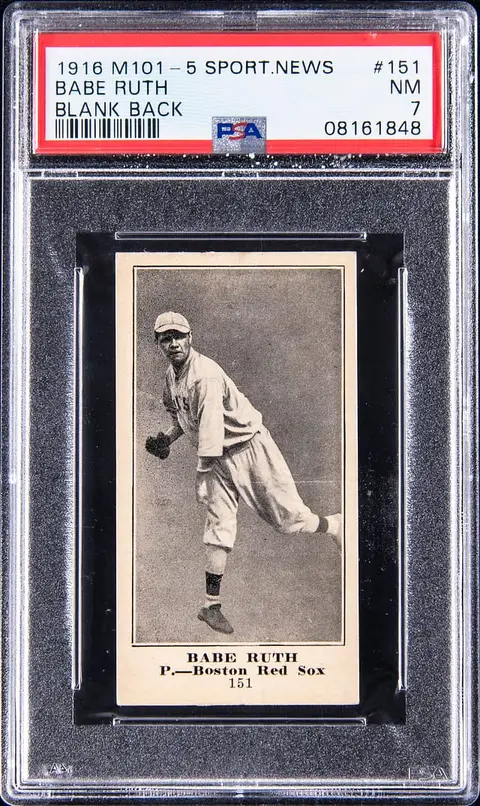
Sold Card
1916 M101-5 Sporting News #151 Babe Ruth, Blank Back Rookie Card w/Outstanding Centering - PSA NM 7 - Pop 3; Only 3 Higher PSA Copies
Sale Price
Platform
Goldin1916 M101-5 Sporting News #151 Babe Ruth, Blank Back Rookie Card w/Outstanding Centering - PSA NM 7 - Pop 3; Only 3 Higher PSA Copies Sells for $1,415,200 at Goldin
On March 8, 2026, Goldin sold one of the most important baseball cards in the hobby: a 1916 M101-5 Sporting News #151 Babe Ruth rookie card, blank back, graded PSA NM 7, for $1,415,200.
For vintage collectors and newer hobbyists trying to understand why this matters, this sale is a clear data point in how the market is currently valuing truly elite pre-war material.
What exactly is this card?
Let’s break down the basics of the card itself:
- Player: Babe Ruth
- Team: Boston Red Sox (as a pitcher)
- Year: 1916
- Set: M101-5 Sporting News
- Card number: #151
- Back type: Blank back variant
- Status: Widely recognized as one of Babe Ruth’s key rookie cards
- Grading company: PSA (Professional Sports Authenticator)
- Grade: NM 7 (Near Mint)
- Population (pop): 3 copies in PSA 7, with only 3 higher in the PSA population report at the time of the sale
Within the Ruth rookie landscape, the 1916 M101-5 Sporting News #151 is one of the cornerstone issues. It shows Ruth as a young pitcher with the Boston Red Sox, before he became the game-changing slugger with the New York Yankees. For many collectors, this is one of the most historically significant baseball cards ever printed.
The auction listing notes "Outstanding Centering", which is a meaningful detail. Many M101-5 examples suffer from off-centering, print issues, or edge wear. Strong centering in a high grade separates a card from the rest of the surviving population and often contributes to premium pricing within the same numeric grade.
Why the 1916 M101-5 Ruth matters to collectors
To understand the significance of this sale, it helps to put the card into hobby context:
- Era: Pre-war vintage (early 20th century)
- Set type: M101-5 cards were originally issued as a Sporting News set and also distributed by various regional advertisers with different backs. Blank backs are among the recognized variations.
- Key rookie: This #151 Ruth is one of the true Babe Ruth rookies and an essential card for any serious pre-war or Ruth-focused collection.
- Scarcity: True high-grade examples are extremely limited. Most surviving M101-5 Ruths have condition issues: rounded corners, creases, stains, or serious centering problems.
- Condition sensitivity: The thin card stock and distribution method make high grades rare, especially with strong eye appeal.
In other words, this isn’t just another vintage card. It’s a foundational piece in the story of both Babe Ruth and the hobby itself.
Population report and grade scarcity
When collectors talk about a “pop report”, they mean the population report: the grading company’s count of how many copies exist at each grade level.
For this card in a PSA holder, the numbers around this sale are:
- PSA 7 (NM): Population 3
- Higher than PSA 7: Only 3 copies total
That makes this card one of only a handful of examples at the very top of the graded population. In practical terms, collectors chasing a high-end Ruth rookie in a PSA holder have extremely few opportunities to bid on a card of this quality.
Price context: how $1,415,200 fits into the market
This Goldin sale closed at $1,415,200 on March 8, 2026.
When hobbyists talk about “comps”, they mean comparable sales: recent auction or marketplace results for the same card (or something very close to it) that help set expectations for current value.
Because the 1916 M101-5 Ruth is rare in high grade, comps are limited and spaced out over time, but there are a few important patterns:
- High-grade Ruth rookies (across M101-4 / M101-5, and across different backs) have consistently brought strong six- and seven-figure results over the past several years.
- Top-end grades (PSA 7 and above) rarely come to auction, so each sale tends to be treated as a reference point until the next example surfaces.
Compared with the broader landscape of iconic vintage cards (T206 Honus Wagner, 1952 Topps Mickey Mantle, high-grade pre-war Hall of Famers), a $1.4M result for a Ruth rookie in PSA 7 fits within the established pattern that true blue-chip vintage continues to attract deep, long-term demand.
Because ultra-rare, high-grade sales don’t happen every month, it’s difficult to label this price as definitively high or low relative to an exact benchmark. Instead, this sale confirms two key points:
- PSA 7 remains a premium tier for this card. With only 3 copies at this grade and 3 higher, the scarcity is structural, not temporary.
- Collector confidence in elite pre-war material is still strong. When a card like this appears, serious buyers show up, especially through a major auction house like Goldin.
Why the centering and presentation matter
In vintage, not all copies of the same grade are equal in the eyes of collectors. Within PSA 7, factors such as:
- Centering
- Print clarity
- Color and contrast
- Surface cleanliness
can significantly influence how collectors rank one example versus another.
The auction description’s emphasis on "Outstanding Centering" suggests that this specific PSA 7 could be viewed as a stronger-than-typical example for the grade. That nuance often shows up in bidding, especially when advanced collectors compare images and previous offerings.
The role of Goldin and the sale date
This card sold through Goldin on March 8, 2026 (UTC). For high-profile vintage pieces, the auction house matters for a few reasons:
- Visibility: Major auction houses reach a global pool of advanced collectors and high-end buyers.
- Confidence: Established platforms provide detailed descriptions, authentication, and marketing that help bidders feel comfortable with significant bids.
- Data: Sales at large houses are widely tracked and become reference points for future negotiations and private deals.
This Goldin result will likely be cited in future discussions about Ruth rookies for some time, simply because opportunities to buy a PSA 7 don’t come up often.
How this sale fits into the broader Ruth rookie landscape
The Ruth rookie picture is more complex than modern players with a single flagship issue. For Ruth, collectors consider multiple early cards across different sets and backs, including:
- 1914 Baltimore News
- 1916 M101-4 and M101-5 with various advertising backs
- Other early issues overlapping his transition from pitcher to hitter
Within that ecosystem, the 1916 M101-5 Sporting News #151 sits at the top tier of widely recognized, cataloged Ruth rookies. It is one of the cards that define the pre-war segment of the hobby.
High-grade examples in any back variation are so rarely offered that each sale, like this one, essentially resets expectations and becomes a new anchor point for private valuations.
What this means for collectors and small sellers
A sale above $1.4M is obviously out of reach for most collectors, but it still has useful implications for the broader market:
- Signal for vintage confidence: Strong results on true cornerstone cards can reinforce interest in lower-grade or more affordable vintage issues, as collectors look for ways into the same era or player at different price tiers.
- Pop and eye appeal matter: The combination of low population, strong centering, and a respected grading company continues to command premiums. Even on far less expensive cards, these same factors influence pricing.
- Comps as a guide, not a promise: This Goldin sale is a data point, not a guarantee of future performance. But it does give collectors a reference when evaluating offers, insurance coverage, or potential consignments of similar material.
For small sellers, you don’t have to own a Ruth rookie to learn from this sale. The same principles apply to more modest cards:
- Check population reports to understand how common or rare your grade is.
- Compare multiple recent comps rather than relying on a single sale.
- Pay attention to centering and overall eye appeal when pricing or listing.
Final thoughts
The March 8, 2026 Goldin sale of the 1916 M101-5 Sporting News #151 Babe Ruth, blank back, PSA NM 7 (pop 3, only 3 higher) at $1,415,200 is a defining moment for this card’s modern market history.
It reinforces the long-standing view that truly elite pre-war cards — especially iconic rookie issues of Babe Ruth — occupy a separate tier in the hobby: extremely scarce, heavily researched, and closely watched whenever one surfaces.
For collectors tracking the long arc of the vintage market, this sale is less about sudden spikes and more about ongoing confirmation. High-end Ruth rookies remain among the most studied and pursued cards in the hobby, and this PSA 7 is now part of that story.