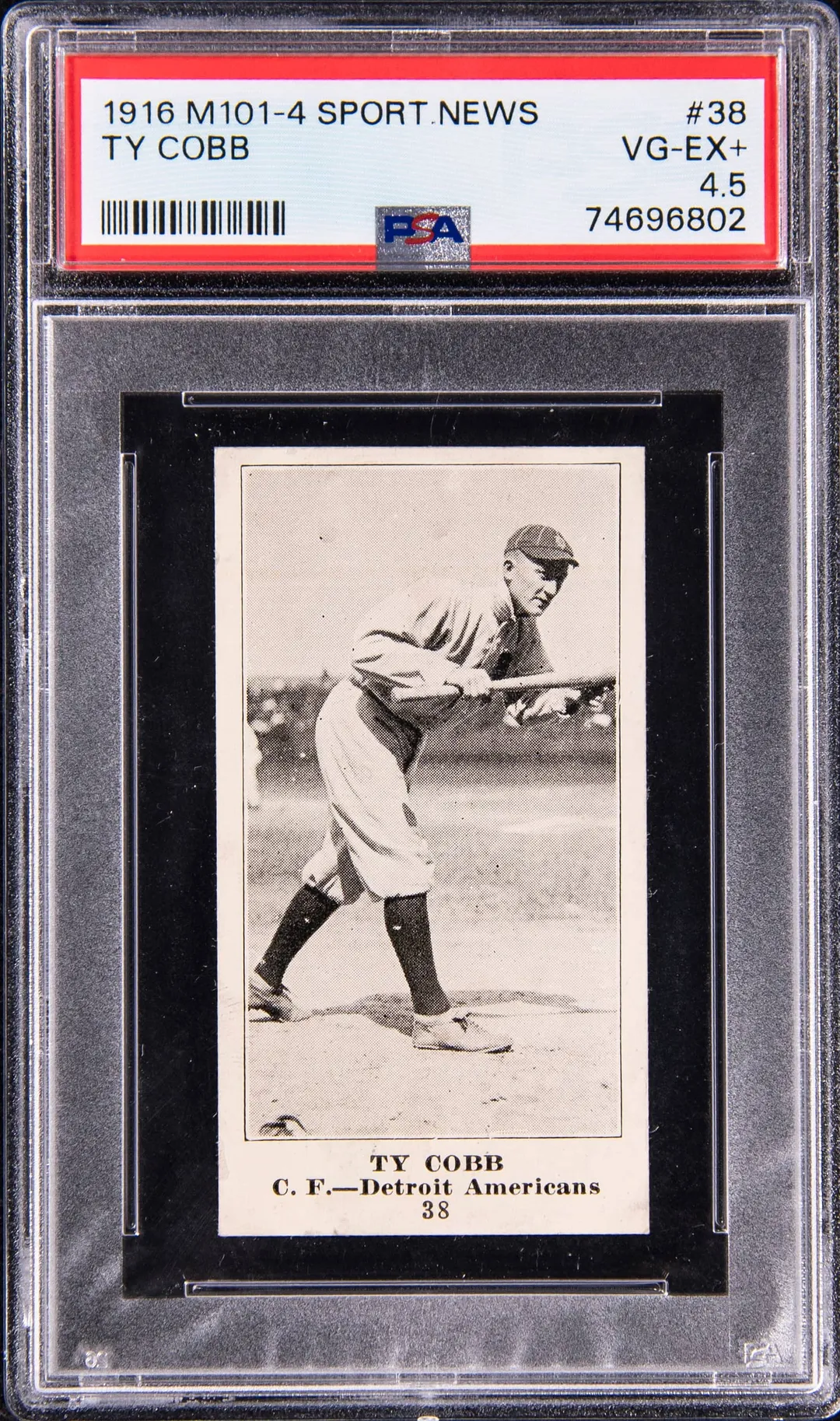
1916 M101-4 Ty Cobb PSA 4.5 Sells for $18,300
Deep dive on the 1916 M101-4 Sporting News #38 Ty Cobb PSA 4.5 POP 1 that sold for $18,300 at Goldin on February 22, 2026.
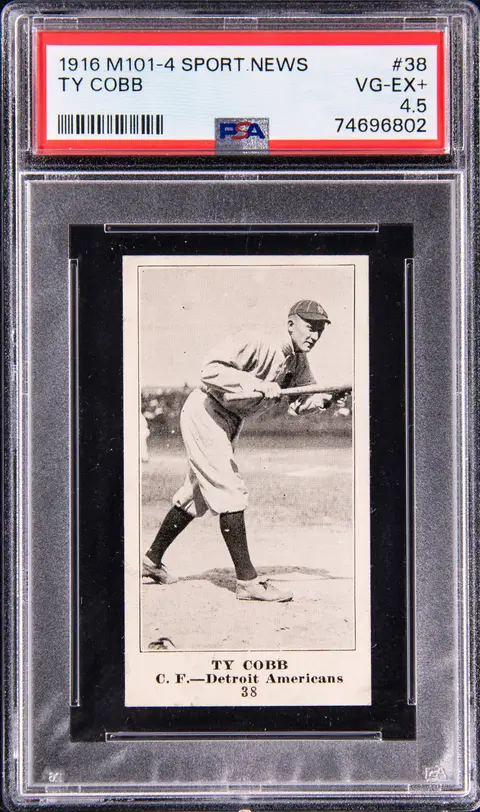
Sold Card
1916 M101-4 Sporting News #38 Ty Cobb - PSA VG-EX+ 4.5 - POP 1
Sale Price
Platform
Goldin1916 M101-4 Sporting News #38 Ty Cobb (PSA VG-EX+ 4.5, POP 1) Sold for $18,300 at Goldin on February 22, 2026
For vintage baseball collectors, the 1916 M101-4 Sporting News Ty Cobb is one of the core pre-war cards of an all-time great. A PSA VG-EX+ 4.5 example (population 1) just sold at Goldin on February 22, 2026, for $18,300. In this breakdown, we’ll look at what this specific card is, why it matters, and how the price fits into the recent market for Cobb and early Sporting News issues.
Card overview
- Player: Ty Cobb
- Team: Detroit Tigers
- Year: 1916
- Set: M101-4 Sporting News
- Card number: #38
- Publisher / issuer: Sporting News-backed M101-4 issue (distributed by The Sporting News and various regional advertisers)
- Grading company: PSA (Professional Sports Authenticator)
- Grade: VG-EX+ 4.5
- Population (PSA): Pop 1 in this exact grade
- Attributes: Pre-war, black-and-white photo card, no autograph or memorabilia
The M101-4 Sporting News set is one of the key mainstream baseball issues of the 1910s. It is often grouped with other major pre-war sets like T206, Cracker Jack, and E121 as a cornerstone run for Hall of Fame collectors. Ty Cobb’s card in this set is not his rookie (his earliest widely collected cards predate 1910), but it is still considered a major, early-career Cobb issue.
Why the 1916 M101-4 Ty Cobb matters
A key pre-war Cobb
Cobb is one of the essential names in vintage baseball collecting, and demand for his pre-war cards tends to be steady across market cycles. For collectors trying to build:
- a Hall of Fame run (one card per Hall of Famer),
- a pre-war star run, or
- a M101-4 or M101-5 set,
this Cobb is one of the must-have cards.
While the T206 portrait poses (especially green background) usually get the most attention, cards like the 1916 M101-4 fill in the narrative of Cobb’s playing days and provide a different photo and design than the tobacco issues. For many collectors, the variety of early Cobb cards is part of the appeal—this is a way to own a significant, 100+ year-old Cobb that isn’t one of the handful of headline T206s.
The M101-4 Sporting News set
The M101-4 and closely related M101-5 sets were issued around 1916 in partnership with The Sporting News and a number of advertisers. The same card fronts can be found with different backs (various regional businesses), which can create rarer back varieties. This particular listing does not specify a back type, so the focus is on the card front and grade.
Key points about the M101-4 set:
- Era: Pre-war (early 20th century), which usually means lower surviving populations and more condition sensitivity.
- Star power: Includes Babe Ruth’s famous rookie, as well as Cobb, Wagner, Mathewson, Johnson, and other Hall of Famers.
- Distribution: Often came as promotional items, which means many were not stored for long-term preservation. Creases, corner wear, and back issues are common.
Because of this, finding eye-appealing, mid-grade copies of stars like Cobb remains challenging.
Grade, pop report, and scarcity
PSA’s population report (often called the “pop report”) is a count of how many examples of a card have been graded at each grade level. This Ty Cobb is a PSA VG-EX+ 4.5 and is listed as POP 1, meaning:
- There is only one copy at PSA in this exact 4.5 grade.
- Above and below this grade, the population thins out compared with modern cards.
For a 1916 issue, a 4–5 range is often seen as a sweet spot for collectors who want a presentable card without chasing the very scarce high-grade examples. Typical issues in this grade range include moderate corner wear, some surface or print imperfections, and sometimes minor centering variance, but still strong overall eye appeal for a 100+ year-old card.
When you compare this to modern or ultra-modern cards where populations in the hundreds or thousands per grade are common, a single-pop 4.5 for a pre-war Hall of Famer underlines the fundamental scarcity in this segment of the hobby.
Market context and recent sales
Because we are dealing with a specific grade (PSA 4.5, pop 1) and a niche pre-war set, direct, identical comparables (“comps”)—meaning recent sales of this exact card in this exact grade—are limited or non-existent. Instead, it’s more useful to look at nearby grades and similar issues.
Based on publicly visible results across major auction houses and marketplaces over the past few years:
- Lower grades (PSA 1–3) of the 1916 M101-4 Cobb typically sell at a noticeable discount to this result, reflecting heavier wear, creasing, or paper loss.
- Mid-grades (around PSA 4–5) for comparable pre-war Cobb issues (including this set and similar era cards) have often settled in a mid–five-figure range or below, depending on eye appeal and back variety.
At a sale price of $18,300 at Goldin on February 22, 2026, this PSA 4.5 result fits into the expected range for a solid mid-grade pre-war Cobb from an important set, especially when you consider:
- The pop 1 status in this exact grade.
- The growing attention paid to M101-4 and M101-5 in recent years, partly driven by the Babe Ruth rookie in the same family of issues.
Compared with the very top-end Cobb cards (like elite-grade T206 portraits or ultra-rare regional issues), this sale is at a far lower absolute price level, but still significant within the context of pre-war Cobb collecting.
How this sale fits collector behavior
Steady demand for Hall of Fame pre-war
Even as modern and ultra-modern cards (particularly serial-numbered parallels and autographs) have had more visible boom-and-bust cycles, pre-war Hall of Fame material has generally shown more measured, steady collecting demand. A few ongoing patterns help explain a sale like this:
- Focus on foundational players: Ty Cobb, Babe Ruth, Honus Wagner, and a small group of others remain core targets for long-term collectors.
- Preference for complete, graded examples: With cards from the 1910s, authenticity and condition are major concerns. Third-party grading from PSA or similar companies provides baseline confidence.
- Mid-grade as a practical target: For many collectors, a 4–5 range is a realistic balance between appearance and budget, especially compared to very high-grade examples where one more grade step can mean a large price jump.
No clear short-term news driver
Unlike modern players whose card prices can swing on season performance, award races, or hobby narratives, Ty Cobb’s market is largely driven by:
- the long-term status of pre-war Hall of Famers;
- incremental shifts in vintage demand;
- awareness of sets like M101-4, thanks in part to media and auction catalog coverage.
There is no recent, single event that would dramatically move a 1916 Cobb price overnight. Instead, this sale is better seen as another data point in a longer trend of collectors continuing to allocate attention and budget to pre-war icons.
Takeaways for collectors and small sellers
For collectors evaluating this sale as a reference point:
- This is a representative mid-grade result for a key pre-war Cobb from an important set, sold through a major auction house (Goldin) on February 22, 2026.
- The $18,300 price is influenced by both the set importance and the population realities—a single-pop 4.5 in a thinly graded pre-war issue is not directly comparable to mass-produced modern inserts.
- If you are looking to acquire something comparable, expect prices to vary by:
- grade spread (e.g., PSA 3 vs PSA 5),
- eye appeal,
- and, in some cases, back variety.
For small sellers:
- When listing early 1900s stars, it helps to clearly state the set (M101-4), year, and Hall of Fame status, and to explain why the set matters.
- Use precise data: auction house, sale date, and confirmed sales history help buyers understand context, especially if direct comps for your exact grade are thin.
Where this fits in the broader vintage landscape
The 1916 M101-4 Cobb is not as headline-grabbing as the Ruth rookie from the same family of sets, but that is exactly why many collectors gravitate to it: it offers early, documented Cobb history from a landmark issue at a smaller fraction of the very top Ruth and Cobb prices.
The Goldin sale of this PSA VG-EX+ 4.5, pop 1, at $18,300 on February 22, 2026, reinforces a familiar pattern in the hobby:
- Pre-war Hall of Fame cards continue to find willing bidders.
- Mid-grade, presentable examples remain a central target area.
- Thin population data and set importance matter as much as the slab number itself.
For anyone mapping out a vintage-focused collection, this sale is a useful marker for where a strong mid-grade M101-4 Ty Cobb currently sits in the market.