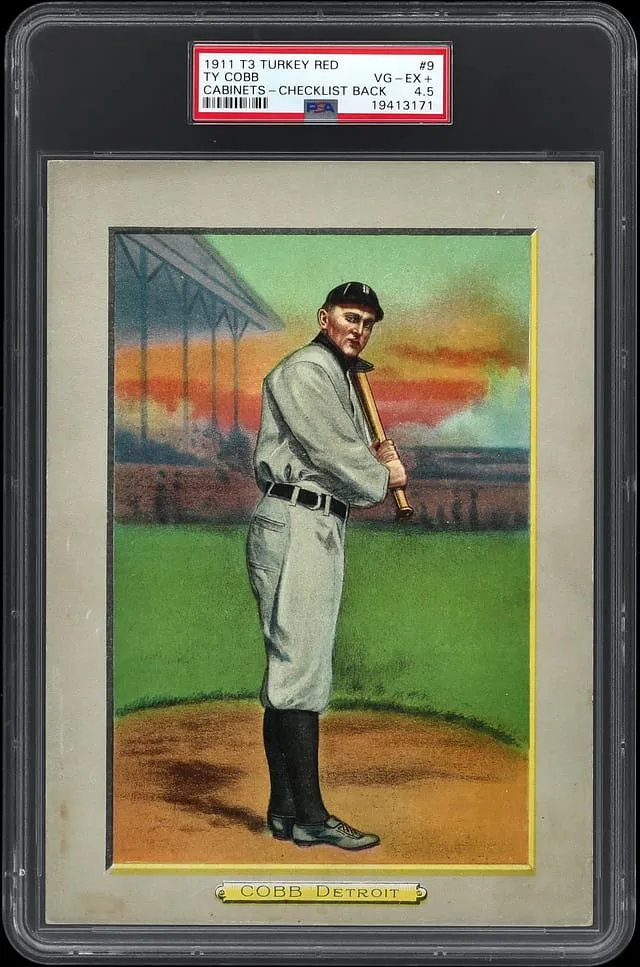
1911 T3 Ty Cobb PSA 4.5 sells for $31,722 at Goldin
Deep dive on the 1911 T3 Turkey Red Ty Cobb PSA 4.5 that sold for $31,722 at Goldin on Feb 22, 2026, with market context for vintage collectors.
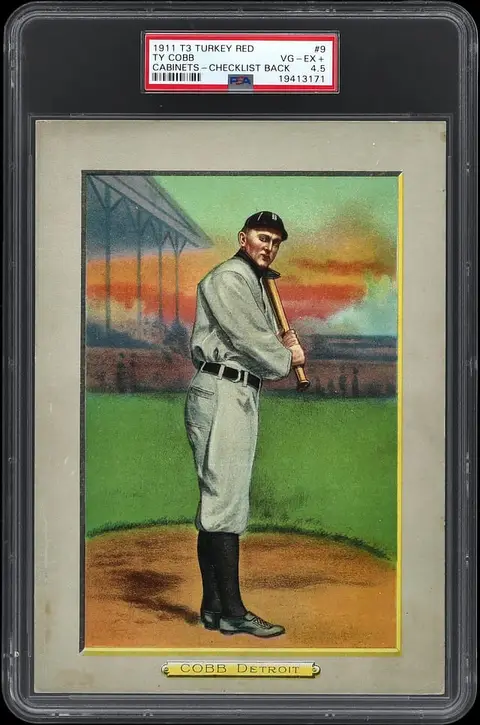
Sold Card
1911 T3 Turkey Red Cabinets Checklist Back #9 Ty Cobb - PSA VG-EX+ 4.5
Sale Price
Platform
Goldin1911 T3 Turkey Red Cabinets Ty Cobb PSA 4.5 Sells for $31,722
On February 22, 2026, Goldin sold a 1911 T3 Turkey Red Cabinets Checklist Back #9 Ty Cobb graded PSA VG-EX+ 4.5 for $31,722. For vintage baseball collectors, this is a meaningful data point for one of the cornerstone prewar Cobb issues.
In this breakdown, we’ll walk through what this card is, why it matters, and how this sale fits into recent market activity.
The Card at a Glance
- Player: Ty Cobb (Detroit Tigers)
- Year: 1911
- Set: T3 Turkey Red Cabinets
- Card #: 9
- Back: Checklist back
- Grade: PSA VG-EX+ 4.5
- Type: Oversized cabinet card, prewar tobacco-era issue
- Rookie?: Not a rookie, but a key early Cobb card and hobby staple
The T3 Turkey Red Cabinets are large-format (roughly 5 3/4" x 8") premium cards issued as cabinet prints. They were originally available by mailing in coupons from tobacco products. The artwork on the Cobb is one of the more recognizable prewar portraits, and the sheer size of the card makes eye appeal and condition especially important.
This particular copy carries a checklist back, one of the two general back types collectors commonly talk about for this set (the other being an advertising back). Checklist backs list subjects and offers, while ad backs focus more on the brand promotion. Many collectors pursue type cards of each back variation, so back style is a meaningful detail when comparing sales.
Why the 1911 T3 Ty Cobb Matters
A cornerstone prewar Cobb
Ty Cobb’s cards from the tobacco and caramel eras (roughly 1909–1915) are the foundation of many vintage baseball collections. While Cobb has multiple famous cards—especially in the T206 set—the T3 Turkey Red is highly respected because of:
- Artwork: The large lithographed image shows Cobb with rich color and detail that smaller tobacco cards can’t match.
- Era: This is right in Cobb’s playing prime, in the same broad window as his major T206 issues.
- Display value: The cabinet size was designed to be displayed; many examples were tacked or pinned, which is why clean copies are tough.
Within a Cobb run, collectors often prioritize T206 portraits, key caramel issues, and notable premiums. The T3 Cabinet is firmly in that conversation as a top-tier, prewar Cobb.
Vintage era, real scarcity
The T3 set is generally considered vintage prewar. Surviving examples face several challenges:
- Larger size means more surface area to crease, wrinkle, or stain.
- Many were displayed on walls or stored loosely rather than in albums.
- Corners and edges are particularly fragile over more than a century.
As a result, mid-grade copies (in the PSA 4–5 range) can actually have relatively strong demand. They balance presentable eye appeal with more attainable pricing than high-grade examples, which are far rarer and often tightly held.
Grading and Population Context
This card is graded PSA VG-EX+ 4.5, placing it in solid mid-grade territory for a 1911 cabinet. Common condition characteristics at this level can include:
- Moderate corner wear
- Light to moderate surface or edge wear
- Some minor creases or wrinkles that do not fully dominate the image
For T3s, strict numerical pop (population) data tends to be more meaningful when broken down by player, not just by set. Population reports ("pop reports") from PSA and other grading companies show how many copies of a given card exist in each grade.
For a popular Hall of Famer like Cobb, there are more graded examples than for commons, but they are still thin compared to postwar or modern issues. High-grade Cobb T3s are especially scarce, which amplifies demand in the 4–5 range for collectors who want a strong visual but can’t or don’t want to chase the very top of the census.
Market Context: How Does $31,722 Fit In?
This Goldin result at $31,722 gives another datapoint for mid-grade T3 Cobb pricing. While exact comparable sales can shift with consignment quality and timing, we can outline general trends seen in recent years:
- Lower mid-grades (PSA 2–3 range): Often trade significantly below this result, reflecting heavier creasing, rounded corners, or more pronounced back issues.
- Similar mid-grades (PSA 4–5 range): Have historically drawn a meaningful premium over 2–3s, especially when the card presents well for the grade.
- High grades (PSA 6 and above): When they appear, they can command a multiple of mid-grade prices because of true condition scarcity and strong competition among advanced Cobb collectors.
When we compare this PSA 4.5 to other mid-grade Turkey Red Cobbs, this $31,722 sale lines up as a strong but believable figure in the current vintage environment. The checklist back, solid mid-grade status, and sale through a major auction house like Goldin all support competitive bidding.
Rather than interpreting this as a new baseline or guarantee, it’s more accurate to see it as a fresh comp—short for "comparable sale"—for a centered, mid-grade T3 Cobb in a respected slab.
Why Collectors Care Right Now
A few themes continue to support interest in cards like this:
- Stable demand for true vintage icons: Prewar Cobb, Ruth, and similar blue-chip names are often treated as foundational collectibles in the hobby.
- Focus on quality over quantity: With so much modern product on the market, some collectors are pivoting back to historically significant, older cards with genuine scarcity.
- Renewed interest in eye appeal: Within any technical grade, well-centered, clean-looking copies draw more attention. Large-format cards like the T3 showcase art and color in a way that rewards eye appeal.
There have not been dramatic news swings around Cobb himself—he is long retired and firmly in baseball history—but the broader trend of collectors revisiting prewar issues supports ongoing interest in this card.
Checklist Back vs. Other Backs
Within T3 Turkey Reds, some collectors differentiate values based on back type:
- Checklist backs like this one highlight the card list and the redemption offer.
- Advertising backs focus on the tobacco brand promotion.
Preferences can be personal or set-building driven. Some hobbyists want both; others just want a strong front image and are less sensitive to back type. When comparing comps, always match:
- Back style (checklist vs ad)
- Grading company
- Numeric grade and qualifiers (if any)
- Overall eye appeal
This helps you avoid misleading price comparisons.
Takeaways for Collectors and Small Sellers
If you collect or handle prewar cards, here are a few practical notes from this sale:
- Mid-grade matters: For oversize, 100+ year-old cards, PSA 4–5 can be a real sweet spot, balancing condition and affordability relative to the few high-grade copies.
- Presentation counts: Two PSA 4.5s can present very differently. Centering, color, and front clarity can heavily influence bidding, even at the same numerical grade.
- Use multiple comps: This $31,722 Goldin sale is a key data point, but not the only one that should inform expectations. Look at other recent sales of T3 Cobb across auction houses and fixed-price marketplaces when you’re buying or selling.
- Mind the format: Oversized prewar cards require different storage and shipping than standard 2.5" x 3.5" cards. Sturdy holders and careful packing are essential if you’re running a small operation.
Final Thoughts
The February 22, 2026 sale of a 1911 T3 Turkey Red Cabinets Checklist Back #9 Ty Cobb, PSA VG-EX+ 4.5, for $31,722 at Goldin underlines how firmly this card sits in the upper tier of prewar Cobb collectibles.
For long-time vintage enthusiasts, it’s another confirmation of what the hobby has known for years: iconic art, true age, and meaningful scarcity continue to attract steady attention. For newer or returning collectors, it’s a reminder that beyond the headlines about modern inserts and short prints, foundational cards like the T3 Cobb still quietly anchor the market.
If you track vintage prices or are building out a Cobb or prewar run, this sale is a useful marker to bookmark as you watch future auctions and listings.